
Skip to content
Flalingo

English practice

Used to and didn’t use to for B1 Preliminary: talk and write about past habits

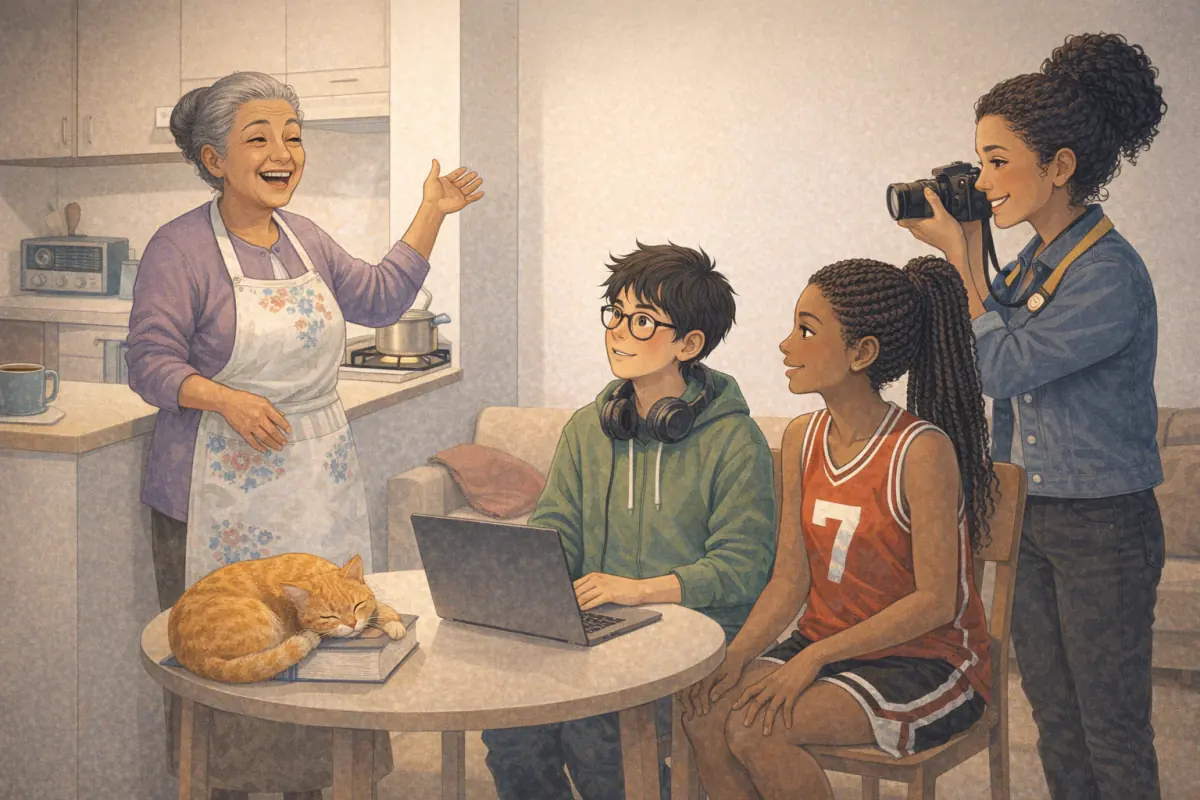
A grandmother tells her story in her small kitchen corner while three friends listen and film; an orange cat sleeps on a dictionary.

How teens preparing for B1 Preliminary (B1) use used to, didn’t use to and Did you use to …?, combine them with the past simple and past continuous, and write a 40–50-word then-and-now paragraph.

Use used to + verb for a past habit or state that is no longer true: “I used to learn English from cartoons.” After did and didn’t, write use to: “I didn’t use to speak much.”, “Did you use to sing?” The past simple describes one finished action, and the past continuous an action in progress. Together they give you longer answers about your past in B1 Preliminary Speaking. This guide is for intermediate (B1) learners aged about 12–16.

Who this is for

  • Students preparing for B1 Preliminary or B1 Preliminary for Schools, about 12–16 years old.
  • You can say what you did last weekend, but your answers about when you were younger stop after one sentence, or you write “didn’t used to”.
  • Parents: ask your teen how they learned English when they were little and what they do now. An answer with a then, a change and a now is already the plan for the paragraph.
  • Too early: if “How often do you …?” and everyday habits in the present still feel hard, start with the A2 Key article on frequency (link below).
  • Too easy: if you already write then-and-now paragraphs without mistakes, move on to the 100-word email in Writing Part 1 and the host profile (links below).

Open the sample pages

Open the sample pages

Word cards

vocabulary

all the words you know in a language

The Language Swap is helping everyone's vocabulary grow.

translate

to say or write something in another language

Can you translate 'window' into Turkish? It's 'pencere'.

repeat

to say or do something again

Deniz repeated the word slowly three times.

revise

to study something again before a test

Kai revises his Turkish words on the bus.

Conversation

Kai Abuela, tell everyone how you learned English.

Abuela Rosa I grew up in Mexico City, and I didn't speak much English then. When I first moved to Kingsbay, I used to learn English from song lyrics.

Abuela Rosa Every evening, while the radio was playing, I wrote the words in a little notebook.

Abuela Rosa One evening I was singing in my kitchen when my neighbour knocked on the door.

Abuela Rosa I thought she was angry, but she asked me to join her choir! That's how I made my first English friend.

Kai Did you use to sing in Mexico too?

Abuela Rosa No, I didn't use to sing in front of people at all. Now I sing with her choir every week!

Amara That's like me. When I was little, I used to switch between English and Twi at home, sometimes in the same sentence!

Language pattern

Hana's paragraph: How I used to learn English

When I was eight, I used to learn English from cartoons. I didn't use to understand much, but I loved the songs. Later I started drawing comics with English words. Now I read English websites every day, and I'm not afraid of mistakes.

Hana's paragraph has 43 words: then (used to), a change (later), and now.

  • When I was …, I used to …
  • I didn't use to …
  • Later I …
  • Now I …

More practice

Abuela Rosa's story

Abuela Rosa tells her story in her small kitchen corner while Kai, Amara and Zara listen and film; an orange cat sleeps on a dictionary.
lyrics

the words of a song

Rosa wrote the lyrics in a little notebook.

choir

a group of people who sing together

Rosa sings with her neighbour's choir every week.

Kai Abuela, tell everyone how you learned English.

Abuela Rosa I grew up in Mexico City, and I didn't speak much English then. When I first moved to Kingsbay, I used to learn English from song lyrics.

Abuela Rosa Every evening, while the radio was playing, I wrote the words in a little notebook.

Abuela Rosa One evening I was singing in my kitchen when my neighbour knocked on the door.

Abuela Rosa I thought she was angry, but she asked me to join her choir! That's how I made my first English friend.

Kai Did you use to sing in Mexico too?

Abuela Rosa No, I didn't use to sing in front of people at all. Now I sing with her choir every week!

Amara That's like me. When I was little, I used to switch between English and Twi at home, sometimes in the same sentence!

used to + verb: a past habit or state that is not true now

  • I used to learn English from song lyrics.
  • I didn't use to sing in front of people.
  • Did you use to sing?

was / were + -ing: an action in progress

  • while the radio was playing
  • I was singing in my kitchen

Past simple: a finished action; it can stop an action in progress

  • … when my neighbour knocked on the door.
  • She asked me to join her choir.

Speaking Part 1: when you were younger

Examiner Kai, what did you use to do in your free time when you were younger?

Kai I used to build games on my grandmother's old computer. It was really slow, but I loved it.

Examiner Do you still do that?

Kai Yes, but now I use the club laptop. At the moment I'm making a quiz game for the Language Swap.

Examiner How did you use to learn new words?

Kai I used to write them on sticky notes and put them on the fridge. My grandmother still finds some!

What did you use to do in your free time when you were younger?

I used to build games on my grandmother's old computer. It was really slow, but I loved it.

Compare then and now. Add a reason or an example to make your answer longer.

  • When I was younger, I used to …
  • I didn't use to …, but now I …
  • At that time I was living in …
  • These days I …
Learn this unit
How would you like to learn?

Used to: a past habit that has changed

Used to + verb describes something that happened again and again, or was true for a long time, but is not true now. It has no present form: for habits now, use the present simple.

The forms (the verb after used to stays in its base form):

  • Positive: “I used to watch cartoons in English.”
  • Negative: “I didn’t use to understand much.”
  • Question: “Did you use to read comics?” “Yes, I did.” / “No, I didn’t.”
  • States too: “I used to be shy.”
  • Pronunciation: say used to as one quick word, /ˈjuːstə/, with an s sound, not a z.

Habit, action in progress, finished action

A story about your past often needs three tenses: used to for the habit, the past continuous (was / were + -ing) for an action in progress, and the past simple for a finished action, which can interrupt it after when.

Listen to a grandmother telling her grandson how she learned English. Notice used to learn (habit), was singing (in progress) and knocked (interruption), then a did question and a didn’t negative:

Grandmother I grew up in Mexico City, and I didn't speak much English then. When I first moved to Kingsbay, I used to learn English from song lyrics.

Grandmother One evening I was singing in my kitchen when my neighbour knocked on the door.

Grandson Did you use to sing in Mexico too?

Grandmother No, I didn't use to sing in front of people at all. Now I sing with her choir every week!

Write a 40–50-word then-and-now paragraph

It isn’t an exam task, but it trains what a Writing Part 2 story or article needs: a clear beginning, change and end. Plan four parts: When I was …, I used to …; I didn’t use to …; Later I … (past simple); Now I … (present simple).

Our model has 43 words. Write about your own past.

  • “When I was nine, I used to learn English from video games.” → then: a habit with used to
  • “I didn’t use to speak much because I was shy.” → a negative with a reason
  • “Later my cousin in Canada started sending me funny voice messages.” → the change, in the past simple
  • “Now I reply in English, and we chat every weekend.” → now, in the present simple

Words for talking about learning

Notice the small word after each feeling adjective:

  • revise, repeat, translate: “I used to revise new words on the bus.”
  • afraid of, good at: “I used to be afraid of speaking. Now I’m good at it.”
  • interested in, proud of: “Now I’m proud of my accent.”
Learn this unit your way

Speaking Part 1: answers about when you were younger

In B1 Preliminary Speaking Part 1, the examiner asks about you, and some questions can be about your past. Say then, now, and a reason or an example. The first question has a model answer:

  • “What did you use to do after school when you were younger?” → “I used to play football in the park every day. Now I have more homework, so I only play on Saturdays.”
  • “How did you use to learn English at first?”
  • “How is your life different now from when you were eight?”

Typical mistakes and how to fix them

Check your work for these (mistake on the left, fix on the right):

  • “I didn’t used to like reading.” → “I didn’t use to like reading.”
  • “I use to play football on Saturdays.” → “I usually play football on Saturdays.”
  • “I used to visit London twice.” → “I visited London twice.” Used to doesn’t count times.
  • “I’m used to watch cartoons.” → “I used to watch cartoons.” “I’m used to + -ing” means something feels normal now.
  • “I was singing when she was knocking.” → “I was singing when she knocked.”

A 15-minute practice routine

Three times a week is enough. One round:

  • 3 minutes: note two past habits, a change and something you do now.
  • 5 minutes: write the paragraph in 40–50 words.
  • 3 minutes: check use (not used) after did, and the present simple after Now.
  • 4 minutes: answer one speaking question aloud and record it.

Your next step

When this feels easy, move on to the 100-word email in Writing Part 1 and a host profile for a visiting student (links below).

Frequently asked questions

Is it “didn’t use to” or “didn’t used to”?

Write “didn’t use to” and “Did you use to …?”: did already shows the past. Both sound the same, so the difference matters in writing.

What is the difference between used to and be used to?

“I used to get up early” means I did it in the past, not now. “I’m used to getting up early” means it feels normal now; be used to takes a noun or an -ing form.

Can I use the past simple instead of used to?

For past habits, often yes: “I watched cartoons every day” is correct. Used to makes it clear that the habit has stopped. For one finished action, only the past simple works.

Flalingo is not affiliated with or endorsed by Cambridge English, the provider of A2 Key and B1 Preliminary.

Learn this unit
How would you like to learn?

What comes next?

One-to-one lessons with a live teacher

Teens at Flalingo work through units like this one-to-one with a live teacher, at their own pace.

Book a free trial lesson