
Skip to content
Flalingo

English practice

The present passive for B1 Preliminary: explain how a dish is made and write a recipe card

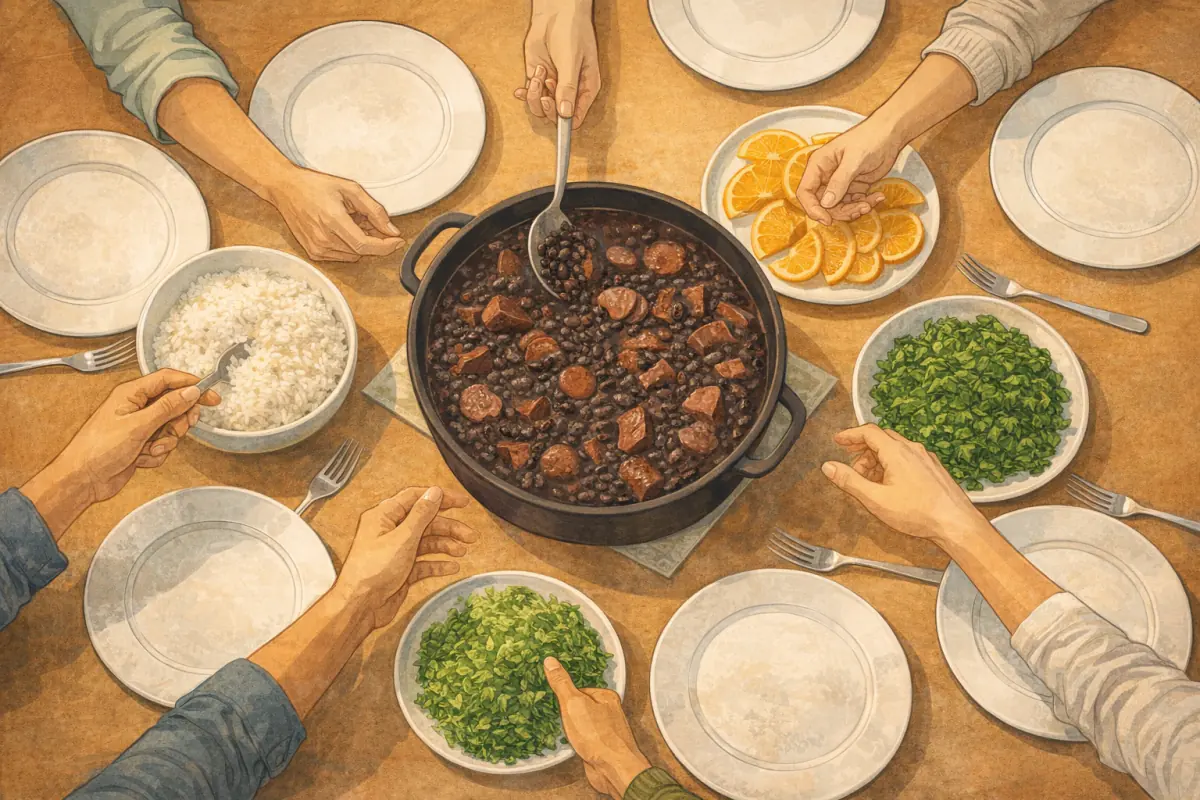
A Sunday lunch table seen from above: a pot of feijoada in the middle, with rice, orange slices, green vegetables and hands reaching for the food.

How teens preparing for B1 Preliminary (B1) use the present passive, a few, a little and plenty of, cooking verbs and order words to explain how food is made and write an 80-word recipe card.

To explain how a dish is made, use the present simple passive: is or are + past participle, as in “The rice is boiled.” The food comes first, because what happens to it matters more than who does it. Give amounts with a few, a little and plenty of, and order the steps with First, Then, After that and Finally. The same small words fill many gaps in B1 Preliminary Reading Part 6. This guide is for intermediate (B1) learners aged about 12–16.

Who this is for

  • Students preparing for B1 Preliminary or B1 Preliminary for Schools, about 12–16 years old.
  • You can say what your family cooks, but when you explain how a dish is made, every sentence starts with “you” or “my mum”, or you mix up a few and a little.
  • Parents: next time you cook together, ask your teen to explain the steps in English: “The onions are cut, then …”. Four steps with First, Then and Finally are already half a recipe card.
  • Too early: if a short A2 Key email still feels hard, start with the A2 article on an email to a friend who is coming to stay (link below).
  • Too easy: if you already explain a process with the passive and no mistakes, move on to the B1 Preliminary Reading matching task and the Writing Part 2 article on screen use (links below).

Open the sample pages

Open the sample pages

Word cards

mix

to put different foods together and move them round

The cabbage is mixed with a spicy sauce.

add

to put one more thing in with the others

Salt is added to the cabbage first.

serve

to give food to people at a meal

Feijoada is served with rice.

taste

to put a little food in your mouth to see if it is good

Hana's grandfather always tastes the sauce first.

Conversation

Kai So, Hana, how is kimchi made?

Hana First, the cabbage is cut into big pieces and salt is added.

Kai And then?

Hana Then it is left overnight. In the morning, the salt is washed off.

Kai What about the red sauce?

Hana The sauce is made with garlic, hot pepper and a little sugar. Then the cabbage is mixed with the sauce by my grandfather. He always does that part.

Hana Finally, the kimchi is put in big jars and kept somewhere cold.

Language pattern

Write a recipe card for a family dish (about 80 words).

Lemon chicken with rice (for four people) Ingredients: four pieces of chicken, two lemons, a little oil, plenty of garlic, a few fresh herbs, rice, salt. Method: First, a little salt is added to the chicken. Then the garlic and lemon juice are mixed and poured over the chicken. After that, it is roasted in the oven for an hour. Meanwhile, the rice is boiled. Finally, everything is served with the fresh herbs on top. It's my favourite Sunday dish!

The model has 80 words. It has a name, ingredients with amounts (a little, plenty of, a few) and a method with passive verbs (is added, are mixed, is roasted, is boiled, is served) and order words (First, Then, After that, Finally).

  • Name: … (for … people)
  • Ingredients: a few …, a little …, plenty of …
  • First, … is / are …
  • Then …
  • After that, …
  • Finally, … is served with …

More practice

How is kimchi made?

Kai So, Hana, how is kimchi made?

Hana First, the cabbage is cut into big pieces and salt is added.

Kai And then?

Hana Then it is left overnight. In the morning, the salt is washed off.

Kai What about the red sauce?

Hana The sauce is made with garlic, hot pepper and a little sugar. Then the cabbage is mixed with the sauce by my grandfather. He always does that part.

Hana Finally, the kimchi is put in big jars and kept somewhere cold.

How is kimchi made?

The cabbage is cut and salt is added. Then everything is mixed with a spicy sauce.

Present simple passive: am / is / are + past participle (cut, added, made, mixed, kept). Use it when the food and the action are more important than the person. Add by + person only when it matters: The kimchi is mixed by my grandfather.

  • is cut
  • is added
  • is made
  • are mixed
  • are kept
  • is mixed by …

Lucas's recipe post

A Sunday lunch table seen from above: a pot of feijoada in the middle, with rice, orange slices, green vegetables and hands reaching for the food.

Our Sunday feijoada, by Lucas

Every Sunday, my family gets together for a big lunch, and the star of the table is always feijoada. It's a traditional Brazilian dish of black beans and meat. People say that every family in Brazil has its own recipe, and this is ours.

Our feijoada starts the night before: the black beans are washed and left in cold water. On Sunday morning, they are boiled slowly with the meat for about three hours. A few onions and plenty of garlic are fried in a little oil and then added to the pot. We don't add many herbs, because we want the beans to have the strongest flavour.

Feijoada is served with white rice, green vegetables and slices of orange. The orange isn't just there for its colour: its fresh, sour taste is perfect with the heavy beans.

My favourite part isn't the eating, though. It's the three hours in the kitchen, when everyone talks and laughs while the pot cooks. And every five minutes, someone asks when lunch is ready!

Want to try it? You'll need a big pot, a lot of time and some hungry friends.

On camera

What dish are you showing us today?

Hi, everyone! Today I'm showing you my family's lemon chicken. It's made every Sunday in our house. First, the chicken is covered in garlic and lemon, and then it's roasted. It smells delicious, and it tastes like home!

  • Hi, everyone! Today I'm showing you …
  • It's made …
  • First, … Then, …
  • It smells / tastes …
Learn this unit
How would you like to learn?

The present passive: is / are + past participle

Use the passive when what happens to a thing matters more than who does it: the reader wants to know what happens to the rice, not who stirs it. Use is with one thing or an uncountable noun, are with plurals. Recipes can also give orders (“Cut the cabbage.”), but to explain how a dish is made, the passive sounds natural.

  • Positive: “The peppers are filled with rice.”
  • Negative: “The fish isn’t fried. It’s grilled.”
  • Question: “How is kimchi made?”
  • Irregular participles: cut → cut, put → put, make → made, keep → kept, leave → left

Hear it: how a family dish is made

Two students talk about kimchi, a spicy Korean cabbage dish. Find the seven passive verbs. “By my grandfather” is there because the person matters; in the last line, two verbs share one is.

Student 1 So, Hana, how is kimchi made?

Student 2 First, the cabbage is cut into big pieces and salt is added.

Student 2 The sauce is made with garlic, hot pepper and a little sugar. Then the cabbage is mixed with the sauce by my grandfather. He always does that part.

Student 2 Finally, the kimchi is put in big jars and kept somewhere cold.

Amounts: a few, a little, plenty of, none

The amount word must match the noun: English separates things you can count (eggs, onions) from things you can’t (salt, oil, milk).

  • “a few” + plural noun: “a few onions”, “a few spoonfuls of sugar”
  • “a little” + uncountable noun: “a little salt”
  • “plenty of” (more than enough) + either: “plenty of garlic”, “plenty of eggs”
  • “none” stands alone, “no” goes before a noun: “How much sugar is left?” “None.”
  • Articles: “a bowl” first, then “the bowl”; no article for things in general: “Kimchi is made from cabbage.”

Cooking verbs and the three -ed sounds

Useful verbs: boil (in water), fry (in oil), roast and bake (in the oven), grill, stir, slice, mash (press until soft) and pour. The -ed ending has three sounds:

  • /t/ after sounds like k, s, p, sh, ch and f: mixed, sliced, baked
  • /d/ after most other sounds: served, poured, boiled
  • /ɪd/, an extra syllable, after t or d: added, roasted

Write an 80-word recipe card

A recipe card isn’t a B1 Preliminary task, but it trains accurate grammar and clear order. Give the name, the ingredients with amounts and the method, with four passive verbs, three amount words and four order words. Our model has about 80 words; write about your own family’s dish.

  • “Banana pancakes (for two people)” → name
  • “Ingredients: two ripe bananas, two eggs, a few spoonfuls of flour, a little milk, a little butter, plenty of honey.” → ingredients with amounts
  • “Method: First, the bananas are mashed with a fork. Then the eggs, flour and milk are added, and everything is mixed well.” → order words, three passives
  • “After that, a little butter is heated in a pan, and small spoonfuls of the mixture are cooked for two minutes on each side.” → two more passives
  • “Finally, the pancakes are served with plenty of honey on top.” → last step
Learn this unit your way

Where this helps in B1 Preliminary

Food words like fresh, spicy and herbs also help in Speaking Part 2, when you describe a photo for about a minute.

Reading Part 6 is an open cloze: a short text with six gaps, one word in each. Many gaps need exactly these small words. Try these:

  • “The peppers ___ filled with rice and lamb.” → are
  • “You only need a ___ salt.” → little
  • “Use plenty ___ fresh herbs.” → of

Typical mistakes and how to fix them

Check your card for these:

  • “The cabbage cut into pieces.” → “The cabbage is cut into pieces.”
  • “Salt is add first.” → “Salt is added first.”
  • “The onions is fried.” → “The onions are fried.”
  • “The cabbage is cutted.” → “The cabbage is cut.”
  • “Add a few salt.” → “Add a little salt.”

A 15-minute practice routine

Three times a week is enough:

  • 3 minutes: pick a family dish and list the ingredients with amounts.
  • 6 minutes: write four or five passive steps with order words.
  • 3 minutes: check is / are, the participles and a few / a little.
  • 3 minutes: explain the dish aloud in 30 seconds and record it.

Your next step

Next, try Reading matching and a Writing Part 2 article (links below), and the past passive: “This cake was first made by my grandmother.”

Frequently asked questions

How do you make the present passive in English?

Is or are + past participle: “Salt is added.” In questions, is or are goes before the subject: “How is it made?”

What is the difference between a few and a little?

A few goes with plural nouns (a few eggs), a little with uncountable nouns (a little milk). Without a, few and little mean not many and not much.

When do I need by in a passive sentence?

Only when the person matters: “The sauce is mixed by my grandfather.” Usually you leave it out: “The bread is baked daily.”

Flalingo is not affiliated with or endorsed by Cambridge English, the provider of A2 Key and B1 Preliminary.

Learn this unit
How would you like to learn?

What comes next?

One-to-one lessons with a live teacher

Teens at Flalingo work through units like this one-to-one with a live teacher, at their own pace.

Book a free trial lesson