
Skip to content
Flalingo

English practice

How to describe your home in an email to a friend who is coming to stay (A2 Key Part 6)

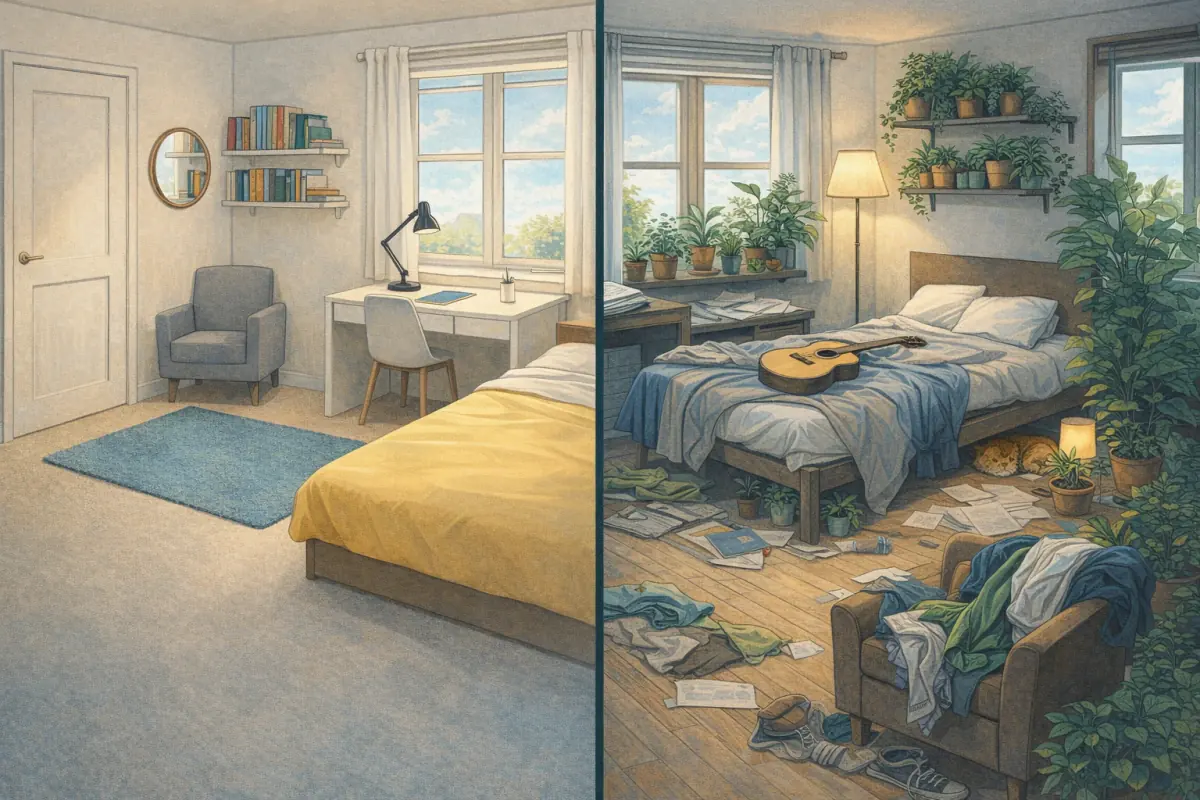
A tidy bedroom and an untidy bedroom side by side.

The A2 Key and A2 Key for Schools Part 6 email to a guest: there is and there are, place words like opposite and next to, where your friend will sleep, a model email and typical mistakes. A2 level, ages 11–15.

An email to a friend who is coming to stay needs three things: a short description of your home (“Our flat is small but comfortable.”), where your friend will sleep (“You can sleep in my room.”) and something to do together (“We can go swimming.”). This is the kind of task you get in A2 Key and A2 Key for Schools Reading and Writing Part 6: 25 words or more, and 30–50 words is plenty. This guide is for A2 (elementary) students aged about 11–15.

Who this is for

  • Students aged about 11–15 preparing for A2 Key or A2 Key for Schools.
  • Students who know words like bedroom and kitchen but mix up “there is” and “there are”, or forget a point in the email.
  • For parents: you can help without strong English; ask your child to describe one room at home in five sentences and check the place words together.
  • Too early: if a short email is still new to you, start with the guide to writing an email to join a club (greetings, endings and three points).
  • Too easy: if you can write a 100-word email about your home, move on to B1 Preliminary writing tasks.

Open the sample pages

Open the sample pages

Word cards

next to

very close, at the side of something

Zara's mirror is next to the door.

opposite

on the other side, looking at something

There's a park opposite Amara's flat.

between

in the middle of two things

Zara's carpet is between the bed and the desk.

behind

at the back of something

Theo's desk is behind the plants.

in front of

the other side from behind

Zara's desk is in front of the window.

Conversation

Theo Is that your room, Zara? There aren't any clothes on the floor!

Zara Of course not. Look, these are my books, and that's my mirror, next to the door.

Zara Where's your desk, Theo? I can't see it.

Theo It's there, behind those plants. There are some papers on it.

Zara And is there a lamp?

Theo Yes, there is. It's on the floor, next to the bed.

Zara Theo! You have to tidy up!

Theo Why? It's comfortable.

Language pattern

Your English friend is coming to stay with you. Write an email to your friend. In your email: describe your house or flat; say where your friend will sleep; say what you can do there. Write 25 words or more.

Hi Sam, I can't wait to see you! Our flat is small but comfortable. There are two bedrooms and a big kitchen. You can sleep on the sofa in the living room. We can play basketball in the park opposite. See you soon! Alex

This model has 44 words and answers all three points.

  • 1 your home: There are ... / Our flat is ...
  • 2 where your friend will sleep: You can sleep ...
  • 3 what you can do: We can ...
  • 25 words or more

More practice

Amara's email

EFUA'S MESSAGE: Hi Amara! Tell me about your new flat. What's your room like? What can you do near your home?

AMARA'S EMAIL: Hi Efua, thanks for your message! Here's my room tour in words. Our flat is on the third floor of a tall building. It isn't very big, but it's comfortable. My brothers Kofi and Yaw share a bedroom, and I've got a small room next to the kitchen.

In my room, there's a bed under the window, a desk and some shelves for my books. There aren't any photos on my walls yet. Can you send me a photo of you?

There's a park opposite our flat. There's a basketball court there, and I play with my new friends every Saturday. Love, Amara

There is, there are

There's a ... / There is a ...

for one thing

There's a guitar on the bed.

There are some ...

for more than one thing

There are some books on the shelf.

There isn't a ... / There aren't any ...

for things that are not there

There aren't any plants in Zara's room.

Is there a ...? / Are there any ...?

for questions

Is there a mirror in your room? Yes, there is.

a / an

an before a, e, i, o, u sounds

a lamp, a desk, an armchair

this / these

for things near you

This is my desk. These are my books.

that / those

for things not near you

Those photos over there are from Mexico City.

Are there any plants in your room?

Yes, there are some plants on the shelf. / No, there aren't any plants.

Use some in positive sentences and any in negatives and questions.

  • There's a lamp.
  • There are some books.
  • There aren't any plants.
  • Is there a mirror?
  • Are there any photos?

Write your email

Your English friend is coming to stay with you. Write an email to your friend. In your email: describe your house or flat; say where your friend will sleep; say what you can do there. Write 25 words or more.

Hi Sam, I can't wait to see you! Our flat is small but comfortable. There are two bedrooms and a big kitchen. You can sleep on the sofa in the living room. We can play basketball in the park opposite. See you soon! Alex

This model has 44 words.

  • There are ...
  • You can sleep ...
  • We can ...
  • next to / opposite

Check your email

Point 1: my home

Did you describe your house or flat?

Our flat is small but comfortable.

Point 2: where you will sleep

Did you say where your friend will sleep?

You can sleep on the sofa.

Point 3: what we can do

Did you say what you can do there?

We can play basketball in the park.

Place words

Did you use a place word (next to, opposite, under, on)?

We can play basketball in the park opposite.

25 words or more

Count your words.

The model has 44 words.

Learn this unit
How would you like to learn?

What the exam task looks like

In A2 Key and A2 Key for Schools Reading and Writing Part 6, you read a situation with three points and write 25 words or more. A task in the same style, written for this guide:

  • “Your English friend Sam is coming to stay for the weekend. Write an email to Sam.”
  • “Describe your home.”
  • “Say where Sam will sleep.”
  • “Say what you can do together.”
  • “Write 25 words or more.”

Point 1: describe your home with there is and there are

Start with one general sentence, then add a detail that matters to a guest. Use “There’s” for one thing and “There are” for more than one; use “some” in positive sentences and “any” in most negatives and questions.

  • General: “We live in a flat on the third floor.”
  • One thing: “There’s a big kitchen.”
  • More than one: “There are some shops near our building.”
  • Not there: “There isn’t a lift.” / “There aren’t any shops in our street.”

Place words that make the picture clear

Learn these five, plus in, on and under:

  • “next to”: “The bathroom is next to your room.”
  • “opposite” (facing it, often across a road): “There’s a park opposite our flat.”
  • “between”: “The sofa is between the window and the door.”
  • “behind”: “There’s a garden behind the house.”
  • “in front of” (close to the front of it): “There’s a bus stop in front of our building.”

Points 2 and 3: where your friend sleeps and what you can do

The sleeping point is easy to forget: it is a plan, not a description. You sleep “in” a bed or a room, but “on” a sofa or the floor.

For the activity, use “can” + verb, without “to”. Many activities use “go” + -ing: go swimming, go shopping.

  • “You can sleep in my room. I can sleep on the sofa.”
  • “We can play basketball in the park opposite.”
  • “We can go swimming. There’s a pool next to my school.”

A model email, line by line

Each line is shown with its job. The whole email is about 50 words.

  • “Hi Sam, I’m so happy you’re coming!” → greeting and a friendly start.
  • “We live in a small flat with two bedrooms and a balcony.” → point 1: your home.
  • “You can sleep in my room, and I can sleep on the sofa.” → point 2: where Sam will sleep.
  • “There’s a pool opposite our building, so we can go swimming.” → point 3: what you can do.
  • “See you on Saturday! Deniz” → ending and your name.
Learn this unit your way

Describing a room out loud

You need the same language when you speak. Here two friends, Zara and Theo, compare their bedrooms. Listen for “There are some”, “Is there a …? Yes, there is.”, “behind” and “next to”.

Zara Where's your desk, Theo? I can't see it.

Theo It's there, behind those plants. There are some papers on it.

Zara And is there a lamp?

Theo Yes, there is. It's on the floor, next to the bed.

Typical mistakes and how to fix them

Look for these when you check (mistake, then fix). Also make sure you said where your friend will sleep.

  • “There is two bedrooms.” → “There are two bedrooms.”
  • “In my room is a desk.” → “There’s a desk in my room.”
  • “There aren’t some shops.” → “There aren’t any shops.”
  • “We have a lot of furnitures.” → “We have a lot of furniture.”
  • “You can sleep in the sofa.” → “You can sleep on the sofa.”

Your 10-minute exam routine

Plan for one minute (home, bed, activity), write for six and check for three. For speaking, describe a room at home in five sentences while someone draws it.

  • “Your English cousin is coming to stay for a week. Write an email. Say what your bedroom is like, where your cousin can put their clothes and what you can do in your town. Write 25 words or more.”
  • Check: a sentence for each point, and a place word?
  • Check: “There’s” for one, “There are” for more? 25 words or more, and your name?

What comes next

Next, practise short messages that make a suggestion and give a reason with “because”. At B1 Preliminary, the email grows to about 100 words and answers four notes.

Frequently asked questions

How many words should the A2 Key Part 6 email be?

25 words or more; there is no upper limit. About 30–50 words is enough, and a longer email does not earn marks on its own.

When do you use “there is” and when “there are”?

“There is” goes before one thing or an uncountable noun (“There isn’t much furniture.”); “there are” goes before more than one (“There are two bedrooms.”).

What is the difference between “opposite” and “in front of”?

“Opposite” means facing it on the other side, often across a road; “in front of” means close to the front of it. Say “opposite our flat”, not “opposite of our flat”.

Flalingo is not affiliated with or endorsed by Cambridge English, the provider of A2 Key and B1 Preliminary.

Learn this unit
How would you like to learn?

What comes next?

One-to-one lessons with a live teacher

Teens at Flalingo work through units like this one-to-one with a live teacher, at their own pace.

Book a free trial lesson