



Skip to content
Flalingo

English practice

How to write a short match report in English like a commentator: present simple and present continuous (A2 Key level)

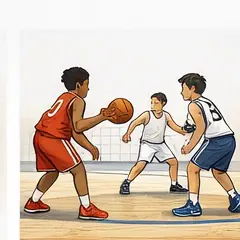
After the match: the team sit together and Coach Bell claps for them.

A five-sentence match report in English: am/is/are + -ing for what is happening, the present simple for quick events and habits, sports words, a model report and typical mistakes. A2 Key level, ages 11–15.

A short match report works well in five sentences: when and where, the first event, the big moment, the score, and how it ends. Write it in the present, like a commentator: am/is/are + -ing for what is going on (“The fans are singing.”), and the present simple for quick events (“She throws the ball, and it goes in.”) and habits (“We usually lose to them.”). Add the score and at least three sports words. This guide is for A2 (elementary) students aged about 11–15, and their parents.

Who this is for

  • Students aged about 11–15 preparing for A2 Key or A2 Key for Schools, especially if sport is the easiest topic for you to write about.
  • Students who know “I play” and “I’m playing” but mix them up when they write fast.
  • For parents: you can check the report without strong English: count five sentences, find the score and underline each is/are + -ing.
  • Too early: if the -s in “she plays” and “he watches” is still new, practise the present simple with daily routines first.
  • Too easy: if you already write longer reports with ease, move on to B1 tasks such as discussing ideas with a partner and agreeing on one.

Open the sample pages

Open the sample pages

Word cards

commentator

a person who talks about a match while it is happening, for people who can't see it

Kai is the commentator for the live stream.

matchmatch

a game between two teams or two players

Today is Amara's first big match.

fan

a person who loves a team, a sport or a singer

The fans are singing the team song.

throwthrow

to send something through the air with your hand

Throw the ball to Amara!

kickkick

to hit something with your foot

In football, you kick the ball.

Conversation

Narrator After Max's video, The Loop needs a new story, with no bread in it! Today it's Amara's first big basketball match.

Zara We're live! Hi, everyone. We're in the school sports hall, and the match is starting.

Theo Look at the fans. They're singing already!

Zara Kai, you're the commentator. What's happening?

Kai Amara is running down the court with the ball. She usually scores from there!

Theo Yes! Two points! Harbour Park are winning!

Kai And Coach Bell is shouting, 'Go, go, go!'

Zara Great! Now look at the camera, Kai. Say hello to everyone at home.

Kai Me? On camera? Er…

Language pattern

What is Amara doing now?

She's running down the court. She usually scores from there!

Use am / is / are + -ing for now. Use play / plays for things you usually do.

More practice

The match report

After the match: the team sit together and Coach Bell claps for them.

Harbour Park lose by two points, but win a lot of fans

Friday is a big day in the school sports hall. It's the first home match of the year for our basketball team, and the hall is full. Northside are a strong team, and at half-time they're winning by ten points.

But Harbour Park don't stop. In the last ten minutes, Amara Mensah (number 7) scores twelve points. With one minute to go, the score is 38–38. Then a Northside player throws the ball from the middle of the court, and it goes in. The final score is 38–40.

'I'm very happy with my players,' says Coach Bell. 'They're fit, and they never stop running.'

The Loop shows the match in a live stream. For ten seconds, the commentator, Kai Morales, says nothing. Then Theo Lindqvist plays the team song on his guitar, and all the fans sing. More than 200 people watch the stream, and it gets 85 comments. That's our best number ever!

The team plays its next match in two weeks.

comment

words that people write under a video or a post on the internet

The live stream gets 85 comments.

report

a piece of writing that tells people what happens, for example in a match

Amara reads the match report in the school newspaper.

Your match report

After the match: the team sit together and Coach Bell claps for them.

Write about a match in five sentences.

Harbour Park 3, Northside 1 It's Saturday morning, and our football team is playing Northside at the sports centre. Northside score first, but our players don't stop running. In the second half, our number 9 scores two goals, and the fans are singing. The final score is Harbour Park 3, Northside 1. It's an exciting match, and the next one is in two weeks.

This report has five sentences and 64 words. It uses the present, like a commentator.

  • It's Saturday morning …
  • … score first
  • … is/are singing
  • The final score is …

Check your report

Look! The fans sing the team song.

Look! The fans are singing the team song.

Look! means now, so use are + -ing.

Check

  • now: am / is / are + -ing (The fans are singing.)
  • usually: play / plays (The team practises a lot.)
  • he / she / it: add -s (Amara scores.)
  • -ing spelling: swimming, running, riding
Learn this unit
How would you like to learn?

Now, usually or a quick event?

A report needs both present forms. Am/is/are + -ing describes something in progress at this moment; words like “Look!” and “at the moment” point to it. The present simple describes habits; words like “usually” and “every week” point to it.

Commentators also use the present simple for short actions that start and finish in a second: “She takes the ball, she runs, she scores!” So in a report, a present simple verb does not always mean “usually”. Test: quick and finished, present simple; still going on, -ing.

  • Now: “Look! The fans are singing.” “Our goalkeeper isn’t moving!”
  • Usually: “The team practises twice a week.” “She usually scores from there.”
  • Quick event: “Number 7 throws the ball, and it goes in.” “Hillview score first.”

Listen: a school match, live

Students are filming a school basketball match for a live stream; one is the commentator. Listen for the -ing forms and one habit (“usually scores”). With a team name, British English often uses “are”.

Zara We're live! Hi, everyone. We're in the school sports hall, and the match is starting.

Theo Look at the fans. They're singing already!

Zara Kai, you're the commentator. What's happening?

Kai Amara is running down the court with the ball. She usually scores from there!

Theo Yes! Two points! Harbour Park are winning!

Sports words: play, go or do, and the score

Use at least three sports words that fit your sport.

  • “play” with ball games and games: play football, play tennis, play chess
  • “go” with -ing activities: go swimming, go sailing, go skateboarding
  • “do” with exercise and sport in general: do exercise, do sport
  • Actions and people: throw, catch, kick, hit, jump; player, team, coach, fan, commentator
  • Results: win a match, beat a team, lose to a team, score a goal
  • The score: “The final score is 2–1.” (say “two–one”); 1–1 is “one all”; in British football, 0 is often “nil”.

A model report, sentence by sentence

Our own example: about 75 words under a headline with the score. Each sentence has one job.

  • “Riverside 2, Hillview 1” → headline.
  • “It’s Saturday afternoon, and our school football team, Riverside, is playing Hillview in the town park.” → 1: when, where, who.
  • “Hillview score first, but our players are running hard and the fans are singing.” → 2: first event, scene with -ing.
  • “In the second half, Mia kicks the ball from the middle of the pitch, and it’s a goal!” → 3: the big moment.
  • “Ten minutes later, our number 4 scores another goal, and the final score is 2–1.” → 4: the score.
  • “We usually lose to Hillview, so everyone is very happy today.” → 5: the ending, with a habit.
Learn this unit your way

Typical mistakes and how to fix them

Many languages use one present form for “now” and “usually”, so check every verb (mistake, then fix):

  • “Look! The fans sing.” → “Look! The fans are singing.”
  • “She running with the ball.” → “She is running with the ball.”
  • “My brother play tennis.” → “My brother plays tennis.”
  • “We play swimming on Sundays.” → “We go swimming on Sundays.”
  • “We won Hillview.” → “We beat Hillview.” (you win a match, but you beat a team)
  • “The match is very excited.” → “The match is very exciting.” (the fans are excited)
  • “runing”, “swiming” → “running”, “swimming”

Your 15-minute routine

Twice a week, write about a match you played, watched or invented.

  • Minutes 1–3: watch a minute of any match and commentate out loud: “Now number 10 is running…”
  • Minutes 4–5: note the teams, the score and three sports words.
  • Minutes 6–12: write five sentences, one job each.
  • Minutes 13–15: check the score, is/are + -ing for the scene and the -s with he, she and it.

What comes next

The A2 Key Reading and Writing paper ends with a short story about three pictures (35 words or more); describing a match in clear steps trains the same skill. In Speaking, you may talk about sports and hobbies, so use -ing after enjoy, love, hate and don’t mind: “I don’t mind playing chess, but I love swimming.”

Frequently asked questions

What is the difference between the present simple and the present continuous?

Am/is/are + -ing is for actions in progress now: “She’s running.” The present simple is for habits: “She runs every morning.” In live reports it is also used for quick events.

Is it play football or do football?

“Play football.” Use play with ball games, go with -ing activities (go swimming) and do with exercise or sport in general.

Is a match report part of the A2 Key exam?

No. A2 Key writing has a short email or note (25 words or more) and a picture story (35 words or more). A five-sentence report is good practice for the story.

Flalingo is not affiliated with or endorsed by Cambridge English, the provider of A2 Key and B1 Preliminary.

Learn this unit
How would you like to learn?

What comes next?

One-to-one lessons with a live teacher

Teens at Flalingo work through units like this one-to-one with a live teacher, at their own pace.

Book a free trial lesson