Skip to content
Flalingo

English practice

B1 Preliminary Speaking Part 3: how to discuss green ideas with a partner and decide together

Two friends take part in an online discussion with three other friends.

How to do the B1 Preliminary and B1 Preliminary for Schools pair discussion: phrases to suggest, agree, disagree politely and decide, if-sentences for reasons, environment words, typical mistakes and a practice routine.

In B1 Preliminary Speaking Part 3, the examiner describes a situation and gives you and your partner pictures of different ideas. You discuss them together and say which would be best. There’s no right answer: the examiners listen to how you talk together and to your English. So discuss several ideas, give a reason for each, ask your partner what they think, and decide clearly at the end. The task is the same in B1 Preliminary for Schools; this guide is for intermediate (B1) learners aged about 12–16.

Who this is for

  • Students preparing for B1 Preliminary or B1 Preliminary for Schools, about 12–16 years old.
  • You can give your own opinion, but in a pair task you either talk alone for too long or just say “Yes, I agree.” and stop.
  • Parents: you can be the partner at home. Pick two plans for the weekend and ask your teen to suggest one in English, give a reason and ask what you think. Your English doesn’t need to be perfect.
  • Too early: if keeping a short conversation going with a partner and some pictures still feels hard, start with the A2 Key pair task (link below).
  • Too easy: if you already discuss several ideas and decide together without long pauses, practise defending an opinion in a Writing Part 2 article, or move on to exam-week rules (links below).

Open the sample pages

Open the sample pages

Word cards

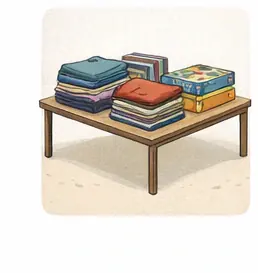
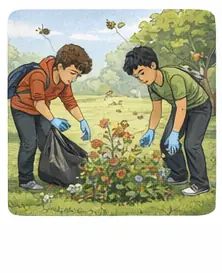
litter-picking daylitter-picking day

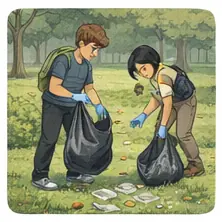
everyone picks up litter in the park for one afternoon

A litter-picking day is easy to organise.

recycling competitionrecycling competition

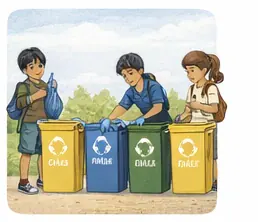
classes compete to recycle the most bottles and paper

The class that recycles the most wins a prize.

second-hand salesecond-hand sale

people sell old clothes and games instead of throwing them away

At the second-hand sale, Amara bought a jacket for two pounds.

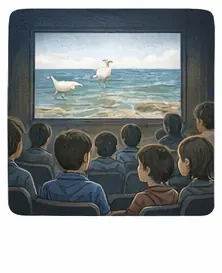
nature film nightnature film night

the school shows a film about animals and the natural world

At the nature film night, we learned about sea birds.

flowers for beesflowers for bees

students plant flowers that bees like around the school

If we plant flowers for bees, more bees will come to the school garden.

Conversation

Hana So, we need one idea for the school green week. Why don't we have a bike-to-school day?

Theo That's a great idea. I cycle every day anyway! But what about students who live far away?

Hana Good point. They could come by public transport instead.

Theo How about a no-plastic lunch day, too? Everyone brings food in boxes, not plastic bags.

Hana I'm not sure about that. Some families might not have boxes.

Theo I see what you mean. What do you think about the bike day, then?

Hana I think it's the best one, because everyone can take part.

Theo OK, so we both agree. The bike-to-school day it is!

Language pattern

The Green Team wants more young people in Kingsbay to help the environment. Here are some ideas. Talk together about the different ideas and say which one would be the best.

Why don't we start with the recycling competition? If classes compete, lots of students will take part. What do you think?

Talk about each idea, give reasons, ask for your partner's opinion and decide together at the end.

  • Why don't we…?
  • What do you think?
  • I'm not sure about that.
  • If we…, more people will…
  • So, we both agree.

More practice

What will happen if…?

Theo and Amara take part in an online discussion with Hana, Deniz and Lucas.

Hana Welcome to our debate. The question is: can young people really change anything?

Deniz If we only clean beaches, the plastic will come back next week.

Lucas Maybe. But unless someone starts, nothing will change.

Amara People might listen to us if we share our videos. Climate change is a big problem, but small actions may help.

Theo I agree. If more people take public transport, there will be less pollution.

Hana So, will we save the whole planet? Probably not. But we'll definitely change our four schools.

What will happen if we don't pick up the plastic?

If we don't pick it up, it will end up in the sea.

Use the present simple after 'if' or 'unless', and will, might or may in the result.

  • if
  • unless
  • will
  • won't
  • might
  • may
  • definitely
  • probably
  • perhaps

First conditional

  • If + present simple, will / won't + verb
  • If we only clean beaches, the plastic will come back.
  • The result can come first: The plastic will come back if we only clean beaches.

unless = if … not

  • Unless someone starts, nothing will change.
  • = If someone doesn't start, nothing will change.

How sure are you?

  • will definitely / definitely won't = very sure
  • will probably / probably won't = fairly sure
  • might / may / perhaps = not sure

Useful phrases

How did it go?

Your discussion

  • Did you ask for your partner's opinion?
  • Did you give reasons?
  • Did you decide together at the end?
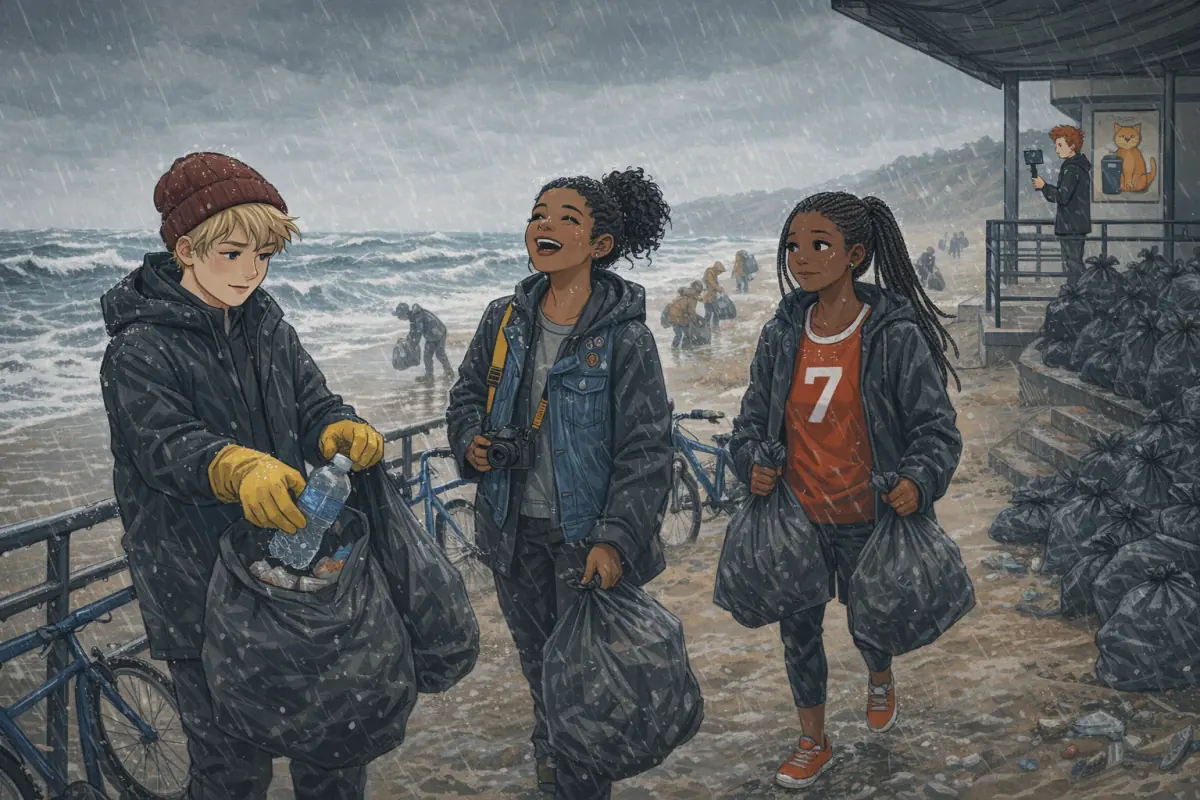
  1. The Green Team picks up litter on Kingsbay beach in heavy rain while Max Carter films them; a poster of Byline hangs by the café.

    Narrator On Saturday, the wind was freezing and the rain didn't stop. But twenty volunteers filled forty bags of rubbish on Kingsbay beach.

    Narrator In Curitiba, Lucas's team cleaned the river on the same day.

    Theo It isn't much, but small actions are a start.

    Narrator That evening, Amara checked her phone.

    Amara Look at this! Max Carter has posted a video of our clean-up, and he's put his own name on it!

Learn this unit
How would you like to learn?

What happens in Speaking Part 3

You take the Speaking test with another candidate, in front of two examiners. In Part 3 you get a sheet of pictures, talk about the ideas together and decide which is best. Part 4 continues the topic with questions for you both.

Here’s a practice task we wrote: “Your school wants more young people to help the environment. Here are some ideas. Talk together about the different ideas and say which one would be best.”

  • “a litter-picking day”: picking up litter in a park
  • “a recycling competition”: classes competing to recycle the most
  • “a second-hand sale”: selling old clothes and games, not throwing them away
  • “a nature film night”: a film about animals and nature
  • “flowers for bees”: planting flowers bees like around the school

Six moves that keep the talk going

You don’t need clever ideas; you need to share the talk. Use each move more than once:

  • Suggest: “Why don’t we have …?”, “How about a …?”
  • Give a reason: “… because everyone can take part.”
  • Agree: “That’s a great idea.”, “Good point.”
  • Disagree politely, with a reason: “I’m not sure about that.”, “I see what you mean, but …”
  • Ask: “What do you think?”, “Which one do you prefer?”
  • Decide: “So, we both agree.”, “In the end, the best idea is …”

Listen: from a suggestion to a decision

Two students choose one idea for a green week at school. Notice each move, from the first suggestion to the final decision. “The … it is!” is a friendly way to confirm a choice:

Student 1 So, we need one idea for the school green week. Why don't we have a bike-to-school day?

Student 2 That's a great idea. I cycle every day anyway! But what about students who live far away?

Student 1 Good point. They could come by public transport instead.

Student 2 How about a no-plastic lunch day, too? Everyone brings food in boxes, not plastic bags.

Student 1 I'm not sure about that. Some families might not have boxes.

Student 2 I see what you mean. What do you think about the bike day, then?

Student 1 I think it's the best one, because everyone can take part.

Student 2 OK, so we both agree. The bike-to-school day it is!

Give reasons with if, unless and might

The quickest reason is a first conditional: if + present simple, then will + verb. Will never comes straight after if. Use might or may when you’re less sure, and unless for “if … not”.

  • “If we have a recycling competition, lots of students will take part.”
  • “If we plant flowers for bees, more bees will come to the school garden.”
  • “A film night might be boring for students who don’t like films.”
  • “Unless the school says yes, we can’t have the sale.”
Learn this unit your way

Green words for stronger reasons

Learn words together with the words they go with:

  • “pick up litter”, “reduce waste”, “cause pollution”
  • “recycle bottles and paper”, “a recycling bin”
  • “protect the beach”, “Plastic damages rivers.”
  • “volunteers”, “public transport”, “second-hand clothes”

Typical mistakes and how to fix them

Listen for these when you practise:

  • “If we will plant flowers, more bees will come.” → “If we plant flowers, …”
  • “I’m agree.” → “I agree.” Agree is a verb.
  • “Let’s discuss about the ideas.” → “Let’s discuss the ideas.”
  • “How about make a film night?” → “How about a film night?” or “How about having …?”
  • Only “Yes, I agree.” → “I agree, because …”, then a new point.
  • No decision at the end → “So, our final decision is …”

A 15-minute practice routine

Twice a week with a friend or a parent; record it if you can:

  • 2 minutes: pick a situation (a class trip, a green week) and write five ideas.
  • 4 minutes: discuss them; each of you asks “What do you think?” at least twice.
  • 1 minute: decide out loud: “So, our final decision is …”
  • 5 minutes: listen back, count your reasons and questions, and fix one if-sentence.
  • 3 minutes: answer a Part 4 style question: “Do you think young people can help to protect the environment?”

Your next step

In Part 4, give an opinion, a reason and an example. When discussions feel easy, try a balanced Writing Part 2 article or rules with must and don’t have to (links below).

Frequently asked questions

Do we have to agree in B1 Preliminary Speaking Part 3?

No. You can disagree politely, but try to decide together. If you can’t, say so clearly: “We don’t agree, but we both like …”

What if my partner talks too much, or hardly at all?

Ask them a question: “What do you think about …?” You’re marked on your own English, not on your partner’s.

Is Speaking Part 3 the same in B1 Preliminary for Schools?

Yes, the format is the same; the topics suit students your age.

Flalingo is not affiliated with or endorsed by Cambridge English, the provider of A2 Key and B1 Preliminary.

Learn this unit
How would you like to learn?

What comes next?

One-to-one lessons with a live teacher

Teens at Flalingo work through units like this one-to-one with a live teacher, at their own pace.

Book a free trial lesson