
Skip to content
Flalingo

English practice

Adjective order in English: describe clothes in a short “for sale” advert (A2 Key, ages 11–15)

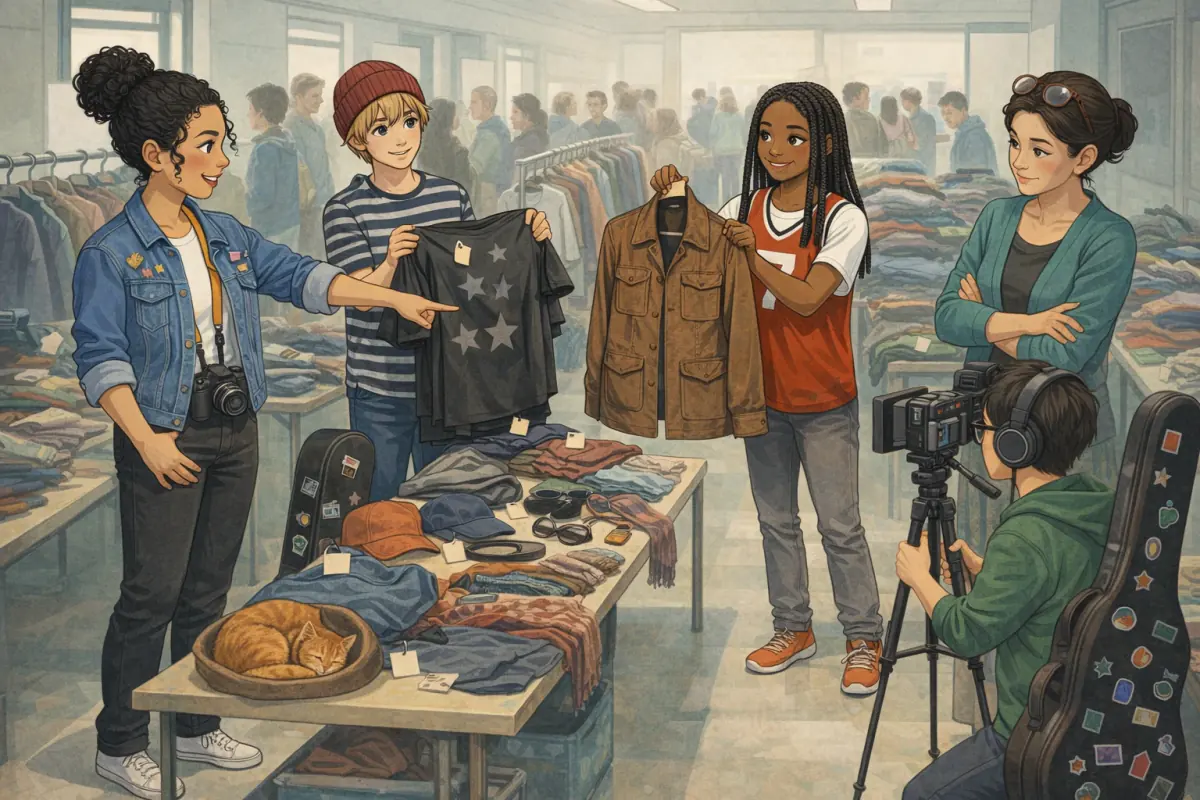
A second-hand market in the school hall: one teenager points at a price tag, another holds old T-shirts, a third holds up a vintage jacket, a fourth films from behind a camera and a teacher watches.

How to write a 30–40-word advert for something you want to sell: clothes words, adjective order (“a lovely old blue jacket”), comparatives with “than”, “too” and “enough”. For A2 Key and A2 Key for Schools, ages 11–15.

A short “for sale” advert gives the buyer five things: the item with two or three describing words, its size, its price, a reason to buy and where to come. Describing words follow a fixed order (opinion, size, age, colour, material): “a lovely old blue denim jacket”. The reason usually compares: “It’s much cheaper than a new one.” These skills also help in A2 Key and A2 Key for Schools, for example in Speaking Part 2. This guide is for A2 students aged about 11–15.

Who this is for

  • Students aged about 11–15 preparing for A2 Key or A2 Key for Schools.
  • Students who know clothes words but are not sure which describing word comes first, or when to use “-er” and when “more”.
  • For parents: you can help without strong English; pick one thing from a wardrobe and ask your child to “sell” it to you in three sentences.
  • Too early: if a short message with one reason is still new, start with the guide to a school canteen suggestion with “because” (A2).
  • Too easy: if describing and comparing things already feels easy, move on to B1, for example the guide to exam-week rules with “mustn’t” and “don’t have to”.

Open the sample pages

Open the sample pages

Word cards

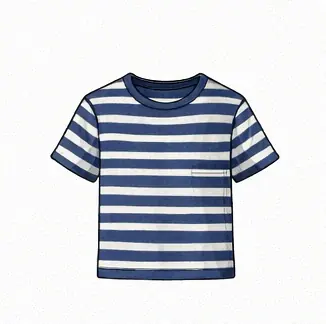
stripedstriped

with lines of different colours

Theo is wearing a dark blue and white striped T-shirt.

wear

to have clothes on your body; He's wearing a hoodie.

Kai wears the same green hoodie every day.

fashion

the kinds of clothes that are popular now

Zara says vintage jackets are in fashion again.

a nice old black T-shirt

what you think + how old + colour + thing

Theo sells a nice old black T-shirt.

a small striped wallet

how big + striped + thing

Zara buys a small striped wallet.

a lovely long red coat

what you think + how big + colour + thing

The girl's mum likes the lovely long red coat.

Conversation

Ms Rivera Excuse me, can I try on this jacket?

Amara Sure. What size are you?

Ms Rivera Small, I think. How much is it?

Amara It's eight pounds. It looks great on you!

Ms Rivera Thank you! Is it in the sale?

Amara Yes, it is. It's usually ten pounds.

Language pattern

What is for sale?

FOR SALE: a lovely old blue denim jacket with two big pockets. Size: small. Price: £8. It's warmer than a hoodie and much cheaper than new jackets in town. Come to The Loop's market in the school hall on Friday!

The model has 40 words. It says the thing, colour, size, price and a reason to buy.

  • FOR SALE:
  • Size:
  • Price: £
  • It's ...er than ...
  • a lovely old blue ...
  • Come to ...!

More practice

A nice old black T-shirt

stripedstriped

with lines of different colours

Theo is wearing a dark blue and white striped T-shirt.

wear

to have clothes on your body; He's wearing a hoodie.

Kai wears the same green hoodie every day.

fashion

the kinds of clothes that are popular now

Zara says vintage jackets are in fashion again.

a nice old black T-shirt

what you think + how old + colour + thing

Theo sells a nice old black T-shirt.

a small striped wallet

how big + striped + thing

Zara buys a small striped wallet.

a lovely long red coat

what you think + how big + colour + thing

The girl's mum likes the lovely long red coat.

The order

  1. What you think: nice, lovely, cool, great
  2. How big: big, small, long, short
  3. How old: old, new, vintage
  4. Colour or lines: black, red, striped
  5. The thing: T-shirt, jacket, scarf

The market chat

Zara Market chat! Theo, your T-shirts are cheaper than a bus ticket. Two pounds, please!

Theo OK, OK. But my old T-shirts are softer than new ones. People like soft.

Amara The vintage jacket is bigger than my other jackets, but it's better.

Kai My hoodie is older than all of you. And it's not for sale.

Ms Rivera Good news: the market is busier than I thought. But check your prices!

Short words: + er

  • cheap → cheaper
  • old → older
  • soft → softer
  • nice → nicer
  • big → bigger (double g)
  • busy → busier (y → i)

Long words: more + word

  • expensive → more expensive
  • beautiful → more beautiful

Different words

  • good → better
  • bad → worse
  • far → further

Then use than

  • My hoodie is older than all of you.
  • Two pounds is more expensive than one pound.

Check your advert

Is it "a blue lovely jacket" or "a lovely blue jacket"?

A lovely blue jacket: what you think comes first, then colour.

Check: -er or more? than? What you think, size, age, colour, thing.

  • cheaper than
  • more expensive than
  • better than
  • a nice old black ...
Learn this unit
How would you like to learn?

The five parts of a “for sale” advert

An advert for a school market or a selling app should help the buyer picture the thing and decide quickly. Our own model, about 40 words:

  • “FOR SALE: a cool old green hoodie with a big front pocket.” → the thing, three describing words, a detail.
  • “Size: medium. Price: £5.” → the facts buyers check first.
  • “It’s softer than a new hoodie and much cheaper than the ones in the shops.” → a reason to buy.
  • “Come to the school market in the hall on Saturday morning!” → where and when.

Clothes words buyers look for

Learn clothes words in groups. Jeans, shorts, trousers and sunglasses are always plural, even for one item: “These jeans are £3.” “How much are they?”

  • On your body: T-shirt, hoodie, jacket, coat, dress
  • On your legs: jeans, shorts, skirt
  • On your feet: trainers (American English: “sneakers”), boots
  • Extras: cap, scarf, belt, sunglasses, wallet
  • Details: pocket, striped, vintage (old but still cool), denim, leather

Adjective order: opinion, size, age, colour, material

Before a noun, English puts describing words in a fixed order; “a blue lovely jacket” sounds wrong to native speakers at once. Use two or three, usually without commas, with “and” between colours: “a blue and white striped T-shirt”.

  • 1 Opinion: nice, lovely, cool
  • 2 Size: big, small, long
  • 3 Age: old, new, vintage
  • 4 Colour or pattern: black, red, striped
  • 5 Material: denim, leather, wool
  • Then the thing: jacket, T-shirt, scarf
  • Examples: “a nice old black T-shirt”, “a small striped wallet”, “a lovely long red coat”

Comparatives: the reason to buy

Compare your thing with something the buyer knows: make the comparative, then add “than”. “Much” makes it stronger: “much cheaper than”. Use “-er” or “more”, never both.

  • Short words, add -er: cheap → cheaper, soft → softer
  • Ending in -e, add -r: nice → nicer
  • One vowel and one consonant at the end, double it: big → bigger
  • Ending in -y, change to -ier: busy → busier
  • Longer words, use “more”: more expensive, more comfortable
  • Irregular: good → better, bad → worse

Too and enough: when something doesn’t fit

“Too” (more than you want) goes before the describing word; “enough” (as much as you need) goes after it. For something you like, say “It’s very nice!”: “too” signals a problem.

  • “The coat is too long for her.”
  • “It’s £60 and I’ve only got £15. It’s too expensive.”
  • “These trainers aren’t big enough.”
  • “Is this jacket warm enough for winter?”
Learn this unit your way

Asking about size and price in a shop

A customer tries on a jacket at a secondhand stall. Listen for the polite question, the size and the price.

With “it”, “try on” splits: “Can I try it on?”, not “Can I try on it?”. “In the sale” means cheaper than usual for a while.

  • Prices: “£8” is “eight pounds”, “£2.50” is “two pounds fifty”.

Customer Excuse me, can I try on this jacket?

Seller Sure. What size are you?

Customer Small, I think. How much is it?

Seller It's eight pounds. It looks great on you!

Customer Thank you! Is it in the sale?

Seller Yes, it is. It's usually ten pounds.

Typical mistakes and how to fix them

Look for these when you finish (mistake, then fix). Describing words never take “-s”.

  • “a blue lovely jacket” → “a lovely blue jacket”
  • “two bigs pockets” → “two big pockets”
  • “more cheaper than” → “cheaper than”
  • “bigger then a hoodie” → “bigger than a hoodie”
  • “It isn’t enough big.” → “It isn’t big enough.”
  • “How much is these jeans?” → “How much are these jeans?”

Your 10-minute advert routine

Choose something you own and write its advert in 10 minutes: plan 2, write 6, check 2. Then read it aloud like a radio advert.

  • Plan: the thing, describing words, size, price, comparison, place.
  • Check 1: opinion, size, age, colour, material, in that order?
  • Check 2: “-er” or “more” (not both), then “than”?
  • Check 3: size, price and place all there?

What comes next

In A2 Key Reading and Writing Part 2, you match seven questions to three short texts on one topic, such as three shops. Often two texts mention the same thing, such as prices, but only one answers the question. Next: an email telling a friend where to meet and how to get there.

Frequently asked questions

What is the correct order of adjectives in English?

Opinion, size, age, shape, colour, origin, material, purpose, then the noun: “a lovely old blue denim jacket”. Two or three describing words are usually enough.

When do you use “-er” and when “more” in comparatives?

“-er” goes with one-syllable words (“cheaper”) and two-syllable words ending in -y (“busier”); “more” goes with most longer words (“more expensive”). “Good” and “bad” become “better” and “worse”.

What is the difference between “for sale”, “on sale” and “in the sale”?

“For sale” means someone is selling it. “In the sale” (British English) means cheaper than usual for a while; Americans say “on sale”. In British English, “on sale” often just means available in shops.

Flalingo is not affiliated with or endorsed by Cambridge English, the provider of A2 Key and B1 Preliminary.

Learn this unit
How would you like to learn?

What comes next?

One-to-one lessons with a live teacher

Teens at Flalingo work through units like this one-to-one with a live teacher, at their own pace.

Book a free trial lesson