
Four words for judging a text
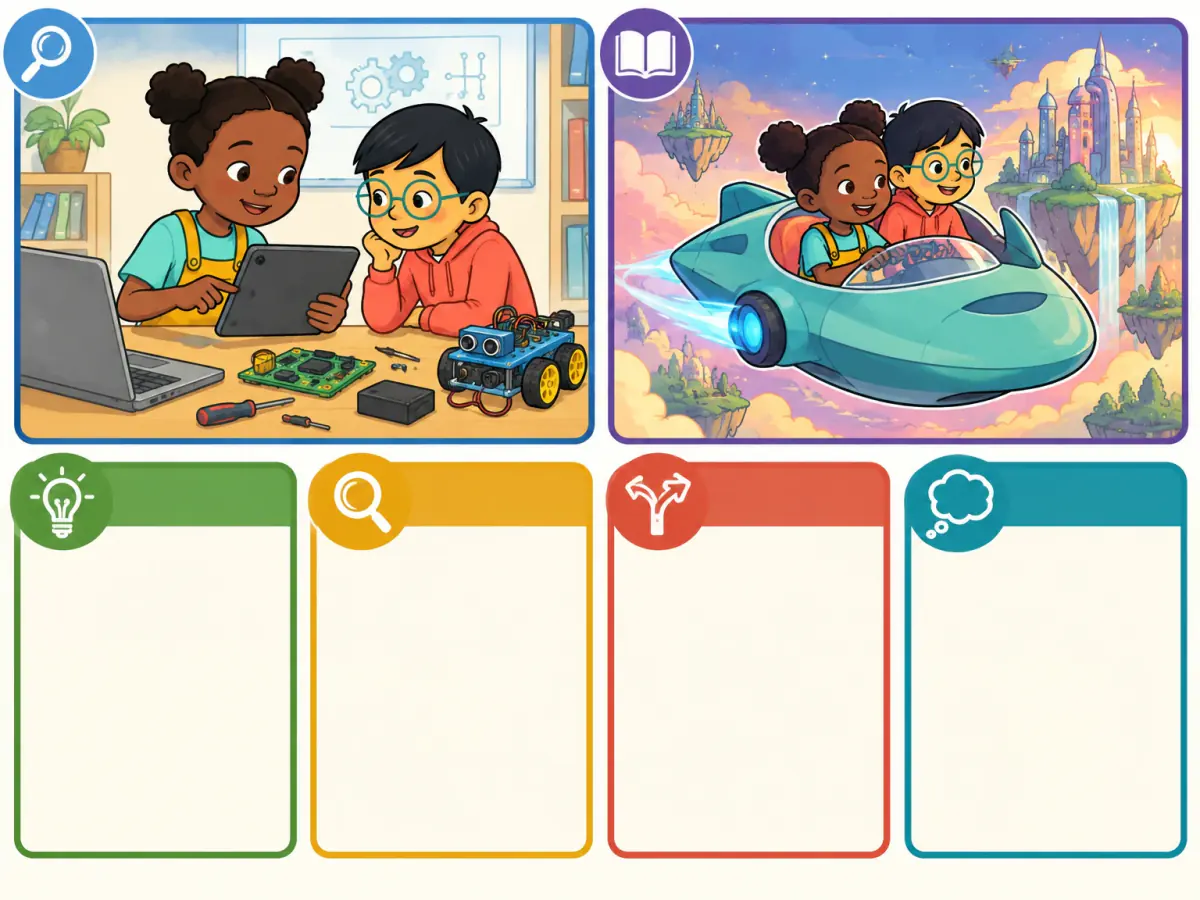
The cards below play four words for asking how a text proves something, here with examples about station screens.
- claim: “The station screens help passengers.”
- observable detail: “A delay warning reduced crowding near one platform.”
- changed assumption: “Everyone can see the screens.” becomes “One screen is too high for some people.”
- uncertainty: one week at three stations cannot prove the screens work everywhere.
How a report earns trust: the good news and the problem
In one short report, a student called Priya watches digital noticeboards at three busy stations for a week. A broken lift message helps passengers choose an accessible route, and a delay warning reduces crowding. But one board is too high for children and wheelchair users, so Priya recommends a lower second screen and staff announcements in emergencies.
A text that admits its problems is often easier to believe. A recommendation is only an idea, though: the report never says a lower screen was put in.
- “One weakness is that the board is too high.”
- “The report recommended a lower screen.”
Grammar spot: too + adjective + for
“Too” means more than is good, so it points to a problem. “The board is very high.” only describes it; “The board is too high for children.” means children have a problem. Add “to” and a verb to say what they cannot do: “The board was too high for children to read.”
- too high for children: a problem
- very high: only a description
- “The screen was too small to read.”
How a story earns trust: the turning point
In a short story, a boy called Eren builds a mechanical foal, a young horse, for a theatre parade and makes it as fast as possible. In rehearsal, it ignores a stop signal and knocks over a basket. Eren slows it down and adds three hand signals, and in the final rehearsal it follows its guide safely.
The basket is the turning point: Eren’s idea changes from “fast is best” to “listening is best”. The story earns trust through a choice, not facts. Ask your child to retell it in the past simple:
- “At first, the foal moved too fast.”
- “Then it knocked over a basket.”
- “Eren slowed it down and added signals.”
- “In the end, it followed its guide.”
Writing the comparison for a real reader
First, your child decides who the reader is, as in this exchange. For a teacher, plan three details: one from the report, one from the story and an opinion.
A strong comparison shows both sides: “The report builds trust with facts from one week, while the story builds trust through Eren’s choice to slow the foal down.” Before writing, talk about it: “Is a careful machine more useful than a fast one?”
- “Both texts show that…”
- “In the report…, but in the story…”
- “I trust … more because…”
Nia Who will read your text?
Leo My teacher will read it, and we will talk about it.
A next scene that is clearly new
To continue the story, your child starts after the ending, keeps what the story has shown (the foal now follows signals) and adds one new event in the past simple:
“On parade day, the music was too loud for anyone to hear a shout. When a dog ran in front of the foal, its guide raised one hand, and the foal stopped at once.” A foal that races again for no reason would break the trust the story built.
A home game: signal inspectors
At a bus stop or in a shop, choose one sign or screen together. Your child gives it a quick spoken report in English: one strength, one weakness and one recommendation. Five minutes is plenty.
- “One strength is that it uses big symbols.”
- “One weakness is that it’s too small for older people to read.”
- “I recommend a bigger screen near the door.”
Common mistakes and quick fixes
Repeat the sentence correctly and carry on.
- “too much high”: just “too high”.
- “He slowed down it.”: put it or them in the middle: “He slowed it down.”
- “It recommended to put a lower screen.”: use a noun: “It recommended a lower screen.”
- “Both texts builds trust.”: “Both texts build trust.”
- A next scene that retells the story: add one event after the ending.
What comes next
Next, your child can write a report of their own, with counts and reasons from a small class survey.