

Skip to content
Flalingo

English practice

OET Reading Part A: how to find and copy exact answers from four short texts in 15 minutes

Two healthcare colleagues in uniform compare open blue folders at a desk; one points to a sheet of paper.

How to work through OET Reading Part A: choose the right text by its job, read the right table row, copy numbers with their units and conditions, and tell a deadline from an event time. For nurses and doctors at B2 and above.

OET Reading Part A gives you four short texts on one healthcare topic and 20 questions in 15 minutes, too little time to read everything carefully. Choose the text that does the job the question needs, using headings and layout. Then scan and read only the sentence or table row around the detail. Copy the answer exactly, with its unit, condition and time. This guide is for nurses and doctors with at least upper-intermediate (B2) English.

Who this is for

  • Nurses and doctors who understand the Part A texts but run out of time before the last questions.
  • Candidates who lose marks on nearly right answers: a missing unit, a neighbouring row, words copied from around the gap.
  • Professionals who check rotas, timetables and policies at work and want the exact detail fast.
  • Too early: if a one-page English text still takes you a long time, build your general reading to upper-intermediate (B2) first; the study-plan guide below helps you set one weekly goal.
  • Too easy: if Part A is reliable within 15 minutes, move on to Part B and its staff notices (link below).

Open the sample pages

Open the sample pages

Word cards

Personal · finding information

When did you last struggle to find a simple piece of information in a document or on a website? What made it hard?

Useful: ‘I was looking for…, but…’ · ‘The information was there, but it was hidden under…’ · ‘In the end, I had to…’

Personal · how you read

Do you usually read instructions from beginning to end, or scan for what you need? Has that ever caused a problem?

Useful: ‘I tend to skim until…’ · ‘I only read carefully when…’ · ‘Once, I missed… because…’

Professional practice · documents at work

Which document at your workplace do staff or patients most often misread? How would you improve it?

Useful: ‘The one that causes most confusion is…’ · ‘I’d move… so that…’ · ‘The heading should say…’

Big idea · reader and writer

When a reader misunderstands an important document, whose responsibility is it: the writer’s or the reader’s?

Useful: ‘I’d say the writer has more responsibility, because…’ · ‘That’s true up to a point, but…’ · ‘Both have a part to play:…’

Example exchange

How can you explain a useful checking habit?

I would underline the deadline label before copying the time, because the same notice also gives the later session time.

One possible formulation; other coherent and accurate responses are welcome.

Language pattern

Copy the unit with the number

  • A number without its unit can change the meaning.
  • A notice says return within seven days. Recording seven without days leaves the time period incomplete.

Use the right condition

  • A general rule may have an exception.
  • Staff collect folders from reception; external visitors collect them from the training desk. The right place depends on who is collecting.

Answer the actual field

  • Avoid repeating words already printed around the gap.
  • Field: Send requests at least ___ before the session. Source: two working days. Copy two working days, not the whole sentence.

More practice

Read the information

Text A — Visitor-support desk: purpose

The visitor-support desk helps people understand practical arrangements at the clinic. Staff can explain where to wait, how to find a department and how to contact the appointment team. The desk does not make clinical decisions or change treatment plans. Questions about an individual’s care should be directed to the appropriate professional.

Text B — Finding the desk

From the main entrance, continue along the ground-floor corridor to the large noticeboard. The visitor-support desk is on the left immediately after the noticeboard, opposite the small meeting room. It is not beside the upstairs lift. Staff directing someone from the side entrance should first guide them towards the main entrance corridor.

Text C — Contacting the support team

For a routine practical enquiry, use the shared support inbox. Staff should include a callback number and a brief description of the information requested. Do not put detailed personal information in the subject line. For a same-day practical issue, telephone the support coordinator on the internal number shown in the staff directory.

Text D — Desk opening times

The desk is staffed from 09:00 to 12:00 and from 13:00 to 16:00 on weekdays. During the midday closure, written enquiries can still be left in the secure enquiry box next to the desk. The box is checked when the afternoon session begins. The desk is not staffed on weekends.

Practice context

  • Four reference extracts for staff at a community clinic. Read them as workplace information, not instructions for treating a patient.

Evidence questions

  • Which text explains the limits of what the service can do?
  • Which text would help a colleague direct a visitor from the main entrance?
  • Which text explains the communication channel for a same-day practical issue?

Read the information

Text A — Training folders

Training folders are prepared for registered participants. Internal staff collect them from reception; external visitors collect them from the training desk. Each folder contains the session outline and blank note pages. Participants who need a different print size should mention this when they register, so the correct version can be prepared.

Text B — Requests and changes

Requests for printed folders must reach the training team at least two working days before the session. Include the session title, date and number of participants. A change to the participant total after the deadline should be reported through the shared training inbox; staff should not assume that extra folders will already be available.

Text C — Borrowed learning resources

Reference folders borrowed for personal study should be returned within seven days. A borrower who needs more time may request an extension before the return date. The training team checks whether another person is waiting before confirming an extension. An unconfirmed request does not automatically change the original return date.

Text D — Returning a resource

Return borrowed reference folders to the labelled tray inside the training office. If the office is closed, use the secure return box beside its door. Do not leave borrowed material on a reception counter, where it may be mistaken for a new session pack. Staff check the return box each weekday morning.

Practice context

  • Four staff-training reference extracts from a training centre. Complete brief answers externally before looking at the supported choices.

Evidence questions

  • Where should an external visitor collect a prepared training folder?
  • How far in advance must a printed-folder request reach the team?
  • Where should a borrowed folder be placed when the training office is closed?

Read the information

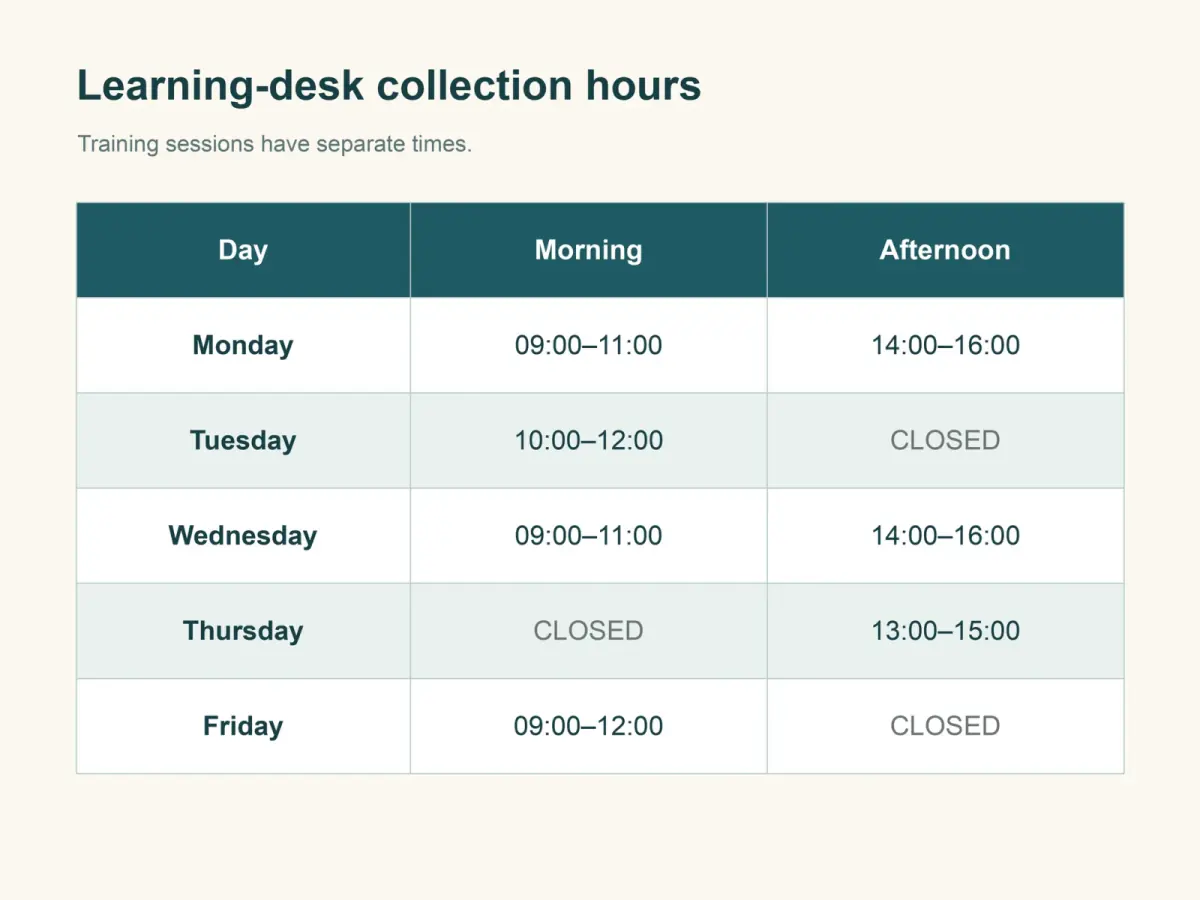
Collection timetable: Monday 09:00–11:00 and 14:00–16:00; Tuesday 10:00–12:00, afternoon closed; Wednesday 09:00–11:00 and 14:00–16:00; Thursday morning closed, 13:00–15:00; Friday 09:00–12:00, afternoon closed.

Text A — Collection service

The learning desk holds pre-booked session packs for staff. A collection is ready only after the organiser has confirmed the participant’s registration. The desk cannot confirm a place on a course. A staff member who has not received registration confirmation should contact the organiser rather than assume that a pack is waiting.

Text B — Learning-desk schedule

Monday: morning 09:00 to 11:00; afternoon 14:00 to 16:00.

Tuesday: morning 10:00 to 12:00; afternoon closed.

Wednesday: morning 09:00 to 11:00; afternoon 14:00 to 16:00.

Thursday: morning closed; afternoon 13:00 to 15:00.

Friday: morning 09:00 to 12:00; afternoon closed.

These are collection hours, not the times of the training sessions themselves.

Text C — Preparing a collection

Receive collection request, then check registration list. If registration is confirmed, prepare the named pack and send a collection message. If the name is not on the list, ask the organiser to check the registration. Do not prepare a pack or send a ready-to-collect message until the registration is confirmed.

Text D — Outside the listed hours

Staff who cannot attend during collection hours may ask the learning team to arrange an alternative. The team must confirm the arrangement before anyone leaves material elsewhere. A request alone is not confirmation. Session packs should not be left in public waiting areas or passed to an unknown person.

Practice context

  • Four reference extracts for a staff-learning desk. Text B is a compact schedule with labelled day rows; Text C is a written decision path.

Evidence questions

  • Which collection window is available on Thursday?
  • What happens next if a requested name is missing from the registration list?
  • What must happen before an alternative collection arrangement is used?

Read the information

Text A — Orientation visit

The centre runs a practical orientation visit for new volunteers. It introduces the reception area, staff-learning room and visitor-support point. The visit is about finding services and understanding whom to contact. It does not include clinical work or observation of patient consultations. Volunteers receive their individual duty information separately from their own coordinator.

Text B — Booking and deadline

The next orientation visit is on Friday 18 October at 14:00. A group organiser should submit the final number of visitors by 12:00 on Wednesday 16 October. Include a contact name and any practical access requests. Do not send detailed personal histories. The organiser receives a confirmation message once the group booking has been checked.

Text C — Arrival information

Confirmed groups meet at the side entrance beside the bicycle racks. Individual volunteers attending without a group meet at main reception. Both groups should arrive ten minutes before the stated start time. A person arriving late should contact the orientation coordinator rather than follow an unfamiliar group into another part of the building.

Text D — Changes after confirmation

An organiser who needs to change the group size should contact the orientation coordinator through the shared visits inbox. The coordinator checks whether the revised group can be accommodated and replies with confirmation or an alternative. The original arrangement remains in place until a change is confirmed. Please do not treat an unanswered message as agreement.

Practice context

  • Four reference extracts about a centre’s orientation visit. This is a shorter classroom retrieval task, not a full twenty-question Reading Part A paper.

Evidence questions

  • What is the deadline for a group organiser’s final visitor count?
  • Where should a confirmed group meet?
  • What is the status of the original arrangement while a requested change is unanswered?

Choose and justify with evidence

Text A — Visitor-support desk: purpose

The visitor-support desk helps people understand practical arrangements at the clinic. Staff can explain where to wait, how to find a department and how to contact the appointment team. The desk does not make clinical decisions or change treatment plans. Questions about an individual’s care should be directed to the appropriate professional.

Text B — Finding the desk

From the main entrance, continue along the ground-floor corridor to the large noticeboard. The visitor-support desk is on the left immediately after the noticeboard, opposite the small meeting room. It is not beside the upstairs lift. Staff directing someone from the side entrance should first guide them towards the main entrance corridor.

Text C — Contacting the support team

For a routine practical enquiry, use the shared support inbox. Staff should include a callback number and a brief description of the information requested. Do not put detailed personal information in the subject line. For a same-day practical issue, telephone the support coordinator on the internal number shown in the staff directory.

Text D — Desk opening times

The desk is staffed from 09:00 to 12:00 and from 13:00 to 16:00 on weekdays. During the midday closure, written enquiries can still be left in the secure enquiry box next to the desk. The box is checked when the afternoon session begins. The desk is not staffed on weekends.

  1. Which text explains the limits of what the service can do?

    Show answer and explanation

    Text A

    Text A describes the desk’s practical role and says it does not make clinical decisions or change treatment plans.

  2. Which text would help a colleague direct a visitor from the main entrance?

    Show answer and explanation

    Text B

    Text B gives the route and landmarks needed to find the desk.

  3. Which text explains the communication channel for a same-day practical issue?

    Show answer and explanation

    Text C

    Text C distinguishes routine inbox enquiries from a same-day call to the coordinator.

Choose and justify with evidence

Text A — Training folders

Training folders are prepared for registered participants. Internal staff collect them from reception; external visitors collect them from the training desk. Each folder contains the session outline and blank note pages. Participants who need a different print size should mention this when they register, so the correct version can be prepared.

Text B — Requests and changes

Requests for printed folders must reach the training team at least two working days before the session. Include the session title, date and number of participants. A change to the participant total after the deadline should be reported through the shared training inbox; staff should not assume that extra folders will already be available.

Text C — Borrowed learning resources

Reference folders borrowed for personal study should be returned within seven days. A borrower who needs more time may request an extension before the return date. The training team checks whether another person is waiting before confirming an extension. An unconfirmed request does not automatically change the original return date.

Text D — Returning a resource

Return borrowed reference folders to the labelled tray inside the training office. If the office is closed, use the secure return box beside its door. Do not leave borrowed material on a reception counter, where it may be mistaken for a new session pack. Staff check the return box each weekday morning.

  1. Where should an external visitor collect a prepared training folder?

    Show answer and explanation

    the training desk

    Text A distinguishes external visitors, who collect at the training desk, from internal staff at reception.

  2. How far in advance must a printed-folder request reach the team?

    Show answer and explanation

    two working days

    Text B says at least two working days; calendar days and seven days refer to different or unsupported periods.

  3. Where should a borrowed folder be placed when the training office is closed?

    Show answer and explanation

    the secure return box

    Text D specifies the secure return box beside the closed office door.

Choose and justify with evidence

Collection timetable: Monday 09:00–11:00 and 14:00–16:00; Tuesday 10:00–12:00, afternoon closed; Wednesday 09:00–11:00 and 14:00–16:00; Thursday morning closed, 13:00–15:00; Friday 09:00–12:00, afternoon closed.

Text A — Collection service

The learning desk holds pre-booked session packs for staff. A collection is ready only after the organiser has confirmed the participant’s registration. The desk cannot confirm a place on a course. A staff member who has not received registration confirmation should contact the organiser rather than assume that a pack is waiting.

Text B — Learning-desk schedule

Monday: morning 09:00 to 11:00; afternoon 14:00 to 16:00.

Tuesday: morning 10:00 to 12:00; afternoon closed.

Wednesday: morning 09:00 to 11:00; afternoon 14:00 to 16:00.

Thursday: morning closed; afternoon 13:00 to 15:00.

Friday: morning 09:00 to 12:00; afternoon closed.

These are collection hours, not the times of the training sessions themselves.

Text C — Preparing a collection

Receive collection request, then check registration list. If registration is confirmed, prepare the named pack and send a collection message. If the name is not on the list, ask the organiser to check the registration. Do not prepare a pack or send a ready-to-collect message until the registration is confirmed.

Text D — Outside the listed hours

Staff who cannot attend during collection hours may ask the learning team to arrange an alternative. The team must confirm the arrangement before anyone leaves material elsewhere. A request alone is not confirmation. Session packs should not be left in public waiting areas or passed to an unknown person.

  1. Which collection window is available on Thursday?

    Show answer and explanation

    13:00–15:00

    The Thursday row has the morning closed and the afternoon window 13:00–15:00.

  2. What happens next if a requested name is missing from the registration list?

    Show answer and explanation

    Ask the organiser to check the registration

    Text C requires an organiser check before preparation or collection confirmation.

  3. What must happen before an alternative collection arrangement is used?

    Show answer and explanation

    The learning team must confirm the arrangement

    Text D says the learning team must confirm an alternative; requesting one is not enough.

Choose and justify with evidence

  1. What is the deadline for a group organiser’s final visitor count?

    Show answer and explanation

    Wednesday 16 October at 12:00

    Text B separates the Friday visit from the Wednesday noon deadline for group numbers.

  2. Where should a confirmed group meet?

    Show answer and explanation

    the side entrance beside the bicycle racks

    Text C gives a different meeting point for confirmed groups and individual volunteers.

  3. What is the status of the original arrangement while a requested change is unanswered?

    Show answer and explanation

    Still in place until the change is confirmed

    Text D explicitly keeps the original arrangement in place pending confirmation.

Learn this unit
How would you like to learn?
Have an account?

A free account opens one unit for good.

What Part A asks you to do

Part A opens the 60-minute Reading test: four short texts, A to D, on one healthcare topic, often with a table or a list of steps. It has its own 15 minutes; then you move on to Parts B and C.

There are three question types, and spelling counts in the last two:

  • Matching: which text says this? Answer A, B, C or D.
  • Short answer: a word, number or short phrase.
  • Sentence completion: missing words, copied from the texts.

Choose the text by its job, then scan

Four texts on one topic rarely do the same job. Spend the first minute on headings and layout, label each text in two words, and match each question to a job before you look for words. Then confirm the answer in the sentence itself.

  • “What can’t the desk do?” → purpose and limits.
  • “How do I reach the desk?” → directions.
  • “Whom do I phone about a same-day problem?” → contact details, not opening times.
  • “When is the desk staffed?” → the timetable.

Copy exactly: the unit, the condition and only the missing words

Nearly right answers lose marks. Three checks catch them:

  • Copy the unit: “seven” for “within seven days” is incomplete, and “two days” is not “two working days”.
  • Use the right condition. “Internal staff collect them from reception; external visitors collect them from the training desk.” For an external visitor, the answer is the training desk.
  • Answer the actual gap. “Send requests at least ___ before the session.” The text says two working days: write only that, not the words around the gap.

Small words that make a time limit exact

Prepositions set time limits, so read them as closely as numbers:

  • by 12:00 on Wednesday: no later than that moment; a deadline.
  • until 16:00: continuing up to that time, then stopping.
  • within seven days: any time before the seven days are up; “in seven days” usually means seven days from now.
  • at least two working days before: a minimum; earlier is fine.
  • from 09:00 to 12:00 and from 13:00 to 16:00: two windows, closed in between.

Read the right row of a table

Find the row, then the column, then any note on what the figures mean. A practice timetable’s Thursday row reads “morning closed; afternoon 13:00 to 15:00”: the answer is 13:00–15:00, not Tuesday’s 10:00 to 12:00 above it.

In a flowchart, follow the branch that fits the case: “If the name is not on the list, ask the organiser to check the registration.”

Learn this unit your way

Tell a deadline from an event time

One notice can give two times with different jobs: “The next orientation visit is on Friday 18 October at 14:00. A group organiser should submit the final number of visitors by 12:00 on Wednesday 16 October.” Before you copy a time, underline its label (by, deadline or starts), as the candidate below explains.

Tutor How can you explain a useful checking habit?

Candidate I would underline the deadline label before copying the time, because the same notice also gives the later session time.

What is the deadline for the final number of visitors?

Common Part A mistakes

Label each error; the label tells you what to practise:

  • Wrong text: the heading says visitors; the question asks about staff.
  • First match: a number that looks right, from another row or text.
  • Something missing: unit, condition or plural (“two working day”).
  • Extra words: repeating “before the session”, already printed after the gap.
  • A request taken as confirmed: “The original arrangement remains in place until a change is confirmed.”
  • If your first language doesn’t mark plurals after numbers, check every final -s.

A Part A practice routine

Three times a week, with one practice Part A set:

  • 15 minutes: do the set under exam timing, headings first.
  • 10 minutes: mark it and label every error.
  • 5 minutes: rewrite each wrong answer exactly as the text gives it.
  • Next set: watch your most frequent label first.

What comes next

Part B has six short workplace texts with one three-option question each; Part C has two longer texts with eight four-option questions each.

For speaking practice, discuss whose responsibility a misread notice is: “I’d say the writer has more responsibility, because…”

Frequently asked questions

How long is OET Reading Part A?

Fifteen minutes for 20 questions. Then you move on to Parts B and C.

Does spelling count in OET Reading Part A?

Yes. In short-answer and sentence-completion questions, a misspelt word makes the answer wrong.

Is OET Reading the same for nurses and doctors?

Yes. Reading is the same for all professions, and answers come from the texts, not clinical knowledge.

Flalingo is not affiliated with or endorsed by the organisations that administer OET.

Learn this unit
How would you like to learn?
Have an account?

A free account opens one unit for good.

What comes next?

Keep practising with Flai

Flai is Flalingo's AI speaking-practice app, with voice conversations, corrections and lesson reports to guide your practice.

Learn with a live teacher

In Flalingo lessons you practise units like this one-to-one with a live teacher.