
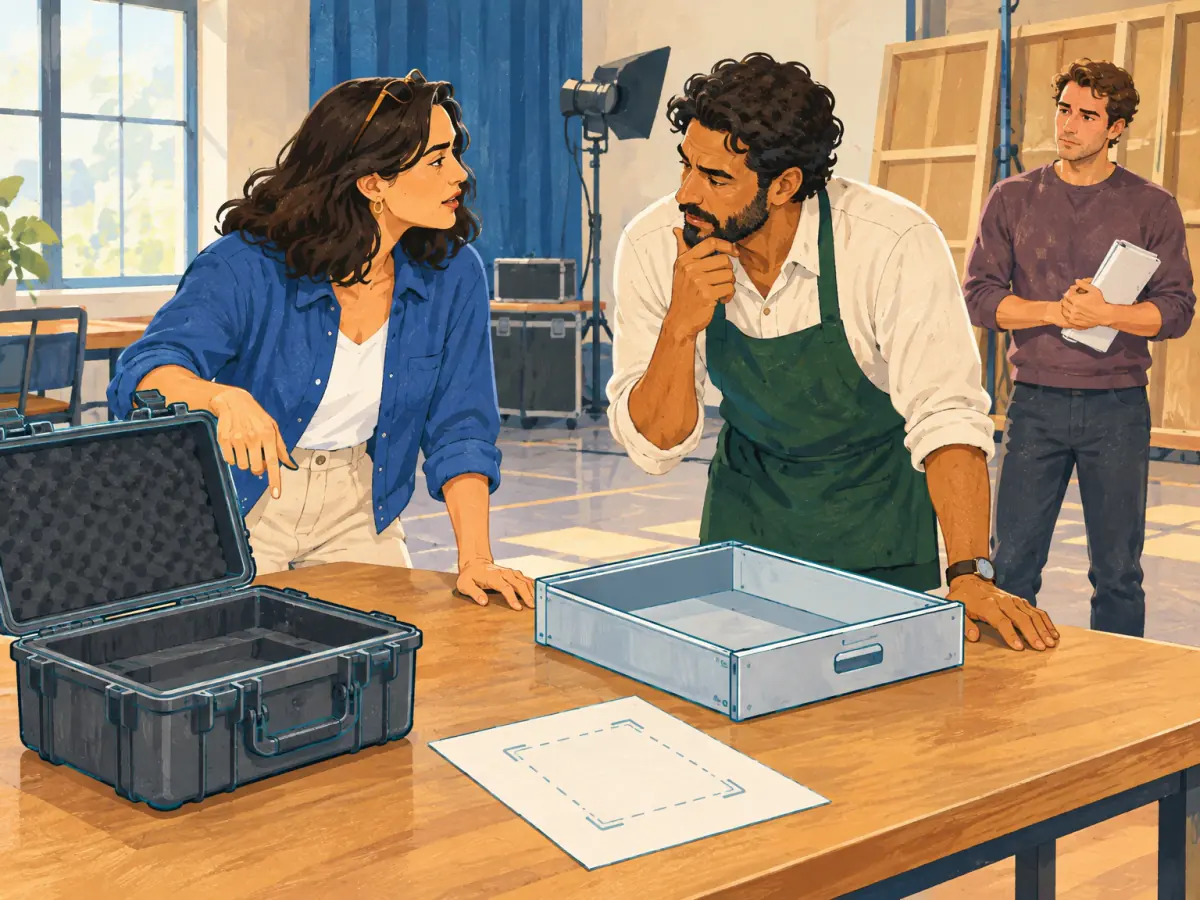
A four-part plan for a 140–190-word photo description
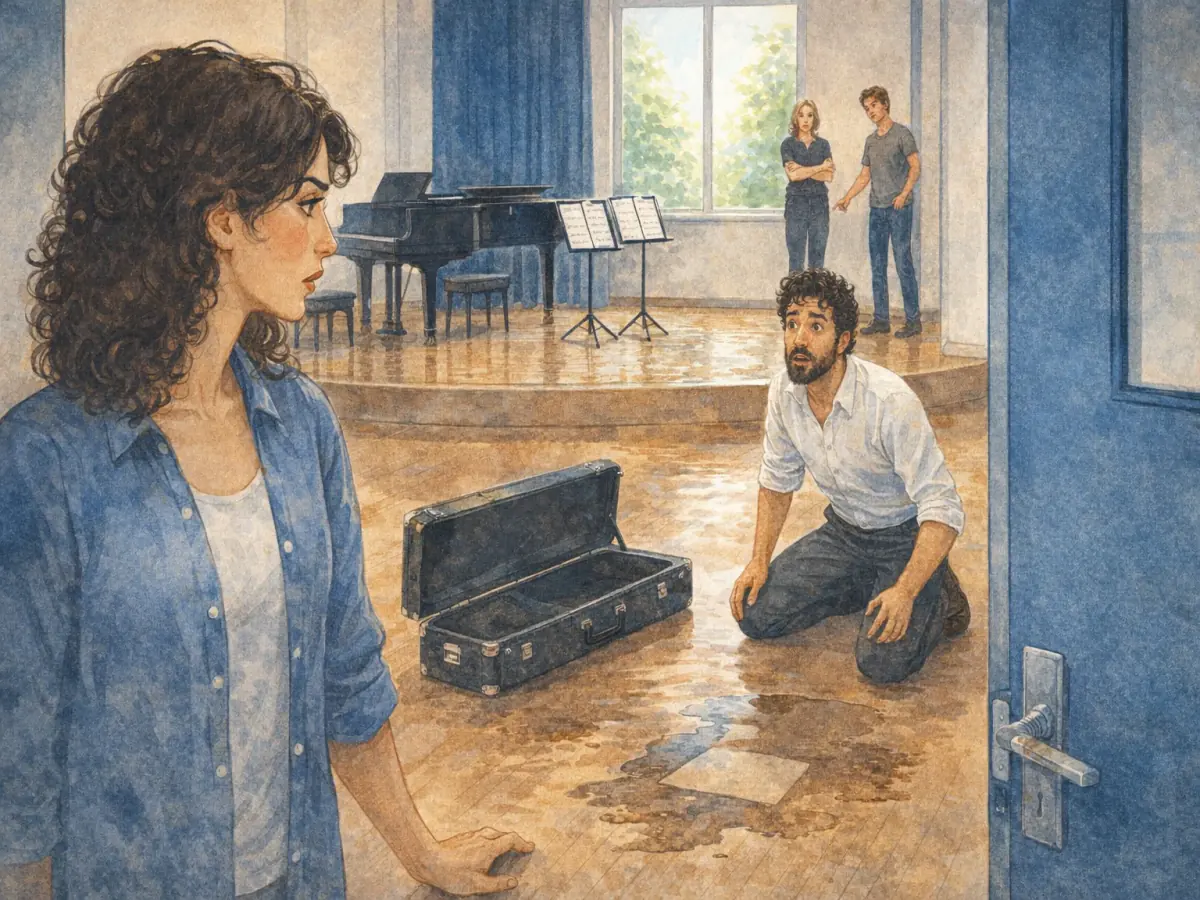
Imagine a rehearsal room: a woman in a doorway, a man kneeling beside a damaged case. Use four location phrases and six body-language words:
- Overview: “The photo shows a rehearsal room with four people and a damaged case.”
- Spatial detail: “In the centre, a man is kneeling next to the case.”
- Cautious inference tied to evidence: “The case may have been moved: a dry rectangle marks where it stood.”
- Personal response: “The photo reminds me of the moment before a practical decision.”
Location phrases that guide the eye
Move in one direction: front to back or left to right.
- Depth and sides: in the foreground, in the centre, in the background, on the left, on the right. “In the foreground, a woman is standing in the doorway.”
- Relations: in front of (nearer the viewer), behind, next to, opposite (facing it, with no of). “The man is opposite the window, behind the case.”
Body language: name it precisely, read it cautiously
Use the present continuous for actions and a participle for positions: “She is pointing at the window.” “Her arms are folded.”
A gesture is evidence, not a dictionary entry: folded arms can mean defensiveness, cold or comfort. Discuss before you write: “Should interviewers judge candidates by their body language?” “Why do we feel so sure about other people’s feelings when the evidence is weak?”
- Posture and hands: folded arms, a raised shoulder, a clenched fist, a hand on the hip.
- Face: raised eyebrows, a frown, a furrowed brow, pressed lips.
- Actions: kneeling, pointing, shrugging, staring, leaning against a wall.
Look, seem, look like or look as if?
Sense verbs give an impression, not a certainty, and take an adjective, not an adverb. Here, a later detail changes how a silent stage scene reads:
- Look, feel or sound + adjective: “Her shoulders look tense.”
- Look or feel + like + noun: “The prop feels like real stone.”
- Look or sound + as if or as though + clause: “It looks as if rain has come in overnight.”
- Seem, for an impression from any evidence: “He seems worried after reading the schedule.”
Maya Her folded arms look defensive at first.
Owen Yes, but the raised shoulder later looks as if it is protecting her.
Owen And the door feels like stone, but it is a painted prop.
How sure are you? Modals of deduction
Match the modal to your evidence. For the present, use modal + be; for events before the photo, modal + have + past participle:
- Almost certain, must: “They must have arrived a while ago: their coats are hanging up.”
- Possible, may, might or could: “She may be waiting for someone.”
- Almost certainly not, can’t or couldn’t: “The door can’t be real stone: one actor is carrying it with one hand.”
- Must have is a deduction; should have is a criticism: “She must have called; she should have called me too.”
Audit every inference
Underline each sentence that goes beyond what the camera recorded and note its evidence. None: delete it. Weak: soften it. Strong: keep it.
- “She is angry.” becomes “She is frowning with her arms folded; she may be annoyed, or simply cold.”
- “Rain came in overnight.” becomes “It looks as if rain came in: there is a wet patch below the window.”
- “The performers damaged the case.” becomes “Nothing in the photo shows who damaged the case.”
Common mistakes
Check your description for these:
- “on the foreground” or “in the left”. Say in the foreground and on the left.
- “She looks like tired.” Say “She looks tired.” Like comes before a noun.
- “He must went.” or “He must of gone.” Say “He must have gone.” In speech: must’ve.
- “It remembers me of my first job.” Say “It reminds me of my first job.”
A 10-minute daily routine
Use any photo. Once a week, write and audit a full description.
- 2 minutes: play the three lines above and name each pattern.
- 3 minutes: describe a photo aloud with four location phrases.
- 3 minutes: make three guesses with must have, might have and can’t have, each with because.
- 2 minutes: write an overview and a response with reminds me of.
What comes next
Next at B2, write an opinion article that keeps its corrections visible, then a city report in which an average hides local problems. At C1, an art review backs every opinion with evidence.