

Skip to content
Flalingo

English practice

How to describe an object and say where it is in English (A2 elementary): in, on, under

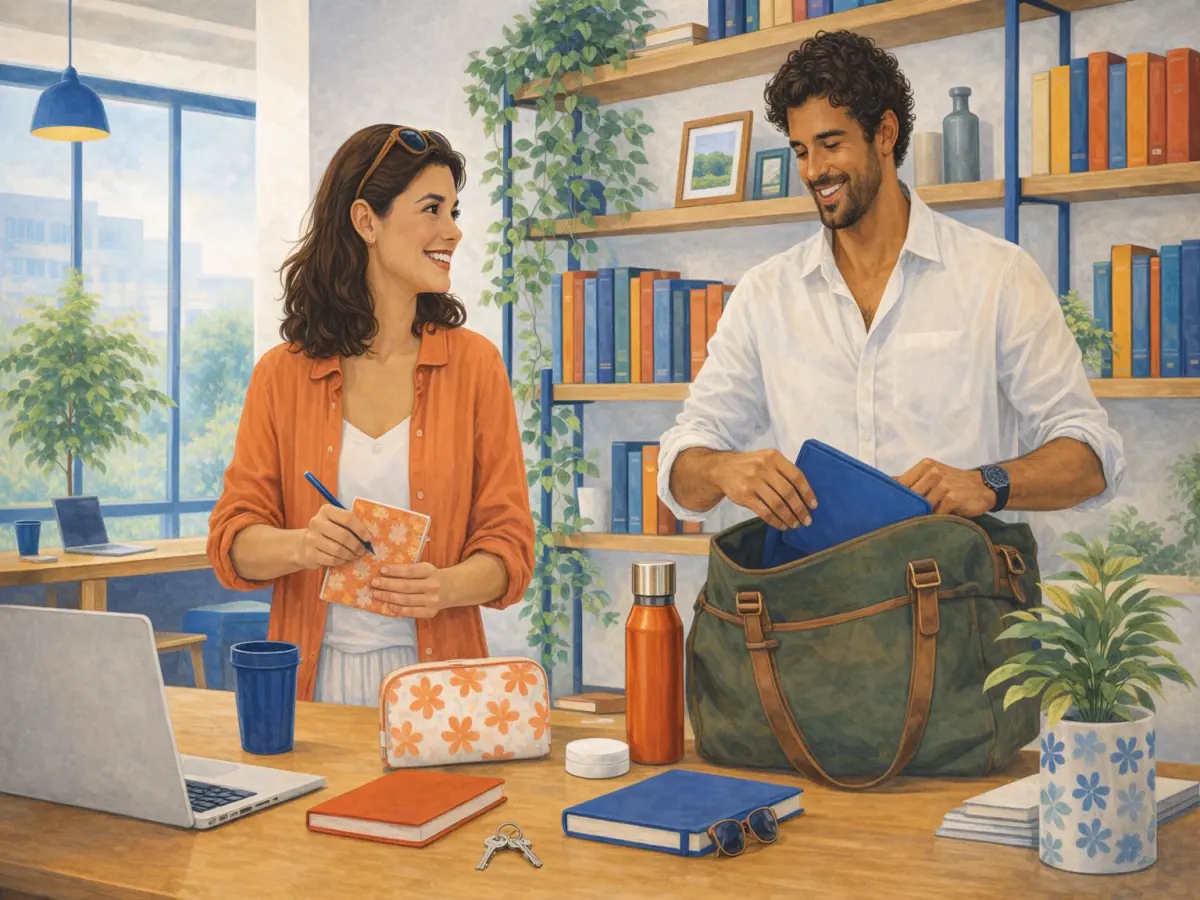
Two friends sorting everyday things in a shared studio.

A2 English for describing everyday things and saying where they are: in, on and under, a/an and plural -s, adjectives like “small blue”, “mine” and “yours”, and a two-sentence note, plus a 10-minute daily routine.

Say what the object looks like first, then where it is, from the closest place to the bigger one: “My notebook is small and blue. It’s in the black bag, under the table.” Use “in” for inside something, “on” for a surface and “under” for below it. Count carefully: “a key” but “two keys”, and more than one thing takes “are”. This is an A2 (elementary) topic for adults who know everyday words and need to describe and find things at home or at work. Ten minutes of practice a day is enough.

Who this is for

  • Adults at elementary level: you know the names of everyday things, but you get stuck when you have to say exactly where they are.
  • People who share a home, office or studio and leave notes or messages like “Your keys are on the shelf.”
  • Anyone who has to describe a lost item: at a hotel, at work or to a friend on the phone.
  • Too early: if “a”, “is” and “are” still feel new, start with the A1 article on asking questions with “are”.
  • Too easy: if you describe and locate things without thinking, move on to a short profile about your work and routine (A2).

Open the sample pages

Open the sample pages

Word cards

in

inside a place or container

on

touching and supported by a surface

under

below something

Conversation

Maya Is this your key?

Owen No, my keys are in the bag.

Maya There are two notebooks on the table.

Owen The blue notebook is mine. The glasses under it are yours.

Language pattern

Where are the keys?

They're in the bag.

Use a plural noun after more than one; use a place word before the object.

  • a / an
  • one / plural -s
  • in
  • on
  • under

More practice

The last train desk

A lost-property counter with everyday objects

The last train leaves at 9:20. On the lost-property desk there is a small black wallet, an orange umbrella and two notebooks. The green notebook is under the wallet. The blue notebook is in a bag. A note says, ‘Please show your ticket and identity card.’ Owen is happy. The black wallet and the blue notebook are his.

Read the model

My notebook is small and blue. It's in the black bag, under the table.

A clear object note

What does the note say?

My notebook is small and blue. It's in the black bag, under the table.

Give the description first, then the location.

  • small
  • blue
  • in
  • under
Learn this unit
How would you like to learn?
Have an account?

A free account opens one unit for good.

In, on and under: three words for where things are

The place word comes first, then the place: “in the bag”. Ask yourself one question: is the thing inside, on top or below?

  • “in” – inside something: “The keys are in the bag.” Also in a drawer, a box or a room.
  • “on” – touching a surface: “The laptop is on the desk.” Also on a shelf, the floor or the wall.
  • “under” – below something: “The charger is under the bag.”
  • “Where’s the charger?” – “It’s in the bag.”
  • “Where are the keys?” – “They’re in the bag.”

One or more: a, an and plural -s

Use “a” or “an” for one thing. For more than one, add -s or -es, even after a number: “two keys”.

  • “a” before a consonant sound, “an” before a vowel sound: “a key”, “an umbrella”, “an orange bag”.
  • Most nouns add -s (keys, bags, tickets); nouns ending in -s, -ch, -sh or -x add -es (glasses, watches, boxes).
  • Say the ending: a z sound in “keys”, an s sound in “books”, an extra syllable in “watches”.
  • Always plural: glasses, sunglasses, scissors and headphones. “My glasses are in the case.”
  • “There’s a wallet on the desk.” “There are two notebooks on the table.”

Whose is it? this, these, mine and yours

“This” is for one thing near you, “these” for more than one. “Mine” and “yours” stand alone, with no noun after them.

  • “Is this your key?” – “No, it isn’t. My keys are in the bag.”
  • “Are these your sunglasses?” – “Yes, they are.”
  • “This notebook is mine.” Never “mine notebook”.

A short conversation: sorting a shared table

Maya and Owen are tidying a table they share. Listen for “key” becoming “keys”, the plural “two notebooks”, and “under it”, which shows exactly which glasses. Then say the answers about your own things.

Maya Is this your key?

Owen No, my keys are in the bag.

Maya There are two notebooks on the table.

Owen The blue notebook is mine. The glasses under it are yours.

Describing things: small, blue, really useful

An adjective goes before the noun (“a small notebook”) or after “is” or “are” (“The notebook is small.”). It never takes -s.

  • “two blue notebooks”: never “blues notebooks” or “notebooks blue”.
  • Size before colour: “a small black wallet”.
  • Join two with “and”: “It’s small and blue.”
  • Stronger or softer: “very cold”, “really beautiful”, “quite cheap” (“quite” is usually weaker than “very”).
  • Useful opposites: big / small, new / old, clean / dirty, full / empty.
Learn this unit your way

Writing the note: what it looks like, then where it is

Write two sentences so someone can find your thing without asking. First, what it looks like. Second, where it is, from the closest place to the bigger one.

Model: “My notebook is small and blue. It’s in the black bag, under the table.” The reader looks under the table, finds the black bag and opens it.

  • For plural things, change both verbs: “My keys are silver. They’re in a small brown bag, on the shelf.”
  • Add a request if you need one: “Please put it in my bag.”

Common mistakes

Each of these is easy to fix:

  • “in the table” → “on the table”: a table, shelf or floor is a surface.
  • “two key” → “two keys”: a number does not replace the plural ending.
  • “a umbrella” → “an umbrella”.
  • “My glasses is …” → “My glasses are …”
  • “The keys in the bag.” → “The keys are in the bag.” Don’t drop “is” or “are”.

A 10-minute daily practice routine

Say everything out loud; a little every day beats one long session a week.

  • 2 minutes: play the conversation, pause after each line and repeat it.
  • 3 minutes: say where three things near you are: “My phone is on the desk.”
  • 2 minutes: say five plurals and listen to the ending: keys, books, watches, bags, glasses.
  • 3 minutes: write a two-sentence note about one object for someone at home or at work. Could they find it?

What comes next

Use the same pattern in simple requests (“Please put it in the drawer.”). In writing, the next step is a short profile about your work and routine, then times and how often you do things.

Frequently asked questions

What is the difference between in and on in English?

“In” means inside something: a bag, a drawer, a room. “On” means touching a surface: a table, a shelf, a wall. So your phone is “in your bag” but “on the table”. Higher but not touching is “above”.

Is it “glasses is” or “glasses are”?

“Are”: glasses, scissors and headphones are plural in English. For one item you can also say “a pair of glasses”: “A pair of glasses is on the table.”

When do you use “an” instead of “a”?

Before a vowel sound: “an umbrella”, “an orange bag”. The sound matters, not the letter: “a uniform” starts with a “y” sound, and in “an hour” the h is silent.

Learn this unit
How would you like to learn?
Have an account?

A free account opens one unit for good.

What comes next?

Keep practising with Flai

Flai is Flalingo's AI speaking-practice app, with voice conversations, corrections and lesson reports to guide your practice.

Learn with a live teacher

In Flalingo lessons you practise units like this one-to-one with a live teacher.