
Beyond ABCs: How 6–8 Year-Olds Build Real English Fluency with AI-Powered Learning
If your child can already sing the alphabet song and count to twenty in English, you might wonder what comes next. The answer is everything that actually matters: reading comprehension, grammar accuracy, sentence construction, and the confidence to hold a real conversation.
The age range of 6 to 8 represents the transition from play-based exposure to controlled, quantifiable progress for parents looking for online English for primary school options. Additionally, such progress no longer needs to be unnoticed thanks to the availability of AI English learning tools for children.
This guide explores what happens when children move past early vocabulary games and begin building genuine fluency. We will look at the research behind structured play in language acquisition, examine how artificial intelligence transforms the feedback loop between teacher, student, and parent, and explain why this particular window of development deserves a different kind of attention than the toddler years. Whether your child is six, seven, or eight, the question is the same: how do you turn early English exposure into a lasting academic foundation?
What Makes Ages 6–8 a Critical Bridge in Language Learning?
Ages 6–8 represent the period when children transition from intuitive, play-driven language absorption to conscious, rule-based language understanding. This is the bridge between picking up words and actually using them with accuracy.
Developmental psychologist Ellen Bialystok at York University has published extensively on how bilingual children in this age range develop metalinguistic awareness, the ability to think about language as a system rather than simply using it. Her research shows that children who receive structured second-language input in everyday life develop stronger executive function, including attention control and cognitive flexibility.
What does this look like in practice? A five-year-old who has been exposed to English might say "I goed to the park." That overgeneralisation is a healthy sign of acquisition. But by age seven, with the right guidance, that same child should be producing "I went to the park" reliably. The gap between those two sentences is where structured learning does its work.
For many families, this is also the moment when younger children start with natural play, and older siblings need something more rigorous. The 6–8 group sits right at that crossover, old enough for curriculum, young enough to need it delivered with warmth and creativity.
Why Is "Structured Play" More Effective Than Free Play for This Age Group?
Structured play combines the engagement of play-based learning with the intentional targeting of specific language skills. For 6–8 year-olds, free play alone is no longer sufficient to produce measurable language gains.
Research published by the American Academy of Pediatrics confirms that guided play, where an adult provides a goal while allowing the child to lead the process, produces stronger outcomes in vocabulary, grammar, and narrative ability than undirected free play. A study from the Max Planck Institute found that children in play-based curricula showed improvements in both pretend play skills and oral language acquisition during their first year of formal education, with added benefits in grammatical knowledge.
Think of it this way: When a six-year-old plays freely with English vocabulary cards, she might sort them by colour. That is fun, but linguistically passive. When the same child plays a detective game where she has to form complete sentences to "solve the case" ("The cat went under the table"), she is practising past tense, prepositions, and sentence structure without realising it. The play is the vehicle. The structure is the engine.
This distinction matters when choosing an English programme for 6-year-olds. Platforms that rely exclusively on gamified apps, where children tap screens to match pictures to words, deliver the illusion of progress without the substance. A child who can match "apple" to a picture of an apple has recognition memory. A child who can say, "I ate a red apple after school yesterday", has language.
How Does an Oxford Curriculum Keep Grammar Fun at This Age?
Oxford University Press materials are used in classrooms across 180 countries, and their primary-level English curricula are designed around progressive skill-building that respects children's developmental stages. For 6–8 year-olds, this means grammar is never presented as a list of rules to memorise. It is embedded in stories, dialogues, and activities that children genuinely enjoy.
The British Council recommends curricula that integrate reading, writing, listening, and speaking in every session rather than isolating skills. Oxford materials do this by design. A single lesson might involve listening to a short story (listening comprehension), answering questions about characters (reading and speaking), and then drawing and describing a new ending (writing and creativity). Each activity targets a different skill, but the child experiences it as one continuous adventure.
Flalingo uses Oxford curriculum materials across its kids’ programmes, integrated with its AI-powered platform so that content adapts to each child’s pace. The curriculum is not a static textbook. It responds. If a child masters the present continuous tense quickly, the system moves forward. If she struggles with irregular past tense, it provides more examples. The same internationally trusted content, delivered with the flexibility that individual learners need.
See what your child’s first FLAI report reveals.
Start with a trial lesson.
What Exactly Is an AI-Powered Progress Report, and Why Should Parents Care?
An AI-powered progress report turns every lesson into actionable data for parents. Instead of hearing "your child did well today," you see exactly what your child said, where they hesitated, which grammar patterns they used correctly, and which ones need attention.
Flalingo’s FLAI report is built around this principle. After each lesson, parents receive a detailed breakdown that covers pronunciation accuracy, vocabulary usage, grammar patterns, fluency, and engagement. The report does not just describe performance. It identifies patterns across sessions.
Here is a concrete example. Your child takes a lesson on Tuesday. During the session, she says "I goed to school" three times. The report flags this as a recurring pattern: overgeneralisation of the regular past tense to the irregular verb "go." On Wednesday, you will see the report. On Thursday, the teacher opens the lesson with a targeted activity around irregular past tense verbs, specifically "went," "ate," and "saw." That cycle, from error to identification to targeted correction, is what makes AI-assisted learning different from traditional tutoring.
For parents who want to understand how to track their child's English progress, this kind of reporting replaces guesswork with evidence.
What Does a FLAI Report Actually Show Parents?
The table below illustrates what parents see after a typical session. Each category includes specific observations, not generic grades.
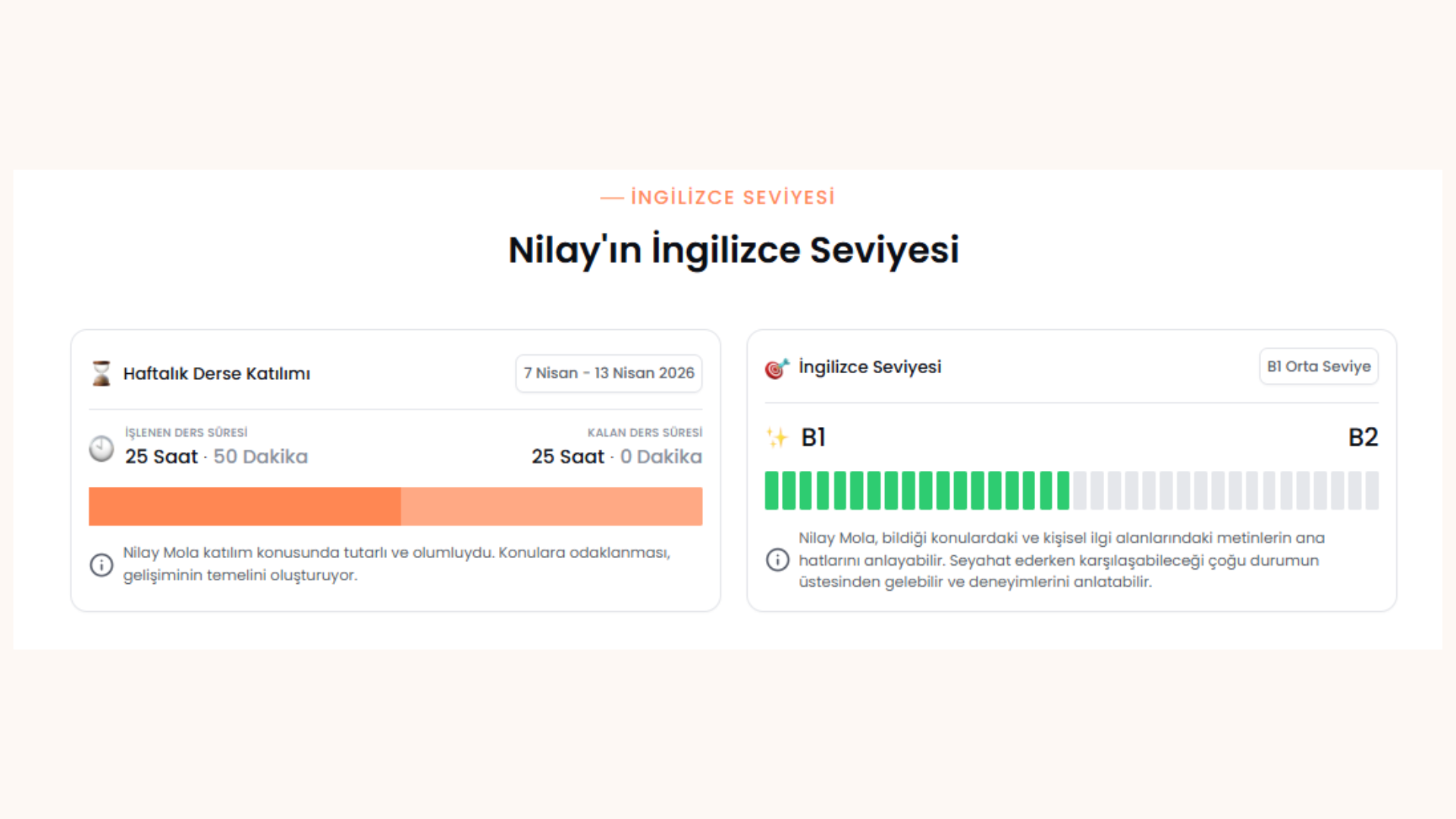
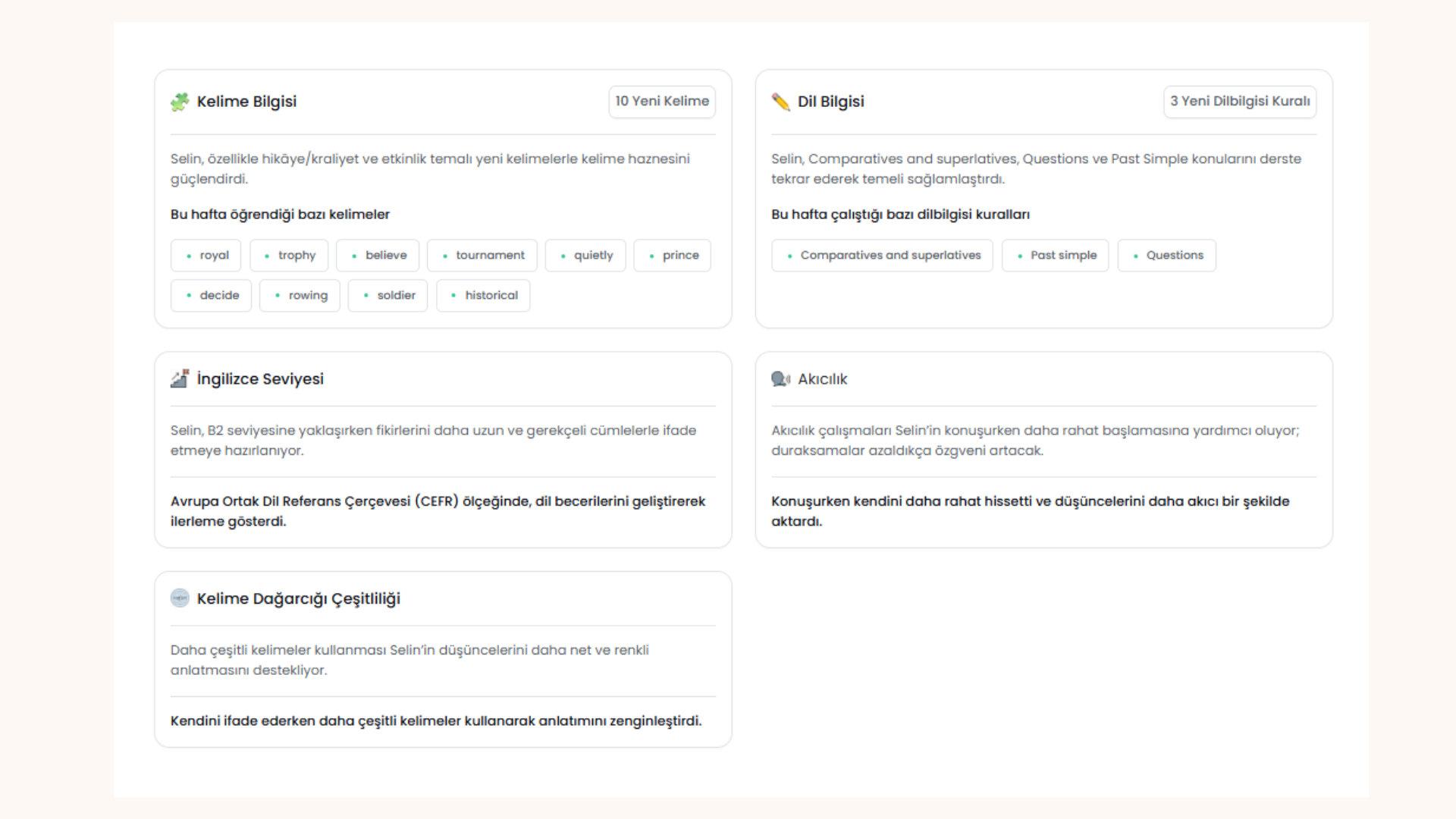
This level of detail transforms the parent’s role. You are not hovering over the lesson or quizzing your child afterwards. You are reading a clear, data-driven summary and watching the recorded session if you want to see the moments behind the numbers.
Learn more about the FLAI report and how it provides session-by-session visibility into your child’s learning trajectory.
How Do Lesson Recordings Help Parents Stay Involved Without Hovering?
Lesson recordings solve the oldest tension in children’s education: parents want to know what happened, but their presence in the room changes the dynamic. A child who knows her parent is watching may perform rather than learn. She may avoid risks, stick to words she already knows, and suppress the natural experimentation that drives acquisition.
With recorded lessons, you step back during the session and step in afterwards. You can watch your child attempt a new sentence, stumble, self-correct, and try again. You can see whether the teacher gave her enough wait time, whether the activities held her attention, and whether she looked comfortable. For children aged 9–12, where the speaking challenge emerges, recordings become even more valuable because performance anxiety starts to influence behaviour, and parents can spot the early signs.
This feature also functions as a safety net for the child. She made a mistake? She mispronounced a word? The world did not end. She can press replay, hear herself, notice the gap, and move on. For children, this normalises error as part of learning rather than something to avoid.
Why Does a Dedicated Teacher Matter More Than a Rotating Roster?
Children learn language through relationships, not transactions. A dedicated teacher who sees your child every session knows her strengths, remembers her favourite topics, and recognises when she is struggling versus when she is simply tired. A rotating roster of unfamiliar faces resets that relationship every time.
For 6–8 year-olds, this consistency is tied directly to emotional safety. Research on attachment and learning consistently shows that children perform better in environments where they feel secure. A familiar teacher who greets your child by name, who remembers that she loves dolphins, who picks up the story from last week’s lesson, creates a learning environment where mistakes feel safe. And mistakes are where language learning actually happens.
In Flalingo, you can choose a dedicated teacher for your child for the duration of their learning journey. This is not a scheduling preference. It is a pedagogical decision. The teacher builds a relationship with the child, and the FLAI system builds a data profile. Together, they create a feedback loop that would be impossible with a different teacher every session.
Traditional Tutoring vs. AI-Powered Online Learning: Which Works Better for This Age?
Traditional private tutoring has obvious strengths: personal attention, real human interaction, and adaptability. But it also has structural limitations that become clear when you compare it to a platform designed specifically for structured English learning for 6-8 year-olds.
The comparison is not about dismissing traditional tutoring. Plenty of talented private tutors deliver excellent results. The difference is in the system around the teacher. A great tutor on a platform with AI-powered diagnostics, an internationally recognised curriculum, lesson recordings, and data-driven progress reports will always outperform the same great tutor working alone with a whiteboard and good intentions.
AI-enhanced learning environments produce faster identification of student weaknesses and more targeted instructional adjustments compared to traditional methods. For parents asking if AI tutoring is effective for kids, the evidence points clearly toward yes, when the AI supports a human teacher rather than replacing one.
From Game-Based to Structured Play: What Changes After Age 6?
Before age six, most children learn English through songs, games, colours, animals, and simple commands. This is effective. It builds phonemic awareness, basic vocabulary, and positive associations with the language. But around age six, something shifts.
Children begin developing metalinguistic awareness: the ability to notice language patterns, ask why certain rules exist, and self-correct when something sounds wrong. A five-year-old accepts "I eated the cake" without question. A seven-year-old pauses, frowns, and tries "I ate the cake" because something about the first version felt off. That "feeling" is metalinguistic awareness, and it only emerges when children have enough exposure to notice patterns.
This is why structured English learning for 6-8 year-olds requires a different approach than toddler programmes. The play does not disappear. It gets a purpose. Instead of free-form vocabulary games, children engage in activities where the language goal is embedded in the play. A storytelling exercise targets past tense narration. A "build your dream house" activity practises "there is / there are" and prepositions. The child is still playing. But the teacher and the curriculum know exactly what linguistic skills each activity targets.
AI in language acquisition highlights that personalised learning paths, adapting content to a child’s demonstrated level rather than their age, produce stronger engagement and faster progress. Flalingo’s system operates on this principle. A six-year-old who reads at an advanced level gets appropriately challenging material, while a seven-year-old who needs more time with phonics receives it without judgment.
What Should Parents Look for in an Online English Course for a 6-8 Year-Old?
The best online English course for 6-8 year-old learners shares a few non-negotiable qualities.
- The programme should offer live, one-on-one interaction with a qualified teacher, not group classes where your child speaks for two minutes out of thirty.
- It should follow a recognised curriculum with clear learning objectives for each level.
- It should provide parents with concrete data about their child’s progress, not just participation badges.
- It should allow families to schedule lessons when they work, not when the institution decides.
Beyond these basics, look for platforms that combine human teaching with AI analytics. The teacher provides the relationship, the creativity, and the real-time adaptation. The AI provides the memory, tracking patterns across sessions that no human could reasonably monitor manually. Together, they create a learning experience that is both personal and precise.
Experts recommend seven strategies for developing children’s communication skills, and nearly all of them, consistent practice, interactive activities, reading aloud, and feedback, are built into platforms like Flalingo by design. The question for parents is not whether these strategies work. It is whether the platform you choose actually delivers them.
Flalingo Kids is not just a language practice app. Powered by FLAI artificial intelligence technology and aligned with international Oxford standards, it is a global brand that secures your child’s academic foundation on the world’s leading online platform. It is the shared choice of mindful parents from every corner of the globe.
See what your child’s first FLAI report reveals.
Start with a trial lesson.
Other content that may interest you



As an ESL educator of 5+ years, I am a guide for students and parents. I simplify complex English topics and online course selection for you. My goal is to help you turn learning from a stressful task into an enjoyable adventure.
English with Flalingo

Learning English with Flalingo means progressing with an intelligent system that works in an integrated manner.