
Best Online English Courses for Kids in Spain (2026): 7 Platforms Compared
Searching for the best online English courses for children in Spain often starts with a familiar scene: a nine-year-old with their Natural Science textbook open to the digestive system and parents who cannot remember how to say “small intestine” in English. It happens in many homes. In the 2021–2022 school year, 40.9% of primary pupils were studying in an integrated bilingual or trilingual programme, and 85.9% of children in the second cycle of preschool education already had some foreign-language activities, almost always in English, according to statistics from the Ministry of Education. In the Community of Madrid alone, the bilingual programme has been running since the 2004–2005 school year and operates in more than 600 state primary schools.
Starting early is less helpful than people think if teaching hours are limited. The Barcelona Age Factor project, led by Carmen Muñoz at the University of Barcelona, compared students who had started learning English at ages 8, 11, 14 and 18, assessing them after 200, 416 and 726 hours of lessons. In that school setting, those who started later progressed faster at first (Muñoz, 2006; MEITS summary). What determines the outcome is the number of hours of exposure and, above all, the hours the child spends speaking. And speaking is precisely what people in Spain struggle with most: the country ranks 36th out of 123 in the EF EPI 2025, with moderate proficiency, and speaking remains its weak point (Aprendemás).
In this comparison, we review seven options using six child-focused criteria and one specific to Spain: whether the platform can support the subjects taught in English at bilingual schools. All prices are in euros.
Short answer
For most families, we recommend Flalingo Kids: one-to-one lessons with a regular teacher with training in teaching, books covering preschool through Cambridge exam preparation, reports for parents and help with bilingual school vocabulary. Novakid suits children who learn through play, Lingokids suits under-8s, Cambly Kids focuses on conversation, Preply helps with specific homework tasks, British Council offers small groups and ABA English suits independent teenagers.
Contents
- How we evaluated the courses
- The best online English courses for children in Spain: quick comparison
- Bilingual schooling and children's data: an analysis for Spain
- #1 - Flalingo Kids
- #2 - Novakid
- #3 - Lingokids
- #4 - Cambly Kids
- #5 - Preply
- #6 - British Council
- #7 - ABA English
- Which option suits your child?
- Frequently asked questions
- Sources
How we evaluated the courses
With children, a course rarely falls short in the first lesson. It happens in the sixth, when the teacher has already changed three times or the child discovers they can switch off the camera. That is why we asked all seven platforms the same seven questions. The last one, in orange, addresses a situation particularly relevant to Spain.
The best online English courses for children in Spain: quick comparison
The table summarises what each platform publishes about itself. “Prices from” shows the cheapest starting option we found. Lesson length, group size and minimum commitment vary considerably, so the details are provided in each section.
Prices last checked: October 2026.
Bilingual schools and children's data: an analysis for Spain
Under the LOMLOE, a foreign language is a compulsory subject from the first year of primary school (Royal Decree 157/2022). Bilingual programs go further, teaching parts of other subjects in English. The oldest model is the one agreed upon by the Ministry of Education and the British Council in 1996: today it covers 90 preschool and primary schools and 58 secondary schools, with around 40,000 students across ten autonomous communities. In primary school, Natural Science and Arts are taught in English; in secondary school, Biology, Physics and Chemistry, Geography and History are taught in English (British Council). The autonomous communities also have their own programs, with different subjects and teaching hours.
A general English course alone will not prepare a child for a Science exam. That requires topic-specific vocabulary and practice explaining it in their own words, for example how a plant gets its nutrients or what the heart does. Here is what each platform offers:
Who authorizes the use of your child's data?
In Spain, minors can consent to the processing of their data from the age of 14. Below that age, consent from parents or guardians is required, as the Spanish Data Protection Agency explains, citing Article 7 of Organic Law 3/2018. In a video lesson, this includes your child's image and voice. A platform recording lessons is not inherently a bad thing: it lets you watch the lesson afterward and allows the team to review anything unusual. What you should ask is who can view those recordings, how long they are stored and in which country.
A trick that works with any teacher
Before each lesson, take a photo of the vocabulary from the unit your child is studying at school and send it to the teacher. Ask the teacher to have your child explain the topic in their own words ("Tell me how plants make food") rather than repeat the list. Ten minutes like this is better preparation for a Science exam than an hour of worksheets.
#1 - Flalingo Kids: a regular teacher who understands the science textbook too
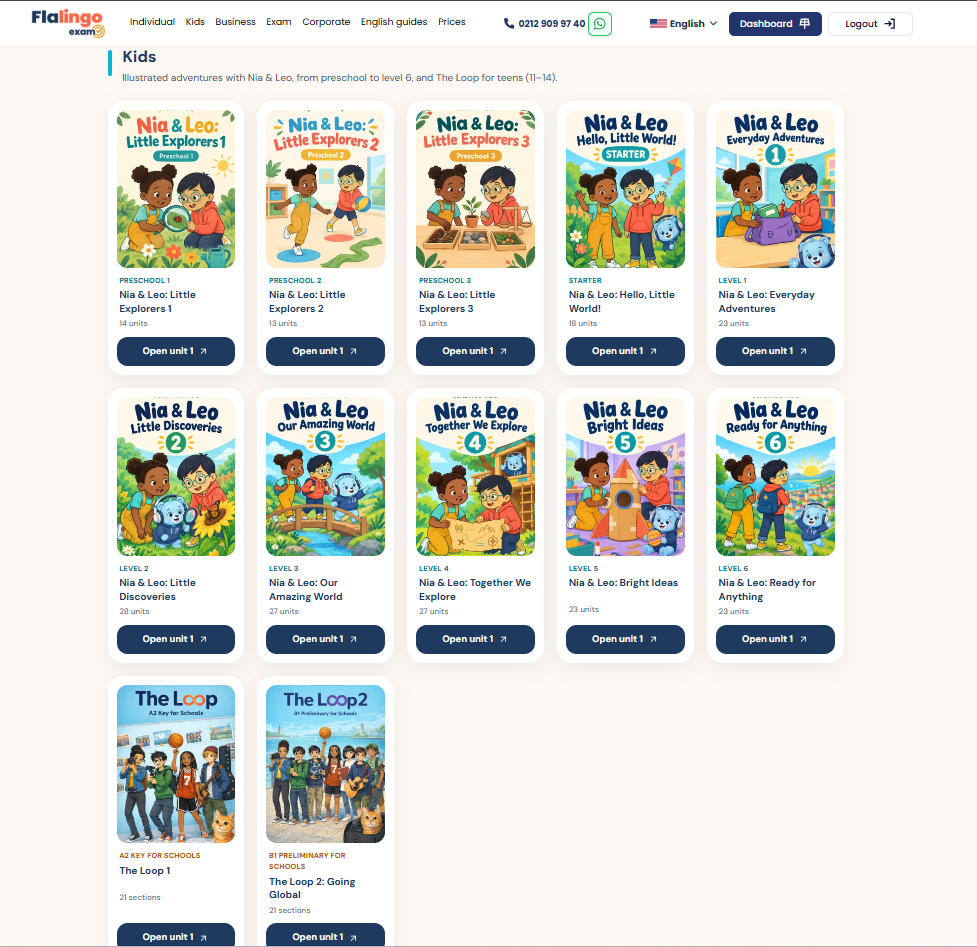
Flalingo Kids offers live, one-to-one English lessons for children and teenagers aged 3 to 17, divided into four age groups (3-5, 6-8, 9-12 and 13 and up). Each lesson lasts 25 or 50 minutes. For preschoolers and children in the early years of primary school, the shorter option is recommended, with pictures, songs and games. From age 13, exam preparation for tests such as Cambridge or TOEFL is introduced (exam preparation at Flalingo).
Flalingo requires its teachers to have a degree in English Studies or English Language Teaching, a teaching certificate, a qualification such as IELTS 8 or TOEFL 100 (TEFL, TESOL or CELTA for native speakers), and two years of experience. Following an interview, a demo lesson and reference checks, the company says it accepts 1 in 73 applicants. Those who teach children also undergo a background check and child safeguarding training. This teaching background has a practical advantage in Spain: if you share the school unit with the teacher, they can work on Natural Science or maths vocabulary.
Continuity is the biggest factor in our recommendation. Smart Matching considers 18 data points, such as the child's interests and whether you prefer a calm or energetic teacher, and suggests between 22 and 30 profiles. The likelihood of staying with the same teacher until the end of the package is over 90%, and seeing the same face every week is much easier for a shy child (we explain this in Your Child Understands English but Won't Speak It). Switching teachers before the next lesson costs nothing.
Lessons are available from morning to night and can be cancelled up to eight hours in advance. Parents can watch lessons live or recorded and receive short videos via WhatsApp each week. After every lesson, FLAI, Flalingo's artificial intelligence, analyses pronunciation, fluency and vocabulary, and a weekly report summarises new words, grammar and exercises (more details in What Is FLAI?). FLAI also reviews lesson content and alerts the quality team if it detects anything inappropriate. Only parents can open accounts for minors, and recordings are deleted or irreversibly anonymised after one year.
All titles are listed on the Smart Personalised Books page. Outside lessons, Flalingo Stories offers 165 free stories for children aged 4 to 12, organised by Starters, Movers and Flyers levels, while Flalingo Games offers vocabulary games. For parents, there is the Parent Academy.
Key features
- Up to seven live, one-to-one lessons a week, lasting 25 or 50 minutes, for children aged 3 to 17
- Support with vocabulary for bilingual school subjects, such as Natural Science or math
- Smart Matching using 18 data points and a list of 22 to 30 teachers
- FLAI analysis after every lesson and a weekly report for parents
- AI safety checks and alerts to the quality team
- Free placement test for children, adapted to their age and reading ability
- Educational advisor, teacher chat, and 24-hour support
Pricing
There are two packages, differing only in duration and price per lesson. Both include native-speaking teachers, Smart Books, FLAI reports, 24-hour support, and access to all recordings. The 12-month package also includes group lessons. With one lesson a week, the breakdown is as follows (details on the Flalingo Kids pricing page):
- Second sibling: an additional 20% discount on all packages
- Free trial lesson, with no card details or upfront payment required
- 100% refund within 30 days of the first lesson
- No automatic renewal when the package ends
Prices last reviewed: October 2026.
Who is it for?
- Children aged 3 to 17, especially those aged 5 to 12, who never speak up in large classes
- Families with children at bilingual schools who need to review Science vocabulary in English
- Parents who cannot attend every lesson and want to know what happens in them
- Older children preparing for A2 Key or B1 Preliminary for Schools
- Budgets starting at around €23 per month (12-month package, one lesson a week)
Family reviews
On Google, Flalingo has 4.9 out of 5 stars from 710 reviews, according to its website (October 2026). The two reviews below are from mothers whose children study with Flalingo Kids. We have translated them from Turkish.
#2 - Novakid: a world of play for learning English from ages 4 to 12
Novakid is an online English school exclusively for children, with a website in European Spanish and a WhatsApp number with Spain's +34 country code. It is mainly aimed at children aged 4 to 12. Each session lasts around 40 minutes: five for warming up, 25 for conversation with the teacher, and ten for games. Two or three sessions per week are recommended.
Novakid reports having more than 3,900 certified teachers, with Standard (non-native) and Premium (native) options, and says that only 1 in 11 applicants passes its selection process. The curriculum follows the CEFR and uses Cambridge's Starters, Movers and Flyers levels. Novakid does not guarantee a regular teacher, but you can book again with teachers your child likes. The parent dashboard includes teacher feedback after each lesson, the recording and a summary at the end of each unit. It does not cover school subjects in English.
Key features
- One-to-one lessons with 25 minutes of conversation within a session lasting around 40 minutes
- More than 3,900 certified native and non-native teachers
- CEFR-aligned curriculum, with a certificate upon completing each level
- Novakid Game World with avatars, stars and rewards
- Parent dashboard with feedback, summaries and a recording of each lesson
- Free trial lesson with no card required, including a level assessment
Pricing
Novakid's pricing page for Spain only gives a starting point: from €95 a month. The final amount depends on the plan (6 or 12 months), the number of lessons a week, the type of teacher and whatever promotions are running.
- Sibling discount: 5% for two children and 10% for three
- 14-day money-back guarantee; after that, unused lessons are refunded under its policy
- One free month of group conversation with the one-to-one lessons, according to the website
Prices last checked: October 2026.
Who is it for?
- Children aged 4–10 who are motivated by games and rewards
- Families who can set aside two or three regular slots a week
- Parents who keep track of automatic renewal
- A budget starting at around €95 per month
Family reviews
On Trustpilot, Novakid has a rating of 4.2 out of 5 from 2,602 reviews (October 2026). Negative reviews mainly concern cancellations and charges. The two reviews below are from Spanish families.
#3 - Lingokids: the Madrid-based app that lets little ones play in English
Lingokids was founded in Madrid and is the only option on this list without a live teacher. It is an app for children aged 2–8, with more than 4,000 games, songs and videos and over 650 learning objectives. English sits alongside math, reading, science, art, music and emotional learning, guided by characters children already know, such as Disney characters, Blippi and Pocoyó.
For a preschooler at a bilingual school, Lingokids offers English immersion at home: they hear the same words as in class (colors, animals, numbers) and connect them with images. What it does not offer is conversation. Children listen and tap the screen, but no one asks them what they did today or corrects a sentence. The Plus version adds progress reports for parents, up to four profiles and no advertising.
Key features
- More than 4,000 games, songs and videos for children aged 2–8
- English, math, science, art and music content
- Disney characters, Blippi and Pocoyó
- Progress reports and up to four profiles with Lingokids Plus
- Parental controls
Pricing
On the Spanish App Store, Lingokids costs €14.99 a month or €71.99 a year, which is around €6 a month. The annual Plus subscription is €89.99. There's a free trial before you pay, and the annual plan is often discounted. If you subscribe from your phone, you cancel in the store settings.
Prices last checked: October 2026.
Who is it for?
- Children aged 2–8, especially preschoolers
- Families looking for a first introduction to English without fixed schedules
- Parents who want to supplement lessons with a teacher
- A small budget, starting at around €6 per month with the annual plan
Family reviews
Lingokids has a rating of 4.7 out of 5 on Trustpilot (164 reviews) and 4.3 on the Spanish App Store (around 27,000 ratings, October 2026). The two reviews below are from mothers, and we have translated them from English.
#4 - Cambly Kids: conversation with native speakers in 30-minute lessons
Cambly Kids is Cambly's children's section. It offers one-on-one, 30-minute lessons for children ages 4 to 15, and all its tutors are native speakers. The courses follow the CEFR from A1 to C1, the platform is kidSAFE certified, and you can choose your tutor and book with them again. Plans range from two to seven lessons per week, with monthly, quarterly, or annual billing.
Cambly is best suited to children who already have a foundation and need to become more confident speaking. One of the reviews below sums it up well: little grammar is taught, with much more emphasis on conversation. For a child at a bilingual school who understands almost everything but answers in monosyllables, that's exactly what's missing. For a complete beginner, or a child who needs to prepare for a science exam, it falls short. Lessons are recorded, and the videos are deleted 12 months after the account stops being used. There are no regular reports for parents.
Key features
- One-on-one, 30-minute lessons for children ages 4 to 15
- 100% native-speaking tutors
- CEFR courses from A1 to C1
- kidSAFE safety certification
- All lessons recorded
- Plans with 2, 3, 5, or 7 lessons per week
Pricing
Cambly publishes its children's plans in US dollars. Converted, a 30-minute lesson costs around €15.41 on monthly billing, €12.80 on quarterly billing (10% less) and €9.96 on the annual plan (30% less). With two lessons a week, that's between €86 and €134 a month.
- 30-minute trial lesson for a token price
- The annual plan renews automatically every 12 months, although you can cancel at any time
- Full refund on the first plan if you ask within the first seven days
Prices last checked: October 2026.
Who is it for?
- Children ages 7 to 15 with a basic level who need more speaking practice
- Students at bilingual schools who understand a lot but say little in response
- Families with changing schedules who prefer short lessons
- A budget of around €86 to €134 per month for two lessons a week
Family reviews
On Trustpilot, Cambly overall has a rating of 2.0 out of 5 from 264 reviews (October 2026), and ratings are very mixed: nearly half are one-star reviews, with complaints about scheduling, access, and support. We haven't found any recent parent reviews specifically about Cambly Kids. The two below refer to Cambly in general. We have translated the second from English.
#5 - Preply: a tutor you choose for English homework
Preply isn't a language school but a marketplace for independent tutors. There are around 14,500 profiles for children's English, and more than 13,300 appear in the English homework help section. You can filter by price, schedule, native-speaking teachers, or Spanish-speaking tutors, and read reviews before booking. Lessons usually last 50 minutes, with trial lessons lasting 25 or 50 minutes, and if the first tutor isn't a good fit, you can try two others at no cost.
For bilingual schooling, Preply is the most flexible option: if you find a tutor who knows Natural Science or Social Science, they can work through your child's textbook topic by topic. The flip side is that there is no shared curriculum. The quality, teaching method and approach to working with children depend on the individual, and you have to do the screening yourself. With young children, it's worth staying nearby during the first few lessons. The Lesson Insights feature uses AI to summarize the lesson, but only if you enable it, and it transcribes the audio to do so.
Key features
- Around 14,500 English tutors for children
- Filters for price, availability, native language and specialty
- 50-minute one-to-one lessons, with a 25- or 50-minute trial
- Two free tutor changes if the first isn't a good fit
- Subscription with your chosen tutor, with the option to pause or switch
- Optional AI lesson summaries (Lesson Insights)
Prices
Each tutor sets their own rate. According to Preply, the average for children's English lessons is around US$14 an hour, roughly €12.51, ranging from about €3 to more than €45. Native-speaker profiles with plenty of experience sit at the top end.
- The subscription renews every 28 days
- You can cancel up to one day before the next charge
- If the first tutor isn't right, two more trials at no cost
Prices last checked: October 2026.
Who is it for?
- Children with a specific goal: a Science exam, reading or pronunciation
- Families who want a tutor who can explain things in Spanish at first
- Parents willing to take their time trying out and choosing a tutor
- A variable budget, from around €3 to more than €45 per lesson
Family reviews
Preply has a 4.4 out of 5 rating on Trustpilot with 25,897 reviews (October 2026). The two below, originally written in Spanish, discuss Preply in general rather than children's lessons specifically.
#6 - British Council: small groups following the school-year calendar
The British Council is the best-known option for many Spanish families: it has centers in Madrid, Barcelona, Bilbao, Palma and Valencia, and worked with the Ministry of Education to design the bilingual program that has been running since 1996. Its online courses for children and teenagers follow the academic year. Primary Plus is for children aged 8 to 11, and Secondary Plus is for ages 12 to 17. There is also Cambridge exam preparation (B1 Preliminary for Schools, B2 First for Schools, C1 Advanced and C2 Proficiency) and a termly add-on, English Extra.
Lessons are live, in groups of 8 to 12 students, with sessions lasting at least 50 minutes on two afternoons a week (Mondays and Wednesdays or Tuesdays and Thursdays for primary pupils). Between lessons, primary pupils complete activities on the Learning Hub platform. There is no trial lesson, only a free level consultation. For children under 8, courses are in person, while online one-to-one tutoring (EnglishScore Tutors) starts at age 13.
Key features
- Primary Plus (ages 8–11) and Secondary Plus (ages 12–17)
- Groups of 8 to 12 students, two afternoons a week
- Cambridge exam preparation from B1 to C2 for ages 12–17
- Guided activities on Learning Hub and a free level consultation
Prices
According to the prices and timetables page (in Spanish), the 2026-2027 online course for Primary and Secondary costs €1,400. You can pay in two instalments (a €280 deposit and €1,120 on 7 October) or in nine (€156 a month, with a final payment of €152). The Upper Secondary C2 Communication Skills course costs €725. Exam preparation is priced separately and doesn't include exam fees.
[EDİTÖR NOTU: Bu sayfanın İngilizce versiyonunu doğrulayamadım (istek zaman aşımına uğradı); İspanyolca link korundu.]
- 5% discount for families with three or more members enrolled on courses of 30 hours or more
- Card payments only at the centres; otherwise direct debit or bank transfer
- Your place is reserved with the first payment
Prices last checked: October 2026.
Who is it for?
- Children aged 8 to 17 who learn better in a group
- Families who want a fixed schedule throughout the school year
- Teenagers preparing for First, Advanced or Proficiency
- A budget of around €156 a month for nine months
Family reviews
The British Council's Trustpilot profile has a rating of 1.8 out of 5 from 119 reviews (October 2026), and most complaints concern official exams, refunds and customer service, rather than children's courses. The profile is not managed by the company. The two reviews below do refer to courses: the first is from a Ukrainian mother whose son studies online (translated from English), and the second is from a student.
#7 - ABA English: the Barcelona-based course with short films, for teenagers who study independently
ABA English is a Barcelona-based platform that says it has more than 30 million registered students. It is not a children's course. It is designed for young people and adults and starts at A1, so a teenager who reads confidently and can organise their own study can follow it without difficulty. The course has 144 units across six levels, from A1 to C1. Each unit starts with a short film showing everyday situations, with native-speaker audio and subtitles, followed by vocabulary, grammar and writing exercises.
Premium includes daily live review and group conversation classes, open to students of all ages, so your child will share the screen with adults. There is an assigned teacher to answer questions, an in-house certificate for each level and, with Premium Pro, preparation for TOEFL, IELTS and Cambridge exams. For younger children, ABA's useful resources include some blog articles with games to practise at home, such as the one on English prepositions for children.
Key features
- 144 units across 6 levels, from A1 to C1, each with a short film
- Daily group review and conversation classes (Premium)
- An assigned teacher and an ABA English certificate for each level
- Free placement test and first unit
Pricing
ABA's website doesn't show prices until you choose a plan. On the Spanish App Store, the 3-month Premium subscription costs €47.99 and the annual one €179.99, around €15 a month. During promotions the annual plan comes down quite a bit, and the store lists an annual subscription at €69.99. The website also has lifetime plans and the Premium Pro version.
- One payment when you sign up for the plan
- Auto-renewal every 3, 12 or 24 months, depending on the plan
- 14-day cooling-off period from when the subscription is activated
- Renewal can be cancelled up to 15 days after the charge
Prices last checked: October 2026.
Who is it for?
- Teenagers aged 13 and over who read confidently and work independently
- Young people starting at A1 who want to progress at their own pace
- Families looking for an inexpensive supplement to secondary school lessons
- A budget starting at around €15 a month with the annual plan
Student reviews
ABA English has a Trustpilot rating of 4.2 out of 5 from 2,934 reviews (October 2026). Negative reviews focus on cancellations and automatic renewal. The two reviews below are from adult students, as ABA does not have a dedicated children's audience.
Which option is right for your child?
A ranking tells you little about what your child needs right now. It helps more to ask yourself what gap you want to fill:
- Speaking practice with the same teacher for months, visible progress and support for bilingual schooling: Flalingo Kids
- A child aged 4 to 10 who gets hooked on stars and avatars: Novakid
- Preschoolers learning their first words, with no schedules or camera: Lingokids
- A child who already has the basics and needs to build confidence with native speakers: Cambly Kids
- A specific school topic, with explanations in Spanish if needed: Preply
- Group classes, a fixed schedule and a language-school calendar: British Council
- An independent teenager who wants to progress on their own from A1: ABA English
Before paying, do a simple check. Ask in writing whether classes are recorded, who can view the recordings and when they are deleted. Then let your child take the trial class on their own and, afterwards, ask what they talked about with the teacher. If they tell you without prompting, the class has worked.
Flalingo Kids takes first place because it offers the best combination of the three things that sustain a child's English learning in Spain: a teacher who stays with them, a series of books that takes them from preschool through to Cambridge exams, and someone who can help with vocabulary from their bilingual school.
Feel like getting back to your own English learning? Our comparison of the best online English courses in Spain for adults shows which platforms suit working people and which prepare you for official exams.
Free trial class for your child

As an ESL educator of 5+ years, I am a guide for students and parents. I simplify complex English topics and online course selection for you. My goal is to help you turn learning from a stressful task into an enjoyable adventure.
English with Flalingo
Learning English with Flalingo means progressing with an intelligent system that works in an integrated manner.