
TOEFL Mastery: How AI Technology and Oxford Materials Build the Academic English You Need

TOEFL preparation has changed. A decade ago, a high score meant grinding through practice tests, memorising word lists, and hoping your writing practice reached a reviewer who had time to grade it. The best online TOEFL tutors today offer something different: authentic academic reading, speaking sessions analysed by AI for vocabulary range, and lesson plans built around the integrated reading, listening, speaking, and writing format ETS actually tests.
The students who reach 100 and above, the ones admitted to Harvard, MIT, Toronto, and Johns Hopkins, are rarely the ones who studied the longest. They are the ones who trained in TOEFL academic English the way ETS measures it.
This guide walks through what the test actually measures, what score your target university expects, why academic vocabulary decides your ceiling, and how the combination of Oxford curriculum materials and AI analysis shortens the path from B1 to B2 conversation English to the C1 to C2 academic register that Ivy League admissions assume you already have.
What Is the Difference Between TOEFL and Other English Tests You Have Taken?
The TOEFL does not test whether you can chat, order food, or describe your weekend. It tests whether you can survive a first-year university seminar in English. The reading passages come from real university textbooks covering biology, urban geography, art history, and economics. The listening sections drop you into lecture halls and graduate seminars where professors use phrases like “empirical support,” “counterintuitive findings,” and “methodological limitations.”
This is what ETS calls academic English, and it is a distinct register. Cambridge English describes academic writing and speaking as more formal, more structured, and more dense with information than everyday English. A student who tests at B2 in general conversation can test at B1 or lower when asked to summarise a lecture on plate tectonics and write a response integrating a reading passage on the same topic.
This is the gap premium preparation closes. Oxford academic materials, used across 180 countries in university pathway programs, introduce this register through authentic textbook excerpts rather than invented dialogues. Flalingo integrates these same Oxford resources into its live TOEFL sessions, so students are not practising on synthetic sentences. They are reading the kind of text a Columbia freshman opens on her first day.
What Exactly Does the TOEFL iBT Measure in One Sitting?
The TOEFL iBT measures four skills, but it measures them together. According to ETS’s official test content page, the exam runs under two hours and combines reading, listening, speaking, and writing in tasks designed to replicate real academic work.
The format matters more than many candidates realise. In the speaking section, you read a short passage, listen to a lecture that responds to it, and then speak about both. In the writing section, the integrated task asks you to read a 250 to 300-word academic text, listen to a lecture that adds nuance or counterpoint, and then write a response that synthesises the two. You cannot pass these tasks by being strong in one skill alone. You need to decode academic reading quickly, extract key points from lectures at native speed, organise ideas under time pressure, and produce speech or text with accurate academic vocabulary. You’ll receive four section scores (0-30), as well as an overall score, on the 1 – 6 scale.
This is why isolated practice falls short. A student can spend a year doing reading drills and still fail speaking because she never trained her ear for lecture-style input while preparing to respond verbally. Live sessions that fold all four skills into a single task, the way Flalingo designs its TOEFL-oriented lessons, match the real test format instead of splitting it into silos.
What TOEFL Score Do You Actually Need for Your Target University?
Your target score depends on your desired program, but for Ivy League and other top North American universities, the practical floor is 100 out of 120, with most competitive applicants landing between 105 and 114. ETS scales each of the four sections from 0 to 30, producing a total score from 0 to 120. Also, as of January 2026, apart from the four section scores, you will receive an overall score on the 1 – 6 scale.
Published minimums rarely match admitted minimums. A university that lists 100 often admits students who averaged 108, particularly for humanities and social sciences programs where reading and writing weigh heaviest. The table below shows typical published minimums and competitive ranges at twenty of the most selective North American universities.
Note: Figures reflect commonly cited admissions data. Always verify the current minimum on the official admissions page of your target program before you sit the test.
For an honest self-assessment, add 5 to 8 points to any university’s published minimum to estimate what admitted students typically score. Then work backwards. If your current practice tests put you at 85 and your target is Yale at 110, you need 25 points of real improvement, which translates to roughly 10 to 16 weeks of focused preparation, depending on your starting vocabulary and academic exposure.
TOEFL vs. IELTS: Which Test Should You Actually Choose?
For students targeting US universities, the TOEFL iBT is the safer default, while IELTS Academic is often preferred in the UK, Australia, and parts of Canada. Both tests are accepted at most global universities, but they measure English differently, and your personal profile should decide which one you sit.
The TOEFL is fully computer-based, uses integrated tasks, and features American English in most listening clips. The IELTS splits its speaking section into a live interview with an examiner, offers broader accent variety across British, Australian, New Zealand, and Irish recordings, and scores on a 0 to 9 band scale.
Choosing between them is less about which test is easier and more about which matches your cognitive style. If you write structured arguments well but feel uneasy speaking to a stranger under pressure, the TOEFL’s recorded speaking format probably suits you. If you are more comfortable in live conversation than synthesising a written passage with a recorded lecture, the IELTS may be a better fit. If you still feel uncertain after comparing TOEFL with IELTS on format and scoring, most preparation platforms, including Flalingo’s dedicated TOEFL and IELTS tracks, offer a diagnostic session that identifies which test plays to your existing strengths.
Why Does Academic Vocabulary Quietly Decide Your Entire Score?
Vocabulary range is the single largest predictor of your TOEFL ceiling. A student with strong grammar but conversational vocabulary typically plateaus at 85 to 95. A student with a wide academic vocabulary, even with moderate grammar errors, can reach 105 and beyond. Every section of the TOEFL either tests vocabulary directly, as reading does, or rewards it indirectly through listening comprehension, writing quality, and speaking precision.
This is where TOEFL vocabulary building becomes the decisive factor. ETS emphasises exposure to academic texts and sustained reading in English as core strategies for high scorers. Students who read only novels and news articles rarely hit the test rewards.
What Is the Academic Word List, and How Many Words Do You Actually Need?
The Academic Word List, or AWL, is a set of 570 word families identified by linguist Averil Coxhead as the most frequent in academic texts across disciplines. These are not specialised terms like photosynthesis or derivatives. They are the connective analytical words academics rely on: analyse, constitute, hypothesis, derive, subsequent, and implement.
Coxhead found that AWL words account for roughly 10 per cent of all words in academic writing, on top of the 80 per cent covered by high-frequency general English. Master those two together, and you comprehend about 90 per cent of academic vocabulary. The remaining 10 per cent is discipline-specific, and you absorb it naturally through reading in your field.
For TOEFL candidates, the academic word list should be studied in context rather than on flashcards. The AWL is organised into 10 sublists by frequency, and reputable resources like eapfoundation.com and the Oxford Learner’s Dictionaries academic word list publish the full list with example sentences. Oxford’s version also includes the Oxford 3000, 5000, and the OPAL (Oxford Phrasal Academic Lexicon), which covers the verb patterns and collocations native academic writers use without thinking.
How Can AI Actually Measure Whether You Sound Like a Graduate Student?
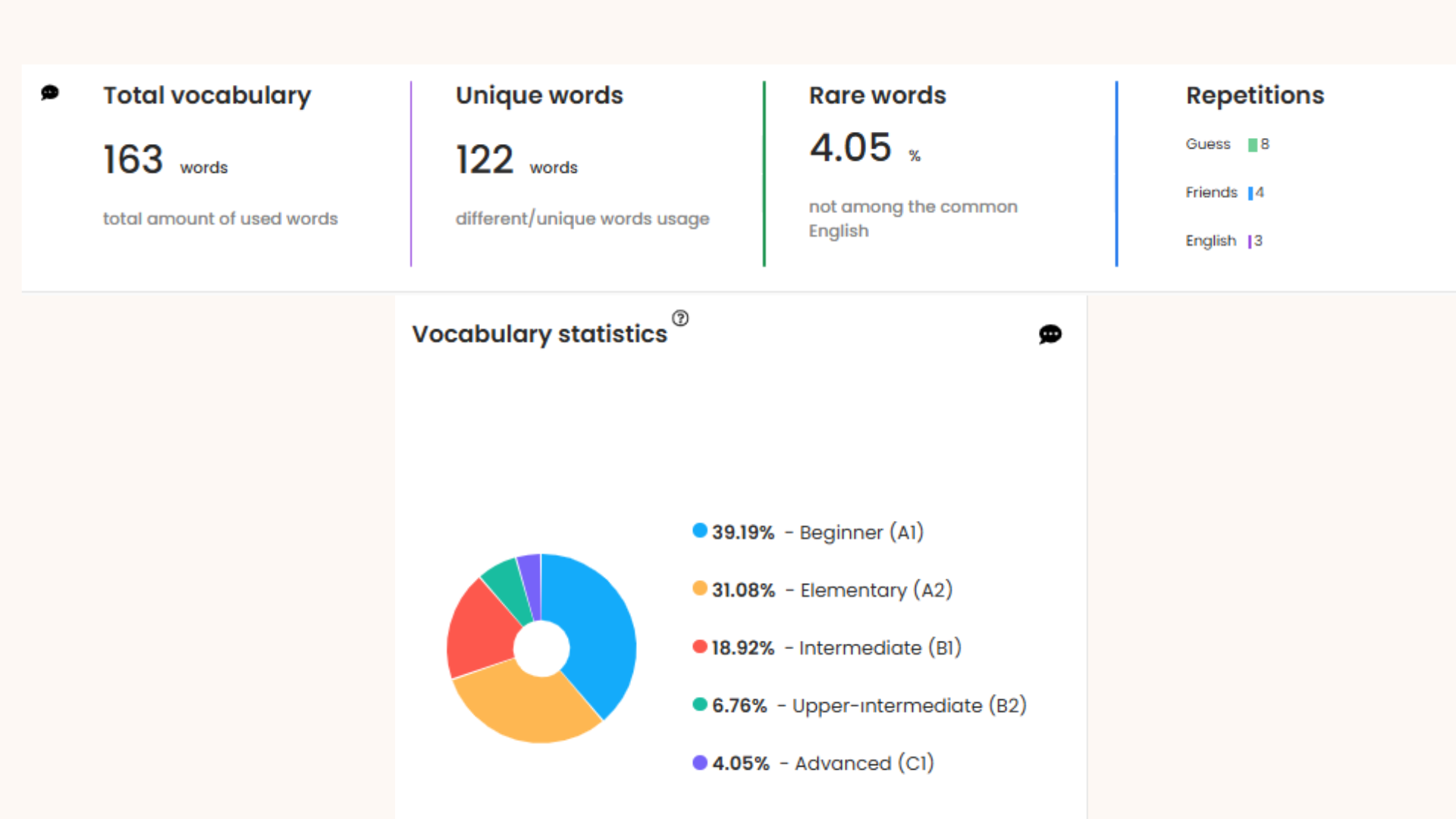
AI measures vocabulary sophistication by analysing your live speech or writing against academic corpora and mapping each word you use to its CEFR level, from A1 through C2. A human tutor can hear that your English sounds simple, but struggles to quantify it. An AI trained on academic corpora can count exactly which words you used in a session, where they fall on the CEFR scale, how often you reached into B2, C1, or C2 territory, and how many AWL words you deployed naturally.
This is the capability Flalingo has built into FLAI, its vocabulary complexity engine. After each session, it analyses the transcript and produces a breakdown. FLAI evaluates your live transcripts based on fluency, grammar, and lexical variety. Were you saying they said when the academic answer was they argued, they contended, or they posited? Did you describe a study’s findings as important when the register called for significant, substantial, or noteworthy? Did you reach for a big difference when marked disparity would have signalled C1 fluency?
These substitutions feel cosmetic. They are not. TOEFL writing and speaking rubrics explicitly reward a variety of vocabulary with an appropriate selection of idiomatic expressions and a clear academic register. The difference between a speaking score of 23 and 26, or a writing score of 24 and 28, often comes down to exactly this kind of lexical upgrade.
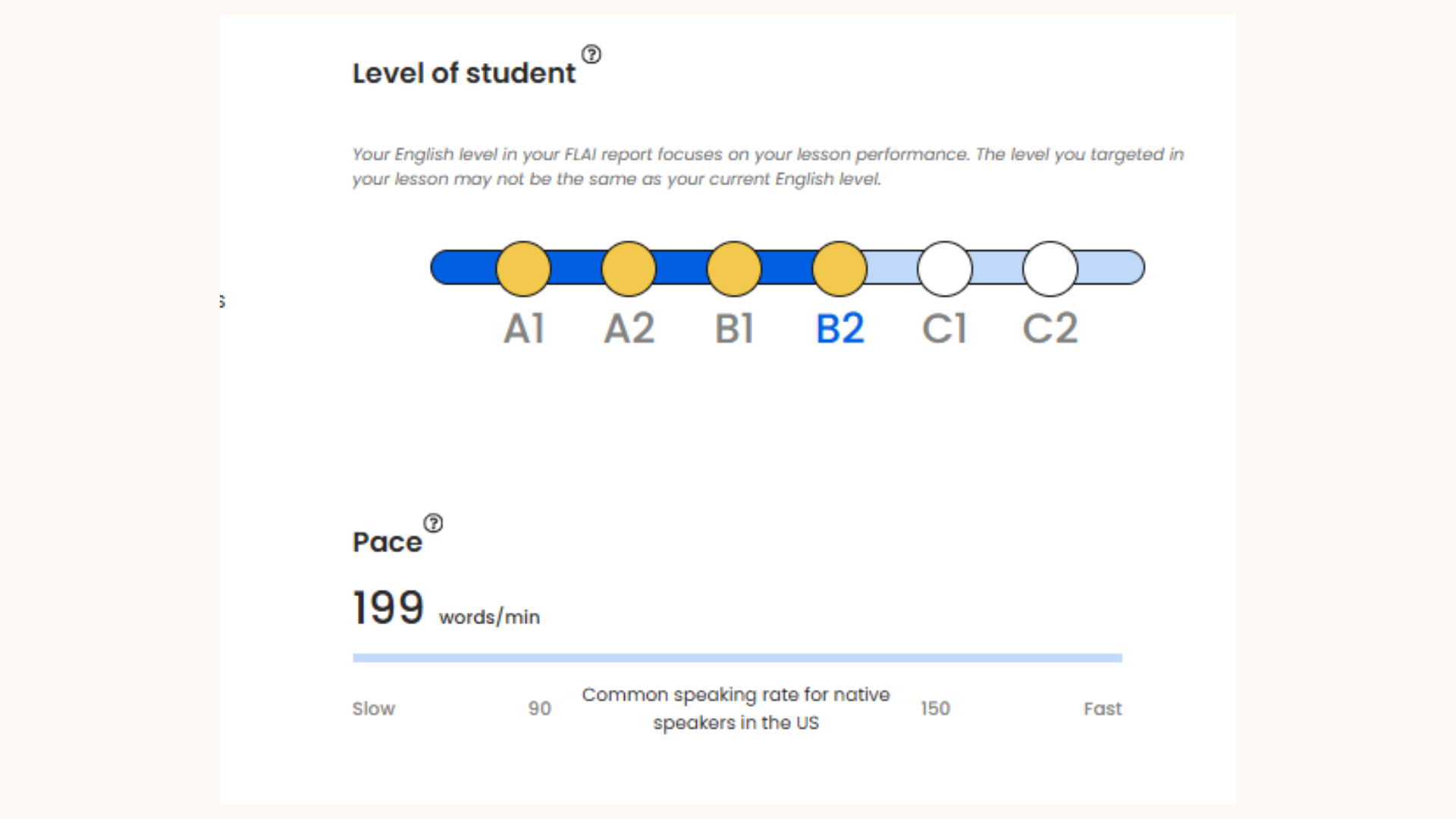
Flalingo’s AI TOEFL preparation approach pairs each live Oxford-based session with FLAI’s post-session analysis, so students see concrete data on their progression toward C1 and C2. The Flalingo FLAI analysis report does not just say you improved. It shows that your C1 word usage increased from 12 per cent to 19 per cent over the last eight sessions, with the specific words highlighted. It also shows your speech and pause rate. Later, the AI generates personalised exercises based on the weak points from the report. Not random exercise, targeting exactly the mistakes made in that lesson.
The report flags which specific skills and which specific vocabulary clusters are dragging your ceiling down. A student might see, on one screen, that her reading is TOEFL-ready at 27, her speaking sits at 22 because of filler words and weak reporting verbs, and that closing the gap means working on six named vocabulary families, not another three months of general English.
Start your TOEFL preparation with a Flalingo specialist
Book your trial session.
Why Does Single Skill Practice Fail Most TOEFL Candidates?
Preparing for the TOEFL skill by skill is the single most common mistake high-scoring candidates regret. The test does not compartmentalise. Neither should your preparation. In the integrated writing task, you need to read, listen, and write in a single 20-minute block. In the integrated speaking tasks, you read, listen, and speak in under 90 seconds of preparation time. The brain learns to shift between receptive and productive skills at academic speed, which is exactly the demand the test places on you.
Flalingo structures its TOEFL sessions around this integration. A single 50-minute lesson might open with an Oxford academic reading passage, move into a related Oxford audio lecture, ask the student to summarise both orally, and close with a short written synthesis that the teacher edits line by line while FLAI tracks vocabulary complexity in the background. This mirrors the test’s cognitive load and trains the transitions most candidates never rehearse.
B1 to B2 is the plateau that stalls most TOEFL journeys. Breaking through it requires exactly the integrated, academically registered input that generic conversation apps cannot provide.
Which Strategies Actually Win Each TOEFL Section?
The students who score above 100 do not use the same strategy across four different sections. They adapt, because reading rewards skimming and pattern recognition, listening rewards hierarchical note taking, speaking rewards compact structure, and writing rewards academic register. The tactics below are the ones experienced TOEFL tutors and ETS official guidance repeatedly surface as decisive.
What Wins the TOEFL Reading Section?
This section rewards structural reading, not word-by-word translation. Treat the passage as a map, locate the question, answer it from the paragraph, and move on.
Skim the first sentence of every paragraph in the first 60 seconds to map the passage structure before touching the questions.
Do inference and rhetorical purpose questions last, since they reward a second pass and eat the clock on a first read.
Learn the 15 recurring question stems (main idea, inference, vocabulary in context, negative fact, insertion, summary) because they repeat across every test.
Target a steady reading pace of 180 to 220 words per minute on academic texts before test day, tested under timer conditions.
How Do You Stop Losing Points in Listening?
Listening is lost in the note-taking, not in the audio itself. Most candidates write too much and understand too little.
Take hierarchical notes rather than linear ones. Main idea on the left, supporting details indented to the right.
Flag tone shifts. Phrases like however, on the other hand, surprisingly, or interestingly signal a test-worthy pivot almost every time.
Capture names, dates, numbers, and contrast markers only. Full sentences cost you the next main point.
Practice with real university lectures (MIT OpenCourseWare, Yale Open Courses) once Oxford listening feels comfortable, to train your ear for native pace.
Why Does Speaking Feel Hardest, and How Do You Pass It
Speaking feels hardest because it is scored on structure plus delivery under 45 seconds of response time. Clear templates and clean pronunciation beat improvisation.
Use a predictable structure for the independent task: state position, give 2 reasons, add 1 brief example per reason, close with a one-sentence restatement.
In the 30 seconds of preparation time, write 4 to 6 noun phrases, never full sentences. You need signposts, not scripts.
Record yourself once a week and listen back. Most candidates use um every 3 seconds without noticing, and raters dock you for it.
Avoid memorised openings. ETS raters are trained to detect scripted responses, and the penalty is heavier than any gain in fluency.
What Separates a Writing Score of 24 From 28?
Writing above 24 is vocabulary and accurate connector use. Grammatical range matters, but vocabulary carries the scoring difference between competent and native adjacent.
In the integrated task, match every point in the lecture to a specific point in the reading. Your structure writes itself once the pairing is clear.
Use reporting verbs that signal stance: argues, contends, disputes, concedes, posits. The verb says signals B1 and costs you points.
In the Writing for Academic Discussion task, add a genuinely new point rather than picking a side between the two student posts the prompt shows you.
Aim for 225 to 275 words on the integrated task and 300 or more on academic discussion, with two to three clean paragraphs, proofread in the final 90 seconds for agreement and article errors.
Why Does Your Tutor’s Academic English Matter More Than Native Status?
An academic English tutor is not the same as a native speaker. The difference shows the first time a student asks, what is the difference between claim, assert, and contend in a TOEFL essay? A native speaker without academic training usually hedges. A tutor trained in the academic register answers precisely: claim flags a position you intend to defend, assert signals a strong statement without proof, contend implies disagreement with a counterview. That kind of granularity, repeated across hundreds of words, is how a student’s writing shifts from B2 to C1.
This is the instructor profile Flalingo filters for on its TOEFL track. Tutors are selected and ongoing trained not only for fluency but for familiarity with academic English registers, the rhetoric of university seminars, and the scoring patterns ETS raters use. Students preparing for Ivy League admissions need a tutor who has read, written, or taught in the register their target university uses, not a conversation partner who is simply a native speaker.
Can You Improve Your TOEFL Score Quickly, or Is This a Long Game?
You can improve a TOEFL exam score quickly, but only if your underlying English already sits at B2 or above. How to improve TOEFL score quickly is the wrong question if your current reading speed is under 150 words per minute on academic texts, or if you cannot follow a five-minute lecture without subtitles. In that case, you need to build your English foundation first, then pivot into test-specific preparation.
For students already at solid B2, moving from 85 to 100 and above is realistic in 10 to 14 weeks with three or four focused sessions per week. ETS’s own tip sheet confirms this pattern, noting that consistent exposure to authentic materials, timed practice under test conditions, and targeted feedback on writing and speaking are the ingredients of rapid gains.
What Does a Realistic 12-Week TOEFL Roadmap Look Like?
A realistic 12-week plan for a student at solid B2 starts with diagnostics, layers academic vocabulary and integrated skills progressively, and finishes with full test simulations. The table below is the cadence Flalingo uses across its 12-week TOEFL track, and it maps to the preparation pattern ETS guidance repeatedly endorses: consistent, authentic, timed, and feedback anchored.
Note: This assumes 3 to 4 focused sessions per week and 6 to 8 hours of independent work between sessions. Students starting from B1 typically need 18 to 24 weeks on the same structure.
The discipline in this roadmap is sequencing, not weekly hours. Front-loading practice tests in week 2 burn through material before the underlying vocabulary is built. Delaying timed practice until week 11 leaves gaps you cannot close. The cadence above layers both, staged against the skill the brain is ready to consolidate that week.
What Does Premium TOEFL Preparation Actually Look Like in Practice?
Premium preparation is not longer preparation or a more expensive one. It is preparation matched to the exact register and format of the test measures. The academic depth the TOEFL demands can only be delivered by a premium education system. With Oxford academic materials and FLAI technology, Flalingo is a global brand carrying students worldwide to their Ivy League goals.
In concrete terms, a premium Flalingo TOEFL preparation session looks like this. Your teacher opens a block with an Oxford academic reading on urbanisation. You read for eight minutes, she checks comprehension with the kind of inference question the TOEFL asks, then plays a three-minute Oxford audio lecture that complicates the passage. You summarise both out loud under a 60-second timer, the way the test requires. She notes two places where you hedged, three where you reached for B1 vocabulary when C1 was available.
After the session, FLAI returns a vocabulary complexity report. Over 12 weeks, your reports trend upward. Your teacher adjusts each session based on the gaps FLAI identifies, and the Oxford curriculum steadily moves you through the topic ranges the actual test draws from: earth sciences, psychology, art history, economics, and contemporary social theory. This is what Flalingo C1-C2 tracking looks like on a weekly basis, and it is also what students mean when they describe a platform as prepared for academic learners rather than casual learners.
The same foundation carries forward. As your academic journey continues abroad, the integrated skills framework and the habit of reaching for academic vocabulary do not disappear at the test centre door. They become the default setting you bring into your first seminar at Stanford, your first essay at Columbia, your first lab report at MIT.
How Should You Actually Choose a TOEFL Preparation Platform?
The TOEFL preparation platform for you should meet five tests: a curriculum anchored in real academic materials, teachers trained in academic English registers, integrated skills practice that mirrors the test format, measurable feedback on vocabulary and structure, and a timeline that respects how long real improvement takes.
Most platforms meet one or two of these. A few meet three. The ones that meet all five are the ones that consistently produce scores above 100. Ask any provider directly. What curriculum do you use, and is it used in accredited university pathway programs? How do you assess vocabulary progression beyond session count? How do your sessions replicate the test’s integrated tasks? What is your average score gain per student over 12 weeks, and can you show the distribution of outcomes?
Flalingo was built around these questions. Oxford materials for authentic academic input. Teachers trained in academic English registers. Integrated session design that mirrors the test. FLAI for vocabulary tracking and C1 to C2 progression data.
Start your TOEFL preparation with a Flalingo specialist
Book your trial session.
Other content that may interest you



Hi, I'm Glory. Teaching English is one of the most rewarding experiences of my life as I get to meet people from different cultures and help them express themselves with confidence. At Flalingo, I take care to create pleasant and relaxed teaching environments where students can speak without fear of making mistakes. My greatest happiness is witnessing the moments when my students realise that they are really making progress.
English with Flalingo

Learning English with Flalingo means progressing with an intelligent system that works in an integrated manner.