
IELTS Preparation That Actually Works: How Expert Tutors and AI Feedback Get You to Your Target Score

Most IELTS candidates who plateau at Band 6 or 6.5 share the same pattern. They speak English well enough for meetings, emails, and everyday conversation, but the score report keeps showing the same number. IELTS preparation online only works when it starts from this gap between general fluency and exam-specific performance.
The test grades against four published criteria in Speaking, a precise Task Response in Writing, and a question-type strategy in Reading and Listening. These are narrow skills, and they respond to targeted coaching, not to more conversation practice.
This article walks through what serious preparation actually looks like in 2026. The role of IELTS-certified tutors who have read thousands of responses against the band descriptors, the value of IELTS mock test online sessions that replicate exam-day conditions, AI feedback that tracks your progress session by session, and section-specific strategies for Speaking, Writing, Reading, and Listening. If you are preparing for university admission, skilled migration, professional licensure, or a visa condition, this is the framework that separates candidates who hit their band from those who retake.
The shift in online IELTS coaching over the past three years has been significant. Pattern recognition that once required an examiner sitting across from you is now partly automated. That change has lowered the cost of reaching Band 7 considerably, provided you choose a platform where the AI supports human expertise instead of replacing it. What follows is how to prepare with that kind of platform, and why the combination consistently outperforms either approach on its own.
What Makes IELTS Preparation Different from Learning English?
IELTS preparation is different from general English study because IELTS grades you against fixed band descriptors in four sections, and the skills that move you from Band 6 to Band 7 are rarely the skills that made you conversational in the first place. A candidate who holds a one-hour chat comfortably with native speakers may still cap at Band 6.5 in Speaking, because the exam measures very specific features like paraphrase range, accuracy under time pressure, and the density of higher-level grammar in spontaneous speech.
To make the gap concrete, here is what IELTS demands according to the official sources, on top of everyday fluency:
- Band-descriptor awareness: Knowing exactly which features of your speech or writing define Band 6 versus Band 7, and which ones you are missing.
- Paraphrase inventory: A stored repertoire of synonyms and restatements for the topics of the exam circles: education, technology, environment, health, and globalisation.
- Task Response structure: The habit of answering exactly what Task 1 and Task 2 ask, in the format they ask for, rather than writing around the topic.
- Question-type strategy: A specific approach for each Reading and Listening format, from Matching Headings to True/False/Not Given to Multiple Choice.
- Discourse markers: Transition phrases that signal coherence to the examiner: on balance, having said that, moreover, in contrast.
- Time discipline: The ability to plan, draft, and review under fixed time limits that do not exist in everyday conversation or writing.
Think of general English fluency as your foundation. It lets you participate in a lesson without constant translation, which is where real improvement begins. The IELTS exam then asks you to add the six skills above on top of that foundation. Candidates reach advanced conversational fluency every day without ever learning how to structure an IELTS Writing Task 2 introduction. That gap is where preparation earns its value, and why the right coaching for this exam looks nothing like a general English course.
What Do IELTS Band Scores Actually Mean, and How Are They Calculated?
IELTS band scores describe your English proficiency on a nine-point scale, where each band represents a defined level of accuracy, range, fluency, and coherence. Your overall band is the average of your four section scores, rounded to the nearest half band, as set out in the British Council's scoring framework. Listening and Reading convert a raw score out of 40 into a band, while Speaking and Writing are marked against four published criteria each, according to the IELTS results guide.
Knowing which band you need is step one; understanding what each band actually looks like is step two, and most candidates skip it. The table below pairs each band with the official descriptor language that examiners use when marking your performance.
The gap between Band 6 and Band 7 is narrower than candidates often imagine, but it is also more specific. It is the gap between a competent user who makes some errors and a good user who handles complex language with occasional slips. Closing it usually means fixing two or three habits, not rebuilding your English. A Band 6.5 candidate might need to widen vocabulary beyond a familiar set of adjectives, reduce fillers that break fluency, or include one or two complex sentence structures per Part 2 response. These are coaching problems, not language problems.
Who Should Teach You IELTS if You Want Band 7 Or Higher?
The best IELTS tutor is someone who knows the public band descriptors as intimately as they know the language, ideally a former examiner or a specialist who marks against those descriptors weekly. General English teachers support communication. IELTS specialists diagnose which feature of your Speaking or Writing is capping your band, then coach that feature directly until the pattern shifts.
What sets IELTS-specific tutors apart is calibration. They have heard what a Band 6 Speaking response sounds like hundreds of times. They recognise, within the first two minutes of a Part 1 exchange, whether a candidate's fluency is genuinely at Band 7 or whether it is being carried by three memorised openings that will collapse under the unpredictable questions in Part 3. Pattern recognition at that level is not something a strong English speaker can deliver without exam training, and it is the difference between practice that moves your band and practice that does not.
There is also a geographic dimension that matters more than candidates realise. A student heading to Melbourne for postgraduate study practices listening comprehension very differently when working with an Australian tutor week after week. Speed of delivery, vowel sounds, and tonal contour all shift. A learner preparing for UK settlement benefits from tutors whose accents match what they will actually encounter at the border and in the lecture hall. Flalingo IELTS preparation draws from a global expert tutor pool, which lets candidates match their instructor not only to their skill gap, but to their destination country. A student bound for Australia can practice with an Australian tutor at the real pace and cadence of daily life there, before the Erasmus plane even lands.
Cost matters too, and candidates are right to weigh it. Private IELTS coaching from a certified specialist in London, Sydney, or Toronto often runs into hundreds of dollars per hour. Online platforms with IELTS-certified tutors offer that cost without compromising the quality of instruction.
Can Mock Tests Really Simulate The Pressure Of Exam Day?
A well-run online IELTS mock test replicates the exam day experience closely enough to shift your preparation from content review to performance training. Exam-day pressure is a separate variable from language skills. Candidates who only practice under relaxed or familiar conditions often underperform their preparation score by half a band under real conditions, a phenomenon the University of Melbourne's exam anxiety resources trace back to unfamiliarity with the format.
A serious mock test compresses time, imposes unfamiliar question topics, and removes the option to pause. Reading forces you to triage sixty minutes across three passages. Speaking gives you one minute of preparation before a two-minute monologue, followed by unpredictable follow-up questions in Part 3. Writing demands a 250-word Task 2 essay in forty minutes with no outline time. The British Council test format page describes these constraints in detail, and the more closely your practice matches them, the less room exam-day surprise has to take points off your score.
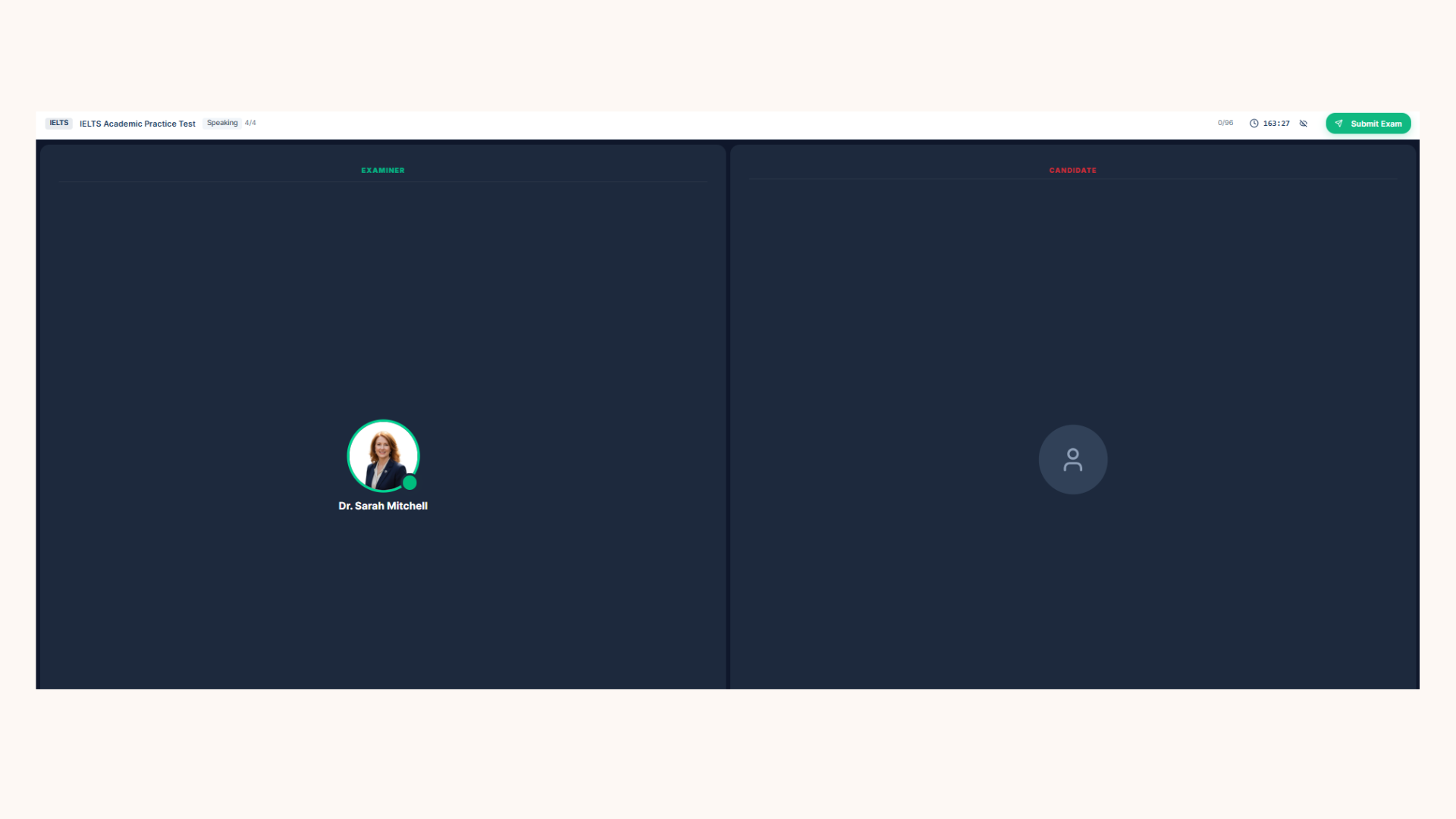
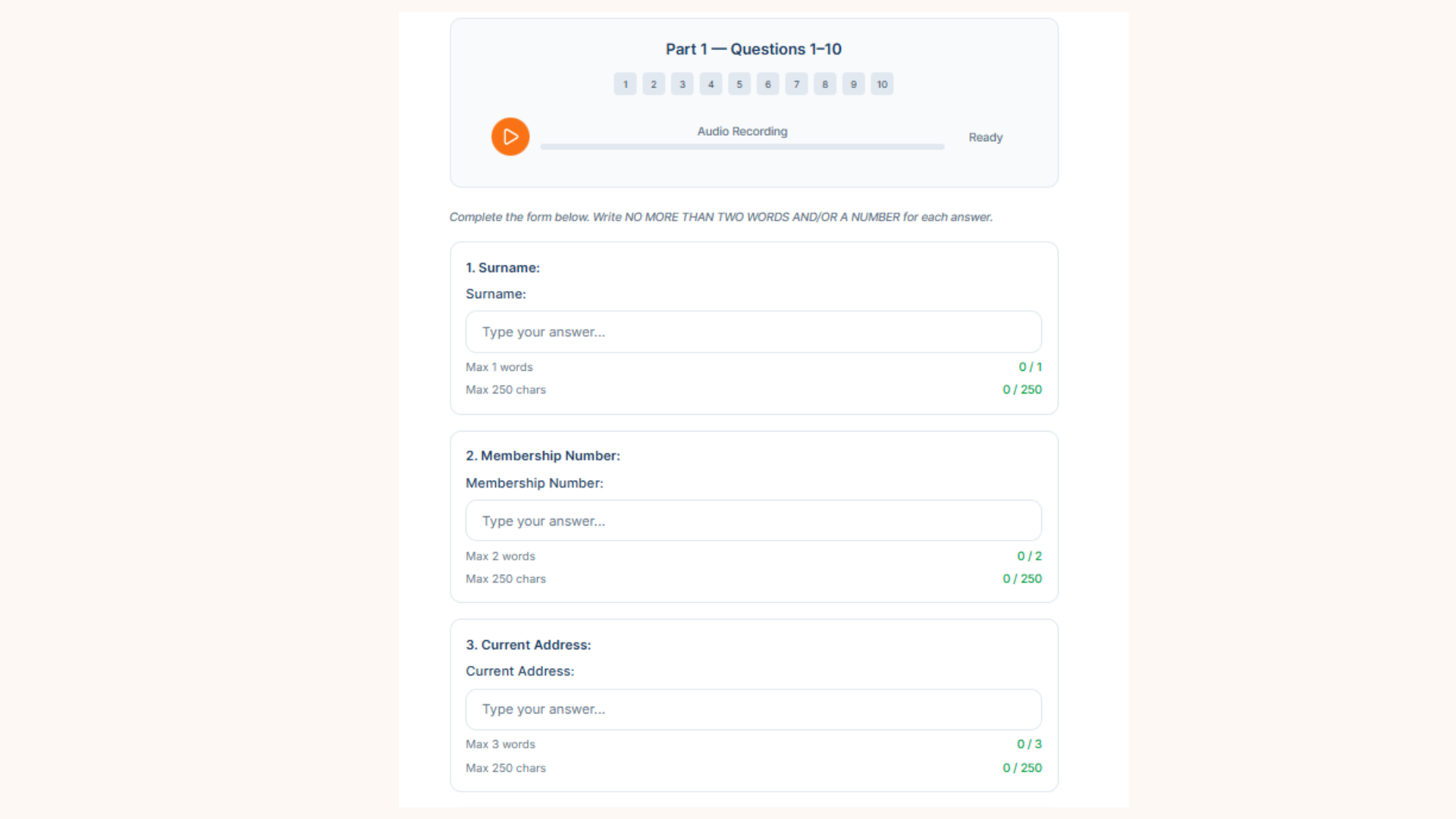
Weekly mock sessions make the difference. Flalingo IELTS mock test sessions run regularly, and are built to the real exam format and scored against the official band criteria. Candidates can take the full four-section test or stress-test a single section they need to strengthen.
What makes a mock session valuable is what happens after the clock stops. A mock test without a descriptor-based debrief is just an exam in disguise. The debrief, where the tutor walks through exactly where your Task Response scored 6.5 instead of 7, or which two pronunciation features slipped into Band 6, is where the learning compounds. Furkan's point stands out here: he asked for a simulation, the tutor responded with real IELTS exam content, and the session became performance practice rather than conversation practice. That is the core mechanic of preparation that actually moves your score.
What does a weekly mock test schedule actually look like?
A twelve-week mock test schedule balances full-length simulations with targeted section retests, and builds in weeks where the only goal is consolidating feedback. The table below maps out the cycle that most candidates aiming to climb from Band 6 to Band 7 follow with their tutor.
How the debrief is structured matters as much as the schedule. After each mock, the review should cover four things in order: the raw result, the criterion-by-criterion breakdown, the three most important patterns to fix before the next mock, and one concrete drill to bring into the following week's sessions. Anything less than that and the mock turns into a score, not a lesson.
Book your first IELTS-focused session with a certified Flalingo specialist
Trial available.
How Do You Master IELTS Speaking Part 2's One-Minute Monologue?
IELTS Speaking Part 2 rewards candidates who can structure an extended response around a cue card and fill it with natural fluency, specific examples, and a range of vocabulary. The one-minute preparation window is not enough time to write a monologue, so what candidates actually need is a repeatable framework they can apply to any topic, from a favourite meal to a time they disagreed with a colleague.
The cue card itself provides the scaffold. Every Part 2 prompt follows a main topic plus three or four guiding bullets (who, what, when, why), which is explained fully in the IDP Speaking band descriptor guide. Coaching for Part 2 usually comes down to two things. One, training candidates to treat those bullets as a skeleton rather than a script. Two, teaching extension techniques so that when the candidate runs out of content at ninety seconds, they can elaborate with a concrete example, a contrasting scenario, or a short reflection rather than drifting into silence.
The most useful framework breaks the two-minute response into four intervals of roughly thirty seconds each, with a specific purpose for each chunk. The table below shows how to allocate your time and what to say in each phase.
Working with a specialist on IELTS Part 2 practice targets the specific fluency features the band descriptors care about. A tutor listening to your Part 2 can catch whether you are losing points on coherence (weak transitions between ideas), on lexical resource (three or four key words recycled constantly), or on fluency (hesitations longer than three seconds, or filler clusters that break rhythm). Recording those sessions and reviewing them with your tutor gives you a second pass through your own performance, which is often where the real pattern surfaces.
There is one layer tutors cannot easily catch at normal listening speed, but AI can. Micro-fillers like "um," "like," and "you know" appear four to six times per minute in typical Band 6 Part 2 responses, and drop to under two per minute in Band 7.5 responses. That is a measurable distribution, not a vibe, and it shows up cleanly in automated analysis across multiple sessions. Pairing human coaching with AI pattern detection is how candidates close the last half-band on Part 2.
What Does a Section-by-Section IELTS Strategy Look Like?
Each IELTS section rewards different skills, and efficient preparation allocates your practice time according to where your band gap is largest. The IDP IELTS preparation hub recommends diagnostic testing before committing to a study plan, a principle that saves candidates weeks of untargeted work. Below is how to think about each section once you know your starting band.
Speaking: The Four Criteria That Decide Your Band
Raising your Speaking score starts with identifying which of the four criteria is dragging your average. The British Council Speaking band descriptors describe each band precisely, and most candidates are weaker in one or two criteria rather than all four. A diagnostic session with a specialist tells you where to focus, so that the next six weeks of practice target the right thing instead of adding general conversation hours that do not move your band.
Practice should prioritise extended monologue (Part 2), argumentative response (Part 3), and topic-adjacent vocabulary. Record yourself weekly. Listen back for repeated linkers like "so" and "and then," which cap coherence at Band 6. A specialist tutor introduces a wider range of discourse markers (however, moreover, on balance, having said that) and drills them until they feel natural rather than forced.
Pronunciation is the criterion that candidates most often underestimate. Band 7 pronunciation does not mean a neutral or native-like accent. It means features like word stress, sentence stress, intonation across questions and statements, and clear individual sounds that do not cause the examiner to strain.
Finally, session volume matters. IELTS speaking practice with fewer than three weekly sessions rarely produces measurable band movement. Three to four per week, plus independent recording and review, is the minimum load that consistently shifts scores.
Writing: Why Task Response Often Matters More Than Vocabulary
Writing Task 2 at Band 7 requires a clear position throughout the essay, fully developed main ideas, a wide vocabulary used with precise word choice, and a range of grammatical structures with good control. Candidates aiming for Band 7 usually need to rework paragraph architecture rather than grammar, which is the part most self-study programs get wrong. Heavy vocabulary with a weak answer to the prompt still scores Band 6, because Task Response is the criterion that governs whether you answered the right question at all.
The structure that consistently scores well is familiar: an introduction with a clear thesis, two body paragraphs each developing one main idea with a specific supporting example, and a conclusion that restates the position without introducing new ideas. The British Council Writing band descriptors make clear that Task Response, not vocabulary, is often the criterion that blocks Band 7. Writing fewer words with a sharper position beats writing more words with a vague one, every time.
Task 1 has its own rules and its own criterion: Task Achievement. Academic candidates describe charts, graphs, processes, or maps in 150 words within twenty minutes. The winning habit is organising your description around trends and comparisons rather than sequentially listing every data point. General Training candidates write a letter, where tone (formal, semi-formal, informal) is scored as part of Task Achievement, and choosing the wrong register costs a clear half-band.
Reading: Strategy Over Raw Reading Speed
IELTS Reading rewards a question-type strategy more than general reading skill. Sixty minutes, three passages, forty questions, and every question type has its own efficient approach. The IDP IELTS Reading tips guide breaks down the main techniques, and candidates who internalise them tend to gain half a band within three weeks, without becoming any faster readers in the general sense.
Skim each passage first for structure, which usually takes about two minutes. Read the questions second. Scan the passage for keywords that match the question language. Matching Headings questions reward identifying the controlling idea of each paragraph, not a surface keyword match. True/False/Not Given questions penalise candidates who read into the passage what it does not actually state. The winning skill is paraphrase recognition: correct answers are almost always paraphrases of the question stem, and the more paraphrase pairs you have in mental storage, the faster the matching happens.
Listening: The Cheapest Band To Raise Once You Know How
Listening is often the section where a focused month of practice produces the largest band jump, because the skills involved are narrow and trainable. Band 7 on Listening goes to candidates who demonstrate concentration across all four sections, catch signposting words (however, on the other hand, finally, in contrast), and spell common academic terms correctly. Spelling errors cost you marks on otherwise correct answers, as the IDP common spelling mistakes guide documents in detail.
Practice with a range of accents, not just the one you studied in school. The exam uses British, Australian, American, New Zealand, and other native-speaker voices, and candidates who have only trained on one accent often miss answers in sections with unfamiliar vowel sounds. Listening Section 4 is a single academic lecture with no pauses, which demands note-taking stamina that many candidates have not built. A reliable training method is listening to academic podcasts at 1.25x playback speed to push your comprehension ceiling, then dropping back to normal speed for the actual test. The speed differential makes the real exam feel slower than your practice, which reduces cognitive load on exam day.
Use the ten-minute transfer time at the end of the test deliberately. Double-check your spelling on every word answer. Confirm that numerical answers match the question format exactly (for example, "Write no more than two words and a number" is a trap that catches candidates who write out the number in words).
Can AI feedback spot what a tutor misses between sessions?
AI feedback identifies patterns across multiple sessions that a tutor cannot track in real time, and evaluates them against the same band descriptors examiners use. Human tutors catch individual errors during a lesson. AI catches the distribution of those errors across ten lessons, which is where fossilised mistakes reveal themselves and where targeted coaching becomes possible.
Flalingo FLAI speaking analysis runs after every session and evaluates performance across the four official Speaking criteria: Fluency and Coherence, Lexical Resource, Grammatical Range and Accuracy, and Pronunciation. The output is specific enough to act on.
A candidate sees, for example, that Grammatical Range and Accuracy has held at Band 6.5 for five sessions because the same three structural errors keep recurring. A child learner said "goed" instead of "went" on Tuesday. On Wednesday, the FLAI report flagged it. On Thursday, the teacher targeted it directly in the lesson. That is the loop that breaks fossilised errors, and it is invisible without AI pattern tracking. For adult candidates, the stakes are higher because the fossilisation is deeper. A learner who has said "I am agree" for fifteen years will not stop saying it because a tutor corrects it once. They stop when they see it flagged across three consecutive FLAI reports, hear it during session playback, and work through targeted drills on that specific structure.
Band progression tracking is the other function that AI IELTS feedback delivers consistently. A candidate moving from Band 5.5 to Band 7 on Speaking sees the slope of that climb visually, session by session, criterion by criterion. When progress stalls, the report shows which of the four criteria has plateaued, so the next session targets that criterion specifically. It replaces the guesswork that most candidates live with between lessons, and it is the closest thing to studying with a permanent examiner in the room.
Which IELTS Mistakes Quietly Sabotage Otherwise Strong Candidates?
Most candidates who miss their target band make three to five repeatable mistakes, and the pattern is well-documented. The British Council's common IELTS mistakes guide catalogues the recurring issues across all four sections. Strong candidates tend to lose marks on executable details rather than on fundamental English ability. The table below lists the mistakes specialist IELTS tutors see most often, paired with how focused coaching addresses each one.
Preparation for a global exam like IELTS cannot be left to chance. Flalingo is the world's leading online education platform in its field, with certified exam-specialist tutors who guide students from every corner of the world to the scores they aim for.
The best time to start is eight to twelve weeks before your test date. That window gives enough time to diagnose, target, and drill the specific features capping your score, without stretching into the zone where motivation drops, and knowledge fades. Shorter windows work if your starting band is close to the target, longer windows work if you are moving more than one band. And once you have your score, prepare for life abroad: the settlement interviews, university onboarding sessions, clinical or professional licensure exams, and the practical daily English you will use in a new country.
Book your first IELTS-focused session with a certified Flalingo specialist
Trial available.
Other content that may interest you




I'm Bright. I am a British-Nigerian English teacher with seven years of experience. I create engaging and tailored lessons that build confidence and fluency to support students to achieve their goals. My aim is to unlock the potential of students from different cultures, making the learning process both efficient and enjoyable.
English with Flalingo

Learning English with Flalingo means progressing with an intelligent system that works in an integrated manner.