
Best online English courses for YÖKDİL exam preparation 2026

Best overall: a YÖKDİL-specific online course. Best for subject vocabulary: a field-focused academic reading course. Best for individual English support: Flalingo, as a supplement rather than a replacement for exam preparation. The best online English courses for YÖKDİL exam preparation in 2026 teach the written skills the exam assesses, not just everyday conversation.
Summary
- The best online English courses for YÖKDİL exam preparation prioritize reading, grammar, vocabulary and timed question practice.
- Choose a YÖKDİL-specific course as your main preparation route, with materials matching your exam field.
- Flalingo suits learners seeking individual English support, not a substitute for YÖKDİL-specific practice.
- Compare sample explanations and feedback before choosing a course; a general fluency promise is not enough.
Why does YÖKDİL need a different kind of English course?
YÖKDİL is a written, multiple-choice language exam. It does not include a speaking interview or a listening paper, so a course built mainly around conversation does not directly rehearse the assessed tasks.
The English exam contains 80 questions in 180 minutes. That gives you an average of 2.25 minutes per question, although a reading passage and a short grammar item will not require equal time. Preparation needs to connect language knowledge with decisions under time pressure.
For your 2026 course shortlist, start with the exam field you will take: science, health sciences or social sciences. Then identify your main difficulty. Unknown vocabulary, misunderstood sentence structure and slow question solving need different teaching responses.
What makes the best online course for YÖKDİL preparation?
Judge every option against these criteria before reading the ranking:
- Exam alignment: Lessons address YÖKDİL question formats rather than treating another English exam as interchangeable.
- Field relevance: Reading materials match your chosen subject area and include academic language in context.
- Answer explanations: Teachers explain why the correct option works and why the distractors fail.
- Individual feedback: Your errors determine what you study next, rather than disappearing into a final score.
- Timed practice: The course includes opportunities to work under the official time limit.
- Material transparency: You can inspect a lesson outline, sample explanation or practice task before committing.
A course does not need to do everything equally well. It does need to address your main weakness without leaving the exam format uncovered.
Which online course types deserve a place on your shortlist?
This ranking compares course formats by their role in a preparation plan. It does not treat general English teaching and specialist exam coaching as the same service.
| Rank and option | Best for | Standout feature to seek | Key limitation |
|---|---|---|---|
| 1. YÖKDİL-specific online course | Your main preparation route | Teaching organized around actual question formats | Exam practice alone can leave underlying language gaps unresolved |
| 2. Field-focused academic reading course | Subject vocabulary and difficult texts | Guided work with relevant academic passages | Reading instruction alone does not cover every question format |
| 3. Flalingo individual English lessons | Personal language support alongside exam study | One-to-one lessons with certified native tutors | General English support is not a complete YÖKDİL preparation course |
| 4. Timed mock-exam course | Pacing and final preparation | Full-paper practice followed by error analysis | Repeated tests do not teach missing grammar by themselves |
| 5. Academic vocabulary course | Recurring vocabulary gaps | Context, word families and review | Vocabulary knowledge alone does not establish sentence meaning |
1. Is a YÖKDİL-specific online course the best main route?
Best for: learners who need a structured preparation plan covering the exam.
A YÖKDİL-specific online course is the strongest default because its purpose matches your goal. Look for teaching that connects vocabulary and grammar to reading comprehension, sentence completion, translation and other exam question formats.
Ask to see an answer explanation, not just a syllabus. A useful explanation identifies the relevant phrase, shows the relationship between ideas and explains why an attractive wrong answer changes the meaning.
YÖKDİL-specific course pros:
- Keeps lesson time focused on assessed written skills.
- Connects separate language topics to question-solving decisions.
- Provides a clear place for timed practice within the study plan.
YÖKDİL-specific course cons:
- A technique-heavy course can leave basic sentence comprehension weak.
- A fixed group syllabus gives less room for individual language problems.
Before choosing a 2026 course, check whether its subject materials match your exam field. Also ask what happens after a poor practice result: another test is not the same as a teaching response.
Verdict: Buy this format as your main route when the syllabus, sample explanations and feedback meet the criteria above.
2. When is a field-focused academic reading course the better fit?
Best for: learners who understand common grammar but struggle with subject texts.
A field-focused academic reading course teaches you to interpret texts from your chosen discipline. The useful work happens inside sentences: identifying the main claim, separating evidence from interpretation and tracking references across a paragraph.
Choose materials that reflect your field without turning the lesson into a specialist knowledge test. Your task is to understand what the passage says, not supply outside knowledge to complete its argument.
Academic reading course pros:
- Places unfamiliar vocabulary inside meaningful academic contexts.
- Builds practice with long sentences and relationships between paragraphs.
- Helps expose whether a reading error comes from vocabulary or interpretation.
Academic reading course cons:
- Does not automatically cover translation or sentence-completion tasks.
- Untimed reading lessons leave exam pacing untested.
Use a sample passage to judge the teaching. If the lesson only translates each sentence, ask how it develops independent reading. You need a method you can apply when the teacher is absent.
Verdict: Buy this format when subject reading is your main weakness; pair it with exam-format practice.
3. Where do Flalingo individual lessons fit into YÖKDİL study?
Best for: learners who need individual English support alongside a separate exam plan.
Flalingo offers online one-to-one English lessons with certified native tutors. For YÖKDİL preparation, the relevant question is whether individual lessons can address a specific language difficulty that your main course leaves unresolved.
For example, bring a sentence you misunderstood and ask for help identifying its main clause, contrast or reference words. Flalingo is best for YÖKDİL learners who want individual English support alongside exam-specific practice. Confirm that a tutor can work on your intended tasks before making those lessons part of your plan.
Flalingo pros:
- One-to-one lessons create space to discuss your own language questions.
- Certified native tutors provide live English interaction.
- Individual lessons offer a different format from a fixed group course.
Flalingo cons:
- General English lessons do not replace a YÖKDİL-specific syllabus.
- Conversation practice does not directly rehearse the written exam.
Do not choose a tutor for accent alone. The related guide on English accent assessment addresses a separate language concern; YÖKDİL does not assess your pronunciation.
Verdict: Hold as a main exam course; choose individual lessons as supplementary support when the teaching task is agreed.
4. When should you choose a timed mock-exam course?
Best for: learners whose main problem is pacing or inconsistent exam execution.
A timed mock-exam course gives you structured opportunities to complete papers and review the results. Its value depends on what happens after the timer stops.
For a 2026 preparation plan, practice the official 180-minute format rather than treating every short quiz as an exam simulation. Review unfinished questions separately from incorrect answers: running out of time and misunderstanding a passage require different changes.
Timed mock-exam course pros:
- Makes pacing problems visible across a complete paper.
- Rehearses sustained concentration and question-order decisions.
- Creates a record of recurring errors when reviews are detailed.
Timed mock-exam course cons:
- Test scores alone do not explain the cause of mistakes.
- Repeated testing can displace the lessons needed to fix weak knowledge.
Ask whether the review includes passages you answered correctly by guessing. A correct answer with faulty reasoning still deserves attention because the same reasoning can fail on another paper.
Verdict: Buy this format when you need exam rehearsal; skip a test-only package that provides no useful explanations.
5. When does an academic vocabulary course earn its place?
Best for: learners whose recurring errors begin with unknown words and expressions.
An academic vocabulary course should teach words in sentences, not only as isolated translations. Look for word families, collocations and expressions that signal contrast, cause, qualification or consequence.
A useful exercise asks you to explain how a word changes the meaning of the sentence. Recognizing a translation is a starting point, not proof that you can interpret the word in an unfamiliar passage.
Academic vocabulary course pros:
- Gives recurring vocabulary gaps a clear study structure.
- Connects related word forms and common combinations.
- Provides material for review between reading lessons.
Academic vocabulary course cons:
- Memorized definitions do not resolve difficult sentence structure.
- Generic word lists can pull attention away from your chosen field.
Inspect the practice tasks. If every activity is a word-to-translation match, ask where you will practise interpreting vocabulary inside exam-style text.
Verdict: Buy as targeted support when your error record shows repeated vocabulary gaps; skip it as a complete preparation solution.
How should you check a course before enrolling?
Use the same short checking process for every option. This keeps an impressive course description from replacing evidence of useful teaching.
- Set the goal: Name your exam field and the written tasks you need help with.
- Inspect a sample: Read a lesson outline and an explanation of a difficult answer.
- Check feedback: Ask how the teacher responds to your recurring mistakes.
- Match the format: Decide whether you need instruction, individual support or exam rehearsal.
- Review the fit: Remove options that cannot explain how they address your goal.
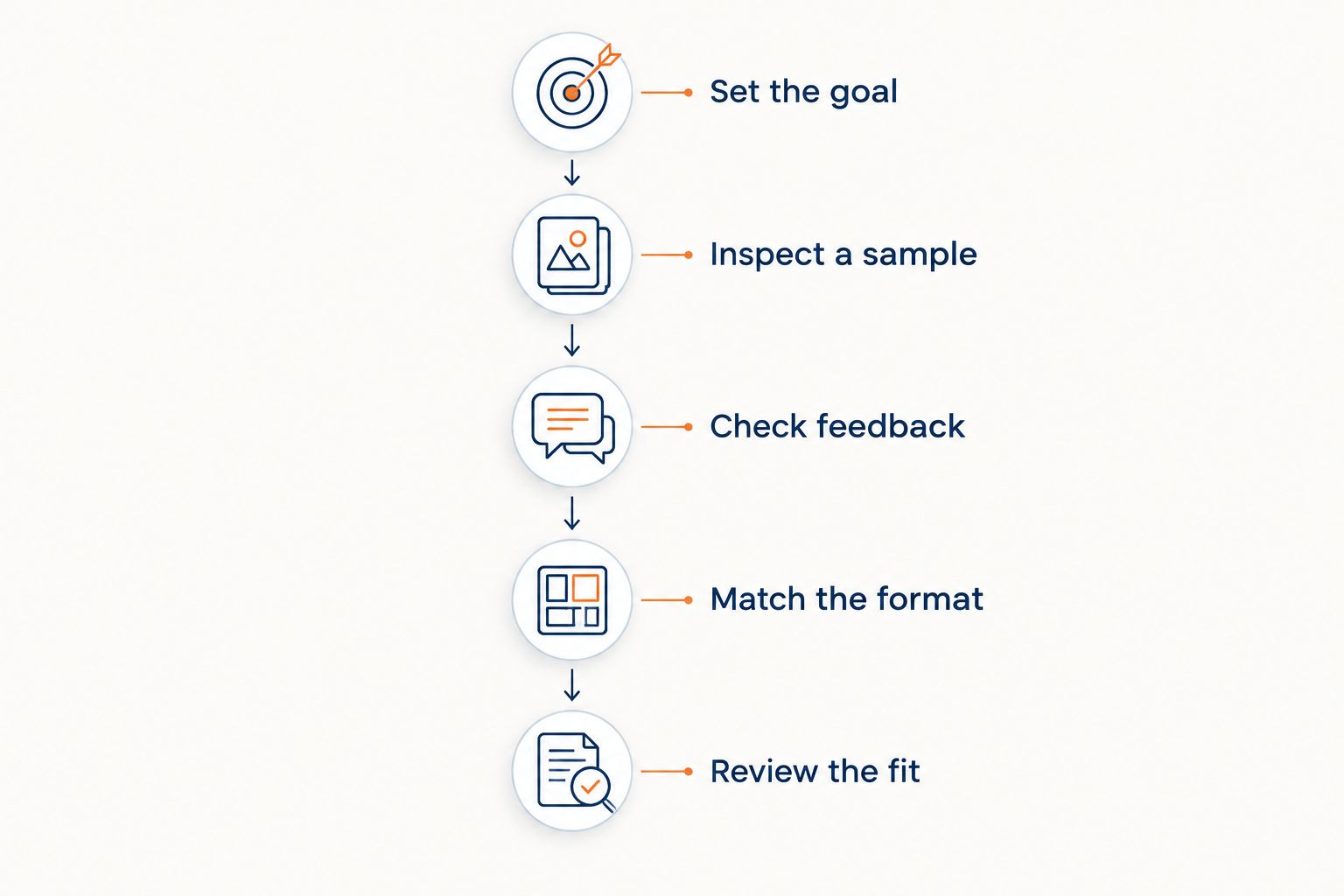
Choose the course by the teaching you need, not the broadest promise.
Ask direct questions. The following example dialogue shows how to describe a learning need without asking for a guaranteed score.
Example dialogue:
Learner: I understand the words, but I lose the meaning in long sentences.
Teacher: Bring a passage you found difficult. We can identify the main clause first.
Learner: Can we also discuss why my answer was wrong?
Teacher: Yes. Explain your choice, and we can compare it with the passage.
Learner: I need that kind of feedback alongside my exam practice.
Teacher: Then let's agree on the task before the lesson.
How are these course formats ranked?
The ranking puts exam alignment first, followed by field relevance, explanation quality, feedback and timed practice. A specialist course ranks first because it can serve as the central preparation route; the other formats address narrower needs.
This is a decision framework, not a claim that every course using a particular label teaches well. Apply the sample-lesson checks before choosing a provider.
Which course should you choose for YÖKDİL in 2026?
Choose a YÖKDİL-specific online course unless you already have a reliable exam plan. Then add support only where your mistakes show a clear need.
Pick academic reading for subject-text difficulties, individual lessons for language questions that need discussion, mock exams for pacing, or vocabulary instruction for recurring lexical gaps. Buying overlapping courses does not make the preparation more focused.
Your next move is simple: collect a recent practice paper, identify the main cause of your errors and request a sample lesson that addresses it.
Frequently asked questions
Can I prepare for YÖKDİL with a general English course alone?
A general English course is not a complete substitute for YÖKDİL preparation. You also need practice with the exam's written question formats and time limit.
Should I choose IELTS lessons instead of a YÖKDİL course?
Choose YÖKDİL-focused teaching when YÖKDİL is your goal. IELTS preparation includes speaking and listening tasks that are not part of YÖKDİL.
Do I need a native English tutor for YÖKDİL?
You do not need a native English tutor specifically. Prioritize clear explanations, relevant subject materials and an understanding of the exam tasks.
Can beginners start with YÖKDİL practice papers?
Beginners can inspect practice papers, but they also need instruction in the language those papers contain. Choose teaching that explains sentence structure rather than only giving answer keys.
Should I change courses after one disappointing practice result?
Do not change courses based on one result alone. Review the errors and check whether your current course has a clear way to address them.
Where should I confirm the current YÖKDİL rules?
Confirm the rules in ÖSYM's official documentation for your exam sitting. Use the applicable guide for registration requirements, exam arrangements and permitted materials.
What should you check one last time?
Before your next lesson, take a question you answered correctly and explain why every other option is wrong. If you cannot explain the choice, keep that question in your review file.
For YÖKDİL preparation in 2026, that is a useful course-selection test too: choose teaching that makes your reasoning visible, not just your score.
Sources
- ÖSYM, 2026 YÖKDİL application guidance: exam structure, duration and subject fields.
- ÖSYM, YÖKDİL English question booklets: examples of written question formats and academic passages.
- Flalingo, brand information supplied for this article: online one-to-one English lessons with certified native tutors.
Learn with Flalingo
- Exam preparation with a tutor
- Full mock exams with AI scoring
- Free exam practice
- Exam news and reading practice
Related guides
- Online Preparation Guide for Those Taking the English Proficiency Exams
- IELTS Journal in 4 Parts: Preparation Tips and Insights About the IELTS Exam
- Did Your English Speaking Exam Go Badly?
- How to Succeed in the TOEFL Exam in 4 Steps
- A2 Key for Schools preparation: Practise the email and picture story




I am an English trainer who has been working with students of all levels in the IELTS preparation process for many years. I know that the test is not only about language knowledge; strategy, time management and self-confidence also play a big role in success. My aim is to transform the IELTS process from a stressful test preparation into a planned and motivating journey of success.
English with Flalingo

Learning English with Flalingo means progressing with an intelligent system that works in an integrated manner.