
Best online English courses for YDS exam preparation 2026

Best overall: a live, YDS-focused online course. Best for targeted weaknesses: individual reading tuition. Best for independent study: a structured self-paced YDS course. The best online English courses for YDS exam preparation in 2026 teach you to interpret written English, explain answer choices and manage exam time, rather than simply practise conversation.
Summary
- The best online English courses for YDS exam preparation prioritise reading, vocabulary, grammar and explained exam practice.
- Choose live YDS teaching for structure, individual tuition for specific weaknesses, or self-paced study for flexibility.
- Flalingo suits learners seeking certified native tutors alongside a separate, exam-focused YDS preparation plan.
- Judge a course by its sample explanations and feedback, not promises of a particular score.
Why does your YDS course choice matter?
YDS preparation and general English study overlap, but they are not interchangeable. Understanding a conversation does not automatically prepare you to distinguish between closely worded written answers under time pressure.
Choose your course around the task you need to perform. A useful lesson explains why a sentence means what it means, which words establish the relationship between ideas, and why an attractive answer is wrong.
Pronunciation work serves a different purpose. If you are considering accent analysis alongside exam study, the guide to whether technology can accurately detect your English accent helps separate that activity from reading-based preparation.
What makes an online course suitable for YDS?
Compare these course formats against the same criteria. The ranking below is a decision guide to teaching approaches, not a ranking of providers claiming verified YDS results.
- Exam alignment: Lessons should use YDS-style written tasks, not treat general conversation as exam preparation.
- Answer explanations: Teaching should explain the correct choice and the specific problem with each distractor.
- Language foundations: Vocabulary, sentence structure and reading instruction should support question practice.
- Useful feedback: Corrections should identify whether an error came from meaning, grammar, inference or time management.
- Practice quality: Exercises should include unfamiliar passages, so success does not depend on remembering an earlier answer.
- Study fit: The format should suit your starting point, schedule and ability to work independently.
For your 2026 shortlist, request a sample lesson before choosing. Watch how the teacher handles a difficult passage. A translation alone is not an explanation of how to answer the question.
Which YDS course format is best at a glance?
| Ranked course format | Best for | Standout teaching feature to seek | Key limitation |
|---|---|---|---|
| Live YDS-focused online course | Learners needing a complete exam-study structure | Guided question analysis with a planned syllabus | A shared pace cannot address every individual gap |
| Individual reading tuition | Learners with recurring, identifiable weaknesses | Feedback on your own reasoning | The tutor needs specific knowledge of YDS tasks |
| Structured self-paced YDS course | Independent learners with changing schedules | Organised lessons that you can revisit | Recorded explanations cannot question your reasoning |
| Guided mock-test course | Learners who understand the content but struggle in exam conditions | Timed practice followed by error analysis | Repeated testing does not replace missing foundations |
| General English tutoring alongside YDS study | Learners needing broader language support | Individual work on language underlying difficult texts | General tutoring is not a complete YDS syllabus |
1. Is a live YDS-focused course the best overall choice?
Best for: learners who need an organised route through exam preparation.
A live YDS-focused course combines scheduled teaching with written question practice. Look for a syllabus that connects grammar and vocabulary to reading tasks, rather than teaching each topic in isolation.
The strongest reason to choose this format is structure. You know what to study next, and you can ask the teacher to explain a difficult distinction before it becomes a repeated mistake.
Live YDS course pros:
- Scheduled lessons give your preparation a defined rhythm.
- Questions during class let you clarify confusing explanations.
- A connected syllabus helps prevent gaps between language study and exam practice.
Live YDS course cons:
- A shared class pace can leave some learners waiting and others behind.
- Attendance alone does not show whether you can apply the lesson independently.
Ask whether learners explain their reasoning during lessons. If the teacher supplies every answer immediately, you see a solution without practising the decision yourself.
Verdict: Buy this format when you need a complete study structure and can attend consistently.
2. When is individual reading tuition the better choice?
Best for: learners who repeatedly lose marks for the same reason.
Individual tuition starts with your mistakes rather than a class syllabus. A tutor can examine how you interpret a sentence, identify its main clause and decide between competing answers.
Choose a tutor who can teach the exam task as well as the language. Being fluent in English does not, by itself, establish experience with YDS question analysis.
Individual reading tuition pros:
- Lesson time can focus on your actual misunderstandings.
- You can explain your reasoning without waiting for a group.
- The tutor can change the task when an exercise is too easy or too difficult.
Individual reading tuition cons:
- A narrow focus can leave other parts of your preparation uncovered.
- Lessons become unfocused if you arrive without questions or marked work.
Bring an unfamiliar passage and your explanation of an incorrect answer to a sample lesson. Look for a tutor who identifies the point where your interpretation changed, not someone who simply gives a smoother translation.
Verdict: Buy this format when you can identify a specific weakness and need detailed correction.
3. Who should choose a structured self-paced YDS course?
Best for: independent learners whose schedules make regular attendance difficult.
A self-paced course lets you study recorded lessons and exercises in your own time. Its usefulness depends on the sequence of material and the quality of its explanations, not the size of the video library.
For a 2026 study plan, inspect the course outline before committing. You should be able to see how foundational lessons lead into question practice and later review.
Self-paced YDS course pros:
- You can revisit a difficult explanation without interrupting a class.
- Study sessions can fit around changing work or university commitments.
- You can spend less time on material you already understand.
Self-paced YDS course cons:
- A recording cannot identify an error in your personal reasoning.
- Watching lessons can replace active practice unless you deliberately separate the two.
Pause before the answer appears. Solve the task, write down your reason, then compare it with the explanation. If the course only reveals the correct letter, it gives you too little information to diagnose a mistake.
Verdict: Buy this format when you can manage your own schedule and check your work honestly.
4. When does a guided mock-test course make sense?
Best for: learners who understand the material but struggle to apply it under exam conditions.
A guided mock-test course centres on timed practice and analysis afterwards. The teaching value comes from reviewing decisions, not simply recording a total score.
YDS English uses 80 questions over 180 minutes. Practising within an exam-length session lets you examine where you slow down, rush or repeatedly reconsider answers.
Guided mock-test course pros:
- Timed practice exposes problems that untimed exercises can hide.
- Error analysis helps distinguish language gaps from rushed decisions.
- Reviewing skipped questions reveals where your approach needs attention.
Guided mock-test course cons:
- A score report without explanation gives little direction for the next study session.
- Repeated full tests leave foundational gaps unresolved unless you study those gaps separately.
Check the applicable ÖSYM guide before planning around a particular 2026 sitting. Use the official instructions for your registration and test-day arrangements, not a course advertisement.
Verdict: Buy this format when timing and exam execution are the main problems. Skip it as your only course if you still cannot explain the passages.
5. Where does general English tutoring fit into YDS preparation?
Best for: learners who need broader language development alongside separate exam practice.
General English tuition can support work on sentence meaning, vocabulary and expressing an interpretation clearly. It does not replace a YDS syllabus unless the lessons explicitly cover the exam's written tasks.
Flalingo is best for learners seeking individual English lessons with certified native tutors alongside separate YDS preparation. Its stated offer is online one-to-one English teaching, not a verified YDS-specific course in this comparison.
General English tutoring pros:
- Individual lessons provide space to ask detailed language questions.
- Explaining a passage aloud makes your interpretation available for correction.
- Broader English study supports goals beyond a single examination.
General English tutoring cons:
- Conversation-led lessons do not automatically cover written exam techniques.
- You still need appropriate YDS questions, timed practice and exam-specific explanations.
If you choose Flalingo, agree on the lesson purpose before starting. Ask whether the tutor can help you unpack difficult written English, and keep a separate plan for question types and mock tests.
Verdict: Buy this format for broader language support. Skip it as a substitute for dedicated YDS preparation.
How should you check a course before enrolling?
Use the same short process for every course on your 2026 shortlist. Keep a written record so that an engaging presentation does not outweigh the actual teaching.
- Diagnose: Complete unfamiliar questions and record why you chose each answer.
- Inspect: Review a sample lesson covering the type of question you find difficult.
- Question: Ask how the course handles your most common mistake.
- Practise: Apply the explanation to a different passage without assistance.
- Review: Check whether you can explain the new answer and reject the alternatives.
The final step matters most. Recognising an explanation after the teacher gives it is different from producing the reasoning yourself.
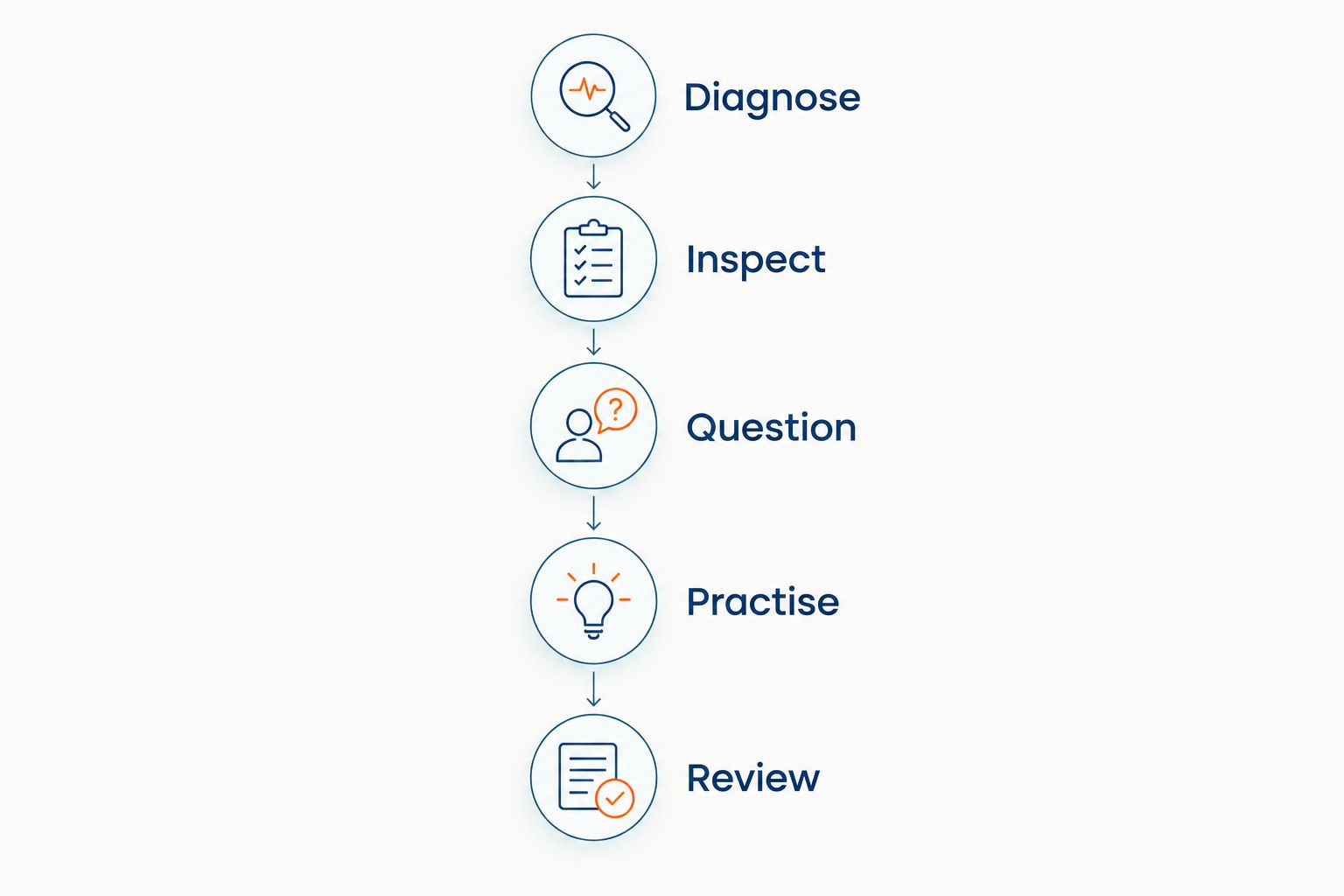
Check whether a lesson helps you solve a different passage independently.
What should useful feedback sound like?
A helpful teacher asks you to connect your answer to evidence in the text. The discussion should reveal your reasoning without turning every mistake into a long grammar lecture.
Example dialogue:
Learner: I chose B because both sentences mention the same problem. Tutor: Do they describe the same relationship between the ideas? Learner: No. The passage contrasts them, but B gives a cause. Tutor: Which word in the passage signals that contrast? Learner: However. I focused on the nouns and missed the connection. Tutor: Good. Now explain why your new answer preserves that contrast.
That exchange gives the learner something specific to check next time. A correction such as “read more carefully” does not.
How are these course formats ranked?
The ranking prioritises exam alignment, explained practice, feedback and study structure. Live YDS teaching comes first because it directly combines those needs; individual tuition becomes the better choice when a particular weakness dominates.
Self-paced study ranks ahead of mock-test-only preparation for learners who still need instruction. General English tutoring remains a supporting option because its broader purpose differs from dedicated exam preparation.
No provider score gains, personal testing results or guaranteed outcomes form part of this ranking.
Frequently asked questions
Can I prepare for YDS if my English is still elementary?
Yes, but begin with foundational English instruction before making full exam papers your main activity. Choose teaching that helps you understand sentence structure and everyday written meaning.
Do I need a native English-speaking tutor for YDS?
No. Relevant exam knowledge and clear explanations matter more than a tutor's first language for YDS-specific teaching.
Should every unfamiliar word go into my vocabulary notebook?
No. Prioritise words that block comprehension or recur in your study material, and record them in a useful sentence rather than as isolated translations.
Does YDS preparation need to include speaking practice?
Speaking practice is not a substitute for the written skills YDS assesses. Use it as supporting language practice if explaining ideas aloud helps you examine your understanding.
What should I ask about access to recorded lessons?
Ask how long access lasts, which materials it includes and whether you can revisit explanations after the teaching period ends. Confirm the terms directly with the provider.
Should I change courses after one disappointing practice result?
Do not decide from one result alone. Examine which errors occurred and whether your current course gives you a clear way to address them.
Which course should you choose in 2026?
Choose a live YDS-focused course if you want the clearest default route. Choose individual reading tuition when you need diagnosis, self-paced study when scheduling is the obstacle, and guided mock tests when you need to improve exam execution.
Keep general English lessons in their proper role. Flalingo can form part of a broader learning plan, while dedicated materials and instruction address the examination itself.
What is one final check before you commit?
Ask the teacher to explain an incorrect option that initially looks convincing. That small request tests whether the lesson teaches distinctions or simply presents answers.
Then solve a fresh question. Choose the course that improves your reasoning, not the course that makes the explanation look effortless.
Sources
- ÖSYM, Yabancı Dil Bilgisi Seviye Tespit Sınavı guidance. Primary authority for YDS format and administration; consult the guide for your 2026 sitting.
- Flalingo official website, source for the description of individual English lessons with certified native tutors. Publication date not stated.
Learn with Flalingo
- Exam preparation with a tutor
- Full mock exams with AI scoring
- Free exam practice
- Exam news and reading practice
Related guides
- If your longer-term goal includes workplace communication, read about whether English training helps finance teams negotiate.
- Best online English courses for YÖKDİL exam preparation 2026
- Online Preparation Guide for Those Taking the English Proficiency Exams
- IELTS Journal in 4 Parts: Preparation Tips and Insights About the IELTS Exam
- Did Your English Speaking Exam Go Badly?
Other content that may interest you




I am an English trainer who has been working with students of all levels in the IELTS preparation process for many years. I know that the test is not only about language knowledge; strategy, time management and self-confidence also play a big role in success. My aim is to transform the IELTS process from a stressful test preparation into a planned and motivating journey of success.
English with Flalingo
Learning English with Flalingo means progressing with an intelligent system that works in an integrated manner.