
Online English lessons for HR professionals: complete 2026 guide

HR professionals’ online English lessons are live language sessions built around recruitment, employee conversations and workplace writing, with the aim of helping you communicate clearly across international teams. Unlike general conversation classes, they should give you practice explaining processes, asking neutral questions and discussing sensitive issues without changing your intended meaning.
Summary
- Choose online English lessons for HR professionals around recruitment, employee relations and workplace writing, not vocabulary lists alone.
- Start with an English level test, then check your speaking through realistic HR tasks.
- Use fictional employee details in lessons and assess progress against specific communication tasks.
- Flalingo suits HR professionals seeking one-to-one online English lessons with certified native tutors.
Why does English matter in HR conversations?
HR communication needs more than correct grammar. You need to distinguish a request from a requirement, explain a process without promising an outcome, and acknowledge a concern without agreeing with every detail.
Consider the difference between ‘You will receive a promotion’ and ‘Your manager will review your eligibility for promotion.’ Both sentences are grammatically correct. They communicate different commitments.
Build your learning plan around the situations you actually handle. If you are comparing English speaking practice apps, first decide whether you need independent rehearsal or a teacher who can question your wording in a live conversation.
Your target is clear, accurate HR communication, not an imitation of a particular accent. Use the steps below to turn that target into a practical lesson brief.
“In my experience, HR professionals often find it challenging to choose the right words when discussing sensitive workplace matters. Being able to explain a policy, ask follow-up questions and respond without creating misunderstandings makes a real difference in international work environments.”
Cansu Eskiocak
How do you build an HR-focused English learning plan?
1. Map your recurring HR tasks
Start with your calendar, not a textbook. List the conversations and documents you handle in English, then identify where you stop, translate or rewrite repeatedly.
Separate language needs from subject knowledge. Knowing your organisation’s recruitment process does not automatically give you the English to explain it. Equally, a language teacher should not decide what that process ought to be.
Choose one priority situation for your first lessons. An HR generalist preparing for international onboarding needs a different brief from a recruiter conducting initial interviews.
Create a simple task record with a situation, a difficult moment and a useful practice outcome. For example: ‘Candidate screening; asking follow-up questions; clarify an unclear answer without suggesting the response.’
- List recruitment, onboarding, employee relations and reporting tasks separately.
- Mark each task as speaking, listening, reading or writing.
- Choose the task with the nearest real deadline.
- Write one observable outcome, such as explaining the interview stages without reading.
2. Establish your starting point
Before choosing lesson materials, record a short explanation of a familiar HR process. Then write an email explaining the same process to a new colleague. Use your normal English rather than correcting every sentence first.
Take Flalingo’s free English level test for a CEFR placement from A1 to C2, then bring the result and your samples to a teacher. Treat the placement as a starting point for choosing materials, not proof that every workplace task is equally comfortable.
For a suggested baseline activity, speak for 2 minutes about onboarding and write a 150-word welcome email. These are practice limits, not test standards. Keep both samples so you can repeat the tasks later.
Ask the teacher to distinguish errors that change meaning from errors that simply sound less natural. That distinction gives your first lessons a clear focus.
- Explain a process without a script.
- Write a message containing an action, an owner and a deadline.
- Note where you switch languages or avoid a necessary detail.
- Ask for separate feedback on clarity, vocabulary and sentence structure.
The Council of Europe's CEFR descriptors can also help you assess spoken interaction and communication skills beyond general grammar knowledge.
3. Choose a tutor around your HR brief
Prepare a lesson brief yourself before contacting a provider. Include your role, your priority task, a fictional example and the kind of correction you want. A clear brief lets you judge whether a proposed lesson addresses your actual work.
Flalingo suits HR professionals seeking one-to-one online English lessons with certified native tutors. Use that format to request focused practice, but confirm the individual tutor’s suitability for your HR scenarios rather than assuming a teaching qualification includes HR experience.
When comparing courses with native-speaker tutors, look beyond the tutor’s first language. Ask how the teacher will handle an unclear question, an inappropriate promise or an email that sounds more severe than intended.
After the level test, use the adult trial lesson to check this fit. Bring one task rather than trying to cover your whole job.
- Share a fictional recruitment or employee-relations scenario.
- Request correction after the role-play rather than after every sentence.
- Ask the tutor to explain why a revised phrase fits the situation.
- Check whether you leave with language you can reuse and adapt.
4. Rehearse difficult conversations in stages
Begin with a colleague or a voice recorder. Explain the situation once, listen back and identify the point where your message becomes unclear. Bring that exact moment to your next lesson.
Build the role-play in stages: give the explanation, answer a straightforward question, then respond to a challenge. This gives the teacher a defined task instead of an open-ended conversation about your working week.
For interview practice, distinguish open questions from questions that suggest an answer. Compare ‘Tell me about a disagreement at work’ with ‘You handled the disagreement calmly, didn’t you?’ Practise asking for evidence without putting words into the candidate’s mouth.
For employee conversations, rehearse acknowledgement and clarification separately. ‘I understand that this has been frustrating’ acknowledges the experience. It does not confirm a particular investigation finding or promise a remedy.
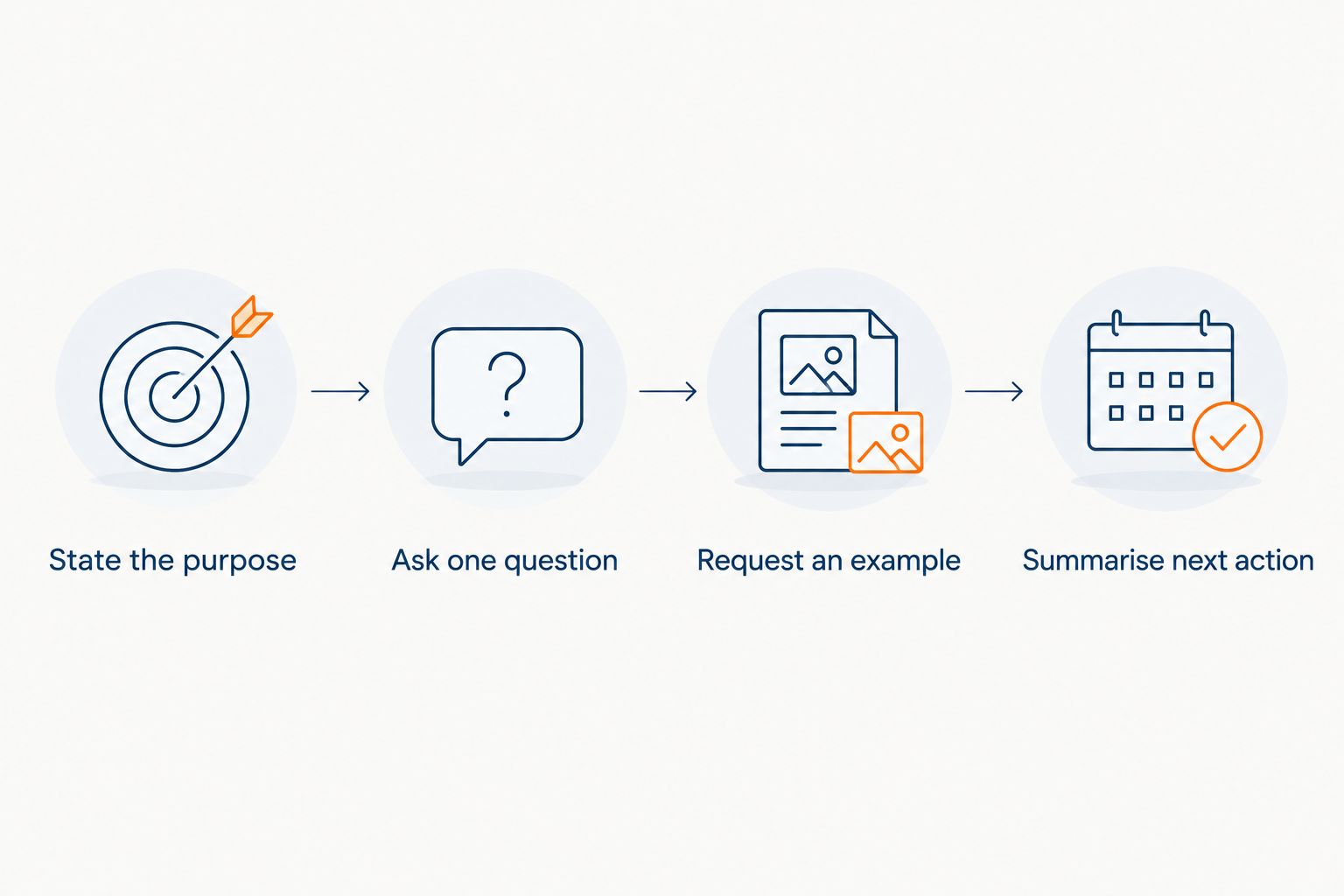
- State the purpose of the conversation in plain English.
- Ask one question at a time.
- Request a specific example when an answer is vague.
- End by summarising the agreed next action.
5. Edit workplace writing for action and tone
Use an anonymised draft or create a fictional email yourself. First check whether the reader can identify what happened, what they need to do and when they need to do it. Correct the grammar after the message is complete.
Compare ‘Please send the signed form by Friday’ with ‘It would be appreciated if the relevant documentation could be returned at your earliest convenience.’ The first names both the action and the deadline. The second leaves the timing open.
Do not make every message softer. An optional invitation, a required action and a policy explanation need different wording. Ask your teacher to preserve those distinctions when editing.
Keep the original and revised versions together. Underline the change that matters and explain it in your own words before trying a new example.
- Put the requested action near the beginning.
- Replace vague references with the relevant document or process name.
- Distinguish requirements from suggestions.
- Check whether your closing sentence identifies the next step.
6. Review progress through repeatable tasks
You can track progress with a document and your saved recordings. Repeat the same type of task after a planned block of lessons, using different fictional details so that you are not simply reciting a memorised answer.
For example, schedule a review after 4 weeks. Repeat the 2-minute explanation and 150-word email, then compare whether the intended message is complete, accurate and understandable without extra clarification.
Ask the tutor to keep a short correction log. Group entries by communication problem, such as unclear time references, indirect questions or missing next steps, rather than collecting an unstructured list of mistakes.
If you manage training for a wider team, distinguish attendance from workplace outcomes. The guide to measuring ROI from English training addresses that separate reporting question.
- Keep the original task instructions for comparison.
- Record whether you completed the message without a script.
- Identify recurring mistakes that change the meaning.
- Select the next lesson goal from the remaining difficulty.
Which learning format fits your HR workload?
Choose the format according to the task, the feedback you need and the schedule you can maintain. A resource library and a live lesson serve different purposes; neither removes the need to define what you want to practise.
| Option | Best for | Main advantage | Key limitation |
| Independent practice with your own materials | Preparing a specific email or explanation | You control the topic and pace | You must identify your own unclear wording |
| Peer role-play | Rehearsing with a trusted colleague | You can use familiar workplace situations | Your colleague is not necessarily qualified to teach English |
| Group business English lessons | Practising discussions with several speakers | You can rehearse turn-taking and group questions | Lesson time must accommodate other learners’ goals |
| Flalingo one-to-one online English lessons | Working individually with a certified native tutor | You can bring a focused personal lesson brief | You still need to confirm the tutor’s fit for your HR tasks |
If individual feedback is your priority, compare one-to-one online English tutoring platforms against the same task brief. Ask each provider what the lesson would involve rather than comparing broad promises about fluency.
Keep language practice separate from legal and policy approval. The exercises here are learning suggestions, not validated assessments, legal guidance or evidence of a guaranteed learning outcome. Use fictional details, follow your organisation’s information-sharing rules and have authorised colleagues approve substantive HR wording.
What does an HR practice conversation sound like?
Use this fictional example to rehearse clarifying an onboarding deadline. Read it once, then change the document and date without looking at the text.
HR: Could you send the signed form by Thursday?
Employee: I’m waiting for one document. Is Friday possible?
HR: Which document are you waiting for?
Employee: My previous employer’s confirmation letter.
HR: Please send the completed sections now and update me on the letter tomorrow.
Employee: Understood. I’ll send the sections today and give you an update tomorrow.
Notice the sequence: request, clarification, revised action and confirmation. Ask your practice partner to introduce a different obstacle, then respond without memorising the entire exchange.
Which mistakes should HR professionals avoid?
Memorising terminology without practising the task
Knowing ‘probation period’ does not show that you can explain its review process. Put each new term inside a question, explanation or follow-up message connected to your role.
Letting a language exercise change a policy commitment
A more natural sentence is not automatically a more accurate one. Check whether an edit changes ‘eligible’ to ‘entitled’, ‘review’ to ‘approve’, or a possibility into a promise.
Sharing real employee or candidate records
Do not paste an actual grievance, medical detail or interview record into a practice exercise. Write a fictional version that preserves the language problem without exposing the person.
The ICO's recruitment and selection guidance explains how organisations should handle candidates' personal information throughout the recruitment process.
Measuring effort instead of communication
Completed lessons show participation, not whether you can handle a particular conversation. Keep the task outcome visible: explain the process, clarify the answer or write the next action.
What should you do before booking lessons?
Write the sentence you most often avoid saying at work. That is a more useful starting point than a long list of HR vocabulary because it identifies a real communication task.
Take Flalingo’s free English level test for your CEFR placement, then bring that sentence and a fictional scenario to an adult trial lesson. Choose further lessons according to the quality of the task practice and feedback.
Frequently asked questions
Can I start HR English lessons if I’m a beginner?
Yes. Ask for simple HR tasks alongside foundational English, such as introducing your role, confirming names and arranging a meeting. Avoid beginning with complex dispute scenarios.
Should I learn British or American English for HR work?
Follow your organisation’s preferred written style and practise understanding the speakers you work with. Keep terminology and spelling consistent within each document.
Can an English tutor prepare me to interview candidates?
An English tutor can help you phrase questions and follow up on answers. Your organisation must determine the interview content, assessment criteria and applicable requirements.
What should I do if I understand emails but struggle in meetings?
Ask for lessons built around listening and spoken responses rather than more email exercises. Practise interrupting politely, checking your understanding and summarising a decision.
Can I use translated company documents as lesson material?
Use only material your organisation permits you to share. Remove identifying and confidential details, and ask a teacher to discuss the English rather than approve the document’s substance.
What if my employer already provides general English classes?
Bring your HR task brief to the existing teacher first. Ask whether the current lessons can include relevant practice before adding another course.
Sources
- Council of Europe: CEFR Descriptors. Official language proficiency descriptors for evaluating communication and interaction skills.
- Information Commissioner's Office (ICO): Employment Practices and Data Protection: Recruitment and Selection. Guidance on handling candidate information during recruitment.
Other content that may interest you




As an HR professional, I connect companies with the right talent. I specialize in managing end-to-end recruitment processes, particularly in the technology and digital sectors, while supporting teams in achieving sustainable growth. By simplifying complex HR processes, I create practical and informative content for both candidates and employers. I also emphasize that effective recruitment is not simply about filling a position, but about building sustainable, high-performing teams.
English with Flalingo

Learning English with Flalingo means progressing with an intelligent system that works in an integrated manner.