
How to check a job candidate's English before you hire

Check a job candidate's English with a consistent assessment followed by a realistic work task and a structured interview. Set the language requirement before meeting applicants, then judge whether each person can communicate accurately enough for the job, not whether they sound like a native speaker.
Summary
- To test candidate English level, combine an initial assessment with work samples and consistent interview questions.
- Flalingo's candidate English assessment suits hiring teams checking applicants before a role-specific interview.
- Assess the English the job requires, including clarification, listening, writing and explaining decisions.
- Set your decision criteria before testing, and record evidence rather than impressions.
What English does the job actually require?
Start with the work, not a label such as fluent. A developer explaining a technical problem needs different language from a receptionist handling unexpected questions. Write down the situations your new colleague must manage without someone translating or rewriting for them.
Ask the hiring manager for examples of real communication. Remove customer names, confidential details and anything that gives an applicant access to live business systems.
Your brief should answer these questions:
- Who will the employee communicate with? Customers, colleagues, suppliers or senior managers.
- What must they accomplish? Explain a delay, understand a request, negotiate a change or document a decision.
- Which channels matter? Calls, meetings, email, chat or written reports.
- What happens when communication fails? Someone asks for clarification, a task needs redoing or a critical instruction is misunderstood.
- What support is normally available? Templates, reference documents, writing assistance or a colleague's review.
Test the conditions of the job, not an artificially difficult version of English. If employees normally use a glossary, give applicants the same glossary. If immediate spoken responses are essential, include an unrehearsed conversation.
This matters because your hiring decision needs a clear explanation. “The candidate confirmed the revised deadline incorrectly” is useful evidence. “Their English did not feel professional” is not a usable assessment criterion.
Language assessments should reflect the communication demands they are designed to measure. The International Language Testing Association's 2024 guidelines emphasise validity, reliability and fairness, highlighting the importance of using tasks that are relevant to the context in which test results will be used.
How should you structure the English check?
Use the following sequence as a suggested hiring workflow. Keep the core tasks and instructions consistent for applicants to the same role, while arranging appropriate access requirements in advance.
- Define tasks. Select the communication situations that matter most to the role.
- Set criteria. Write down what an acceptable response must achieve before reviewing candidates.
- Assess English. Use an initial candidate assessment to inform the follow-up interview.
- Observe work. Ask applicants to complete a relevant task and explain their response.
- Record evidence. Document what they understood, communicated and needed help with.
Flalingo's candidate English assessment is a starting point for the assessment stage. Follow it with the job-specific task rather than treating an assessment result as the entire hiring decision.
For planning purposes, you could reserve 15 minutes for the work sample and follow-up conversation. That is a suggested interview allocation, not a validated test duration or a promise that every role can be assessed within it.
The U.S. Office of Personnel Management explains that structured interviews improve consistency and reliability by using predefined questions and evaluation criteria. Applying the same approach to English assessments helps hiring teams compare candidates against the communication requirements of the role rather than relying on subjective impressions.
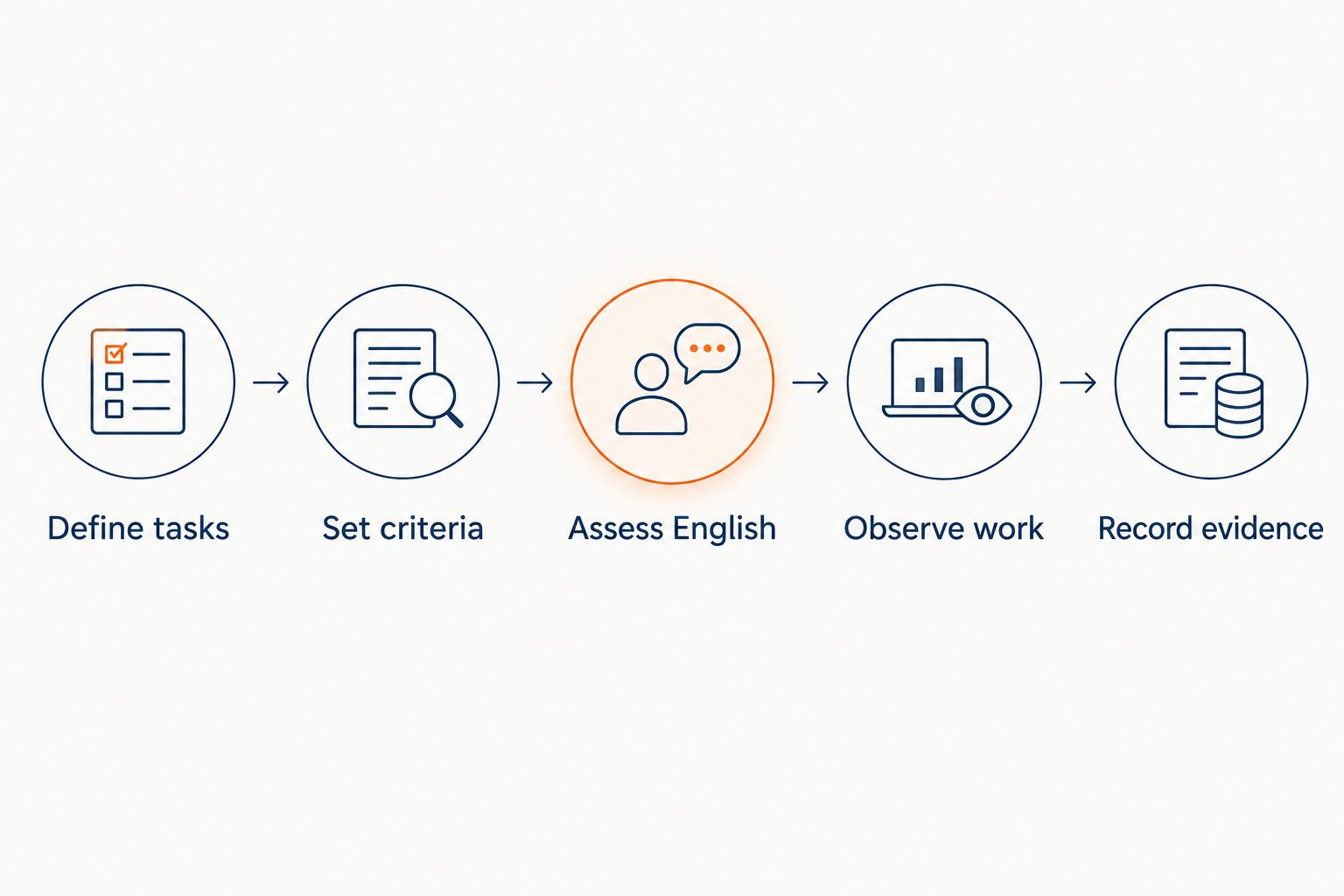
The initial assessment and work sample answer different questions. Keep both records, but make the final decision against the communication demands you defined for the vacancy.
Which assessment method fits each hiring question?
Choose methods by the evidence you need. A written response does not show how someone handles interruptions, and a friendly conversation does not show whether they can write an accurate customer update.
| Method | Best for | Evidence to record | Limitation |
| Initial English assessment | Establishing a starting point for follow-up | Reported result and areas requiring a closer check | Does not replace observing the actual work |
| Structured spoken interview | Checking explanations and clarification | Relevant answers, understood questions and repaired misunderstandings | Does not directly demonstrate written communication |
| Written work sample | Checking practical email or message writing | Correct facts, clear requests and an appropriate next action | Does not show listening or spontaneous speaking |
| Role-play | Checking an interaction from the job | Questions asked, information confirmed and outcome reached | Covers only the situation you choose |
Use the smallest set of tasks that covers the role's essential communication. Do not add an English presentation to a role that never involves presenting simply because it feels demanding.
If you include both writing and speaking, keep their findings separate. A strong written answer should not erase a serious listening problem in a telephone-based role. Equally, a hesitant introduction should not outweigh a clear, accurate work sample for a mainly written position.
What should you ask candidates to do?
Give applicants a short brief with a clear audience and purpose. Use fictional business information so nobody needs specialist knowledge of your company to understand the task.
How can you check written English?
For a customer-facing role, ask the candidate to write an email of 120 words maximum explaining a delayed delivery. Supply the original delivery date, the revised date and the action the customer needs to take. The word limit is an exercise instruction, not a proficiency standard.
Check whether the message preserves those facts. Look for a clear explanation, an appropriate tone and a next step the customer can understand without guessing.
Do not turn this into a hunt for every grammatical mistake. Record errors that change meaning separately from errors that leave the message clear. If writing assistance is allowed, state that in advance and ask the candidate to explain their final wording.
How can you check spoken English?
Ask the candidate to explain a familiar work process for 2 minutes, then introduce a relevant follow-up question. For example, ask what they would do if a customer rejected the proposed solution.
Listen for a complete explanation, understandable sequencing and a response to the question actually asked. Allow the candidate to request clarification. Asking a sensible question is different from failing to understand and continuing with an unrelated answer.
How can you check listening without a separate exam?
Read a short fictional customer request, then ask the candidate to summarise it and confirm the next action. Keep the wording and delivery consistent across applicants.
Include a detail that matters, such as a changed deadline. Record whether the applicant notices it, asks about it or confidently repeats the wrong information.
What does a useful role-play sound like?
Use a situation the employee will actually face. Tell the candidate their role and objective before starting, then stay within the same scenario for every applicant.
Example dialogue: confirming a changed deadline
Interviewer: The client needs the revised report by Thursday, not Friday. Can your team manage that?
Candidate: Just to confirm, do you need the complete report or the summary by Thursday?
Interviewer: The summary is enough. The complete report can follow on Friday.
Candidate: Understood. We will send the summary on Thursday and the complete report on Friday.
Interviewer: Please include the updated sales figures in the summary.
Candidate: Certainly. Who should I contact if those figures have not arrived?
This example gives you observable behaviours: the candidate checks an ambiguity, restates the agreement and identifies a dependency. You are not looking for memorised wording. Change the details and assess whether the applicant can still reach a clear understanding.
How should you score the evidence?
Use a simple rubric with descriptions rather than an unexplained overall impression. The following is a suggested internal decision aid, not a standardised proficiency scale.
| Criterion | Meets requirement | Needs follow-up | Does not meet requirement |
| Understanding | Identifies the essential request correctly | Needs clarification before identifying it | Acts on a materially incorrect interpretation |
| Task completion | Communicates the required outcome and next action | Leaves a relevant point unresolved | Omits or changes an essential instruction |
| Clarity | Meaning is understandable without substantial repair | Meaning becomes clear after follow-up | Meaning remains unclear after clarification |
| Interaction | Answers relevantly and checks uncertainty | Needs prompting to resolve uncertainty | Continues without resolving a significant misunderstanding |
| Written accuracy | Preserves the supplied facts and intended message | Requires editing before use | Produces a misleading message |
Before interviewing, decide which criteria are essential and which are trainable for that role. Record a short example beside each judgement so another reviewer can understand the decision.
For a borderline applicant, use another equivalent task focused on the unresolved criterion. Do not simply repeat the same question until the candidate gives the answer you want.
Why do candidates perform differently across tasks?
An uneven result needs investigation, not an automatic rejection. Check the conditions before deciding what the performance means.
- Task familiarity: Does the exercise depend on company knowledge you never supplied?
- Communication channel: Did you assess speaking when the role mainly requires writing?
- Preparation rules: Did applicants receive different amounts of information beforehand?
- Tool access: Did some applicants use writing assistance while others were told not to?
- Interview delivery: Did interviewers change the wording, pace or follow-up questions?
- Technical conditions: Did audio problems interrupt the listening or speaking task?
State the limits once in your assessment record: this process samples selected tasks under defined conditions. It does not establish performance in every workplace situation or predict a guaranteed outcome after hiring.
How do you avoid confusing accent with job readiness?
Write down the message the candidate communicated, not a judgement about how familiar their accent sounds. If you did not understand a phrase, ask for clarification and record whether the candidate successfully repaired the misunderstanding.
Avoid criteria such as “sounds native” unless you can replace them with a specific, defensible job requirement. “Customers must understand appointment details during a telephone call” describes an observable requirement; a preferred accent does not describe the task.
If your team is considering accent-scoring software, read the separate discussion of whether AI can accurately detect an English accent. Keep that question separate from whether an applicant can complete your role's communication tasks.
What should happen after the hiring decision?
Give the hiring manager a short evidence summary: the tasks used, the requirements met and any unresolved concerns. Separate English findings from technical competence and from the overall recruitment decision.
For a successful applicant with a manageable language gap, turn that gap into a specific development goal. For example, ask them to practise summarising meeting decisions rather than assigning the vague goal “improve business English”.
Flalingo offers online individual English lessons with certified native tutors and serves businesses. Its company training route fits post-hire development; it is not a substitute for defining the hiring requirement first.
If you plan training, agree how you will review the original communication need. The guide to how companies measure ROI from English training addresses the next management question: how to connect training activity with the workplace purpose behind it.
What is your next step before interviewing?
Write the acceptable answer before you meet the candidate. Not a script to memorise, but the facts, clarification and next action that would make the response usable at work.
Then use Flalingo's candidate English assessment as the initial check and follow it with your structured work sample. If the next need is individual learning rather than recruitment, a tutor trial lesson is the step for exploring ongoing support.
Frequently asked questions
Should candidates know there will be an English assessment?
Tell candidates that English will be assessed and explain the format beforehand. State which tools are allowed and how they can request access arrangements.
Can I assess English during a remote interview?
Yes, you can include spoken and written tasks in a remote interview. Check the connection first and repeat any instruction interrupted by technical problems.
Should I ask candidates to switch to English without warning?
Explain the language-assessment stage before it starts. An unexpected switch is not necessary to ask unrehearsed, role-relevant follow-up questions.
What if a candidate submits an existing English certificate?
Review what the certificate covers and when the assessment took place. Use it alongside your role-specific evidence rather than assuming it demonstrates every communication task.
Should technical vocabulary count as English proficiency?
Score technical knowledge separately unless using that vocabulary is an explicit requirement of the role. Provide unfamiliar company terminology that applicants would normally learn during onboarding.
Can candidates use confidential work samples from a previous employer?
Ask for a fictional or anonymised exercise instead. Do not require candidates to disclose another employer's customer information, documents or internal communications.
Sources
- International Language Testing Association (ILTA) – Guidelines for Practice (2024)
- Office of Personnel Management – Structured Interviews




As an HR professional, I connect companies with the right talent. I specialize in managing end-to-end recruitment processes, particularly in the technology and digital sectors, while supporting teams in achieving sustainable growth. By simplifying complex HR processes, I create practical and informative content for both candidates and employers. I also emphasize that effective recruitment is not simply about filling a position, but about building sustainable, high-performing teams.
English with Flalingo

Learning English with Flalingo means progressing with an intelligent system that works in an integrated manner.