
Executive English: How Global Professionals Are Levelling Up Their Careers with Industry-Specific Tutoring

A Turkish CTO delivers a keynote in Berlin. A French product manager negotiates a SaaS renewal with a Chicago buyer. A Brazilian finance director walks into a quarterly review where three of the five seats are filled by colleagues who grew up speaking English. None of these professionals lacks competence. What they often lack is the right layer of English, the kind that carries authority inside a boardroom rather than politeness inside a classroom.
That gap is why business English has shifted from a nice-to-have into a core professional asset. For executives and senior specialists, the demand is no longer general fluency. It is an executive English that sounds like the industry you work in, a model that mirrors the vocabulary of your actual meetings, and a way to measure progress beyond the vague sense that your English has got better.
This guide is written for global professionals, managers, and senior leaders who already speak English but want to use it differently. We will look at how industry-matched tutoring works in practice, why meeting and interview simulations outperform generic conversation classes, which vocabulary sets signal that you belong in a senior role, and how modern platforms are building the experience high-stakes careers require. Expect frameworks from the British Council, Cambridge, ETS, and the Council of Europe, alongside candid reviews from professionals who use this approach every week.
Why Does Your English Level Set The Ceiling On Your Career?
Your English level sets a limit because nearly every senior role inside a global company runs in it, from board meetings to legal documents to client negotiations. When your language lags behind your expertise, the market often treats you as less competent than you are, and that perception converts directly into compensation, visibility, and promotion outcomes.
HR leaders inside multinationals report that English proficiency is the single most cited predictor of being considered for international assignments, ahead of technical certifications and MBAs.
Research by Ellen Bialystok at York University has also shown that high-proficiency bilinguals display stronger executive function under pressure, which is precisely the skill required when you are defending a budget, negotiating a valuation, or running a town hall. Your language capacity and your decision-making capacity end up linked.
For most senior professionals, the honest baseline is general English fluency as the starting point. That baseline is not the finish line. Executive roles require a register that most general courses never touch, which is why the Common European Framework of Reference (CEFR) is useful as a diagnostic. The table below maps each band to what it unlocks inside a professional setting.
British Council breakdowns at each level (A1, A2, B1, B2, C1, C2) give concrete can-do statements worth reading before you decide which level your role actually demands.
What Makes Executive English Different From The English You Learned In School?
Executive English is not more vocabulary layered on top of general English. It is a different register, closer to the way legal, financial, and strategic decisions actually get framed inside multinational organisations.
The shift shows up in small choices. A B2 speaker might say, I disagree with that plan. A C1 executive speaker is more likely to say, I see it slightly differently, and here is why that matters for Q3. Both sentences are grammatically correct. Only one leaves the speaker in a position to keep shaping the conversation.
The same logic applies to tentative language. We need to think about these positions as participants. We propose to implement the following positions for you as a decision-maker. The words are available to every B2 speaker. Very few use them until someone shows them the professional payoff.
The point is not that one register is better in absolute terms. Senior roles require the second column, and almost no general English course teaches it explicitly.
How Does Smart Match Find Your Industry Tutor?
Smart Match pairs you with a tutor whose own professional background aligns with your industry, so that vocabulary, scenarios, and cultural references feel familiar rather than improvised. The idea is simple: if your tutor has already spent time inside a trading floor, a hospital ward, or a product team, the conversation starts where the textbook ends.
Consider a fintech professional in Istanbul preparing for a compliance review with auditors in London. A generic business English tutor can cover meeting openers and polite disagreement. A tutor with a finance background can spend the session on regulatory compliance, liquidity management, and how to explain a capital adequacy gap without sounding evasive. The second tutor does not need a glossary. The conversation runs at the speed of real work.
The same principle applies to accent. A software engineer heading to Sydney for a two-year placement adapts faster if a meaningful share of her practice hours happens with an Australian or British tutor, so her ear tunes to the rhythm and idioms she will hear in stand-ups and lunch breaks. Accent is not about status. It is about reducing cognitive load, which frees capacity for thinking.
This is precisely how Smart Match finds your industry tutor. Flalingo's Smart Match looks at your industry, seniority, target accent, and specific goals, and narrows a pool of roughly 1,800 tutors down to the ones whose background matches yours. The result is a tutor who is both a qualified teacher and someone who has already lived inside the vocabulary you want to master. Flalingo Smart Match industry pairing is the piece that turns a conversation class into an industry rehearsal. That matters in practice. The pattern readers describe most often in reviews is the shift from knowing words to using them with confidence under real conditions.
Find your industry-matched Flalingo tutor.
Book your executive English session.
Which Words Actually Signal That You Belong In The Room?
The right word in the right register does what small talk cannot. It positions you as someone who understands the business, not someone who translates it in their head before speaking. Industry vocabulary is the fastest credibility signal a non-native speaker can build, and it is completely learnable once a tutor runs you through the terms you will actually use.
Below is a starter set of professional vocabulary English terms across four high-demand industries. These are the words that should be second nature before your next meeting in that field, because they reveal whether you treat the industry as a topic to learn or a context you already work in.
An industry-matched tutor works through these terms in scenarios, not as flashcards. You learn due diligence by running a mock acquisition review. You learn churn rate by presenting a quarterly retention report. Repetition happens while pressure rises, which is the condition under which vocabulary actually sticks.
Can You Rehearse The Boardroom Before You Step Into It?
Yes, and the professionals who rehearse consistently outperform those who rely on preparation notes alone. Meeting simulation is running a real scenario before the real one, with someone who pushes back the way your CEO, your investor, or your toughest client will. The point is not to memorise answers. It is to make the pressure familiar.
Inside a well-designed session, the tutor takes on the role you are preparing for. She plays the CEO who has three minutes before the next call and wants your update compressed. She plays the board member who has already spotted the weakness in your numbers. She plays the analyst on a conference call who will ask exactly the question you hope no one asks. You run the quarterly update, answer the hostile question, and close the call on time. Then you run it again.
Repetition matters because executive communication is muscle memory. A first run-through almost always exposes a weak opener, a filler phrase that dilutes authority, or a habit of apologising before a recommendation. A second run-through lets you tighten the opener and drop the apology. By the third or fourth repetition, the scenario sounds like something you have already done, which is exactly what you want the real meeting to feel like.
Between live sessions, FLAI Speaking gives you an on-demand AI conversation partner for the hours when a human tutor is not on your calendar. You pick a topic (a product pitch, a performance review, a hiring debrief, anything you want to rehearse), you have a real spoken conversation with the AI, and within seconds you receive a structured report on how you performed. The report covers four dimensions of spoken English, each scored on the CEFR scale, alongside an overall CEFR rating that updates as you practice.
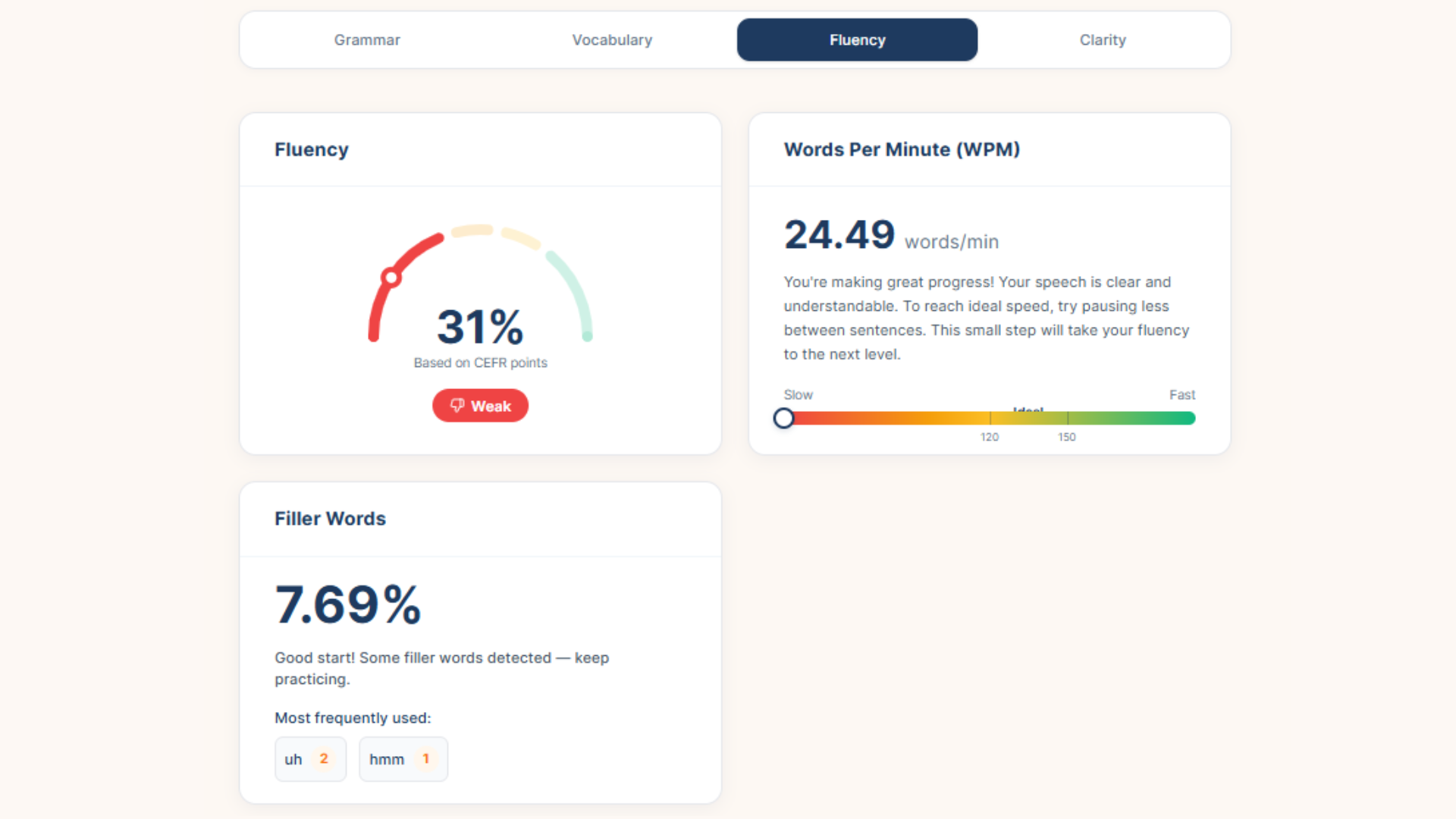
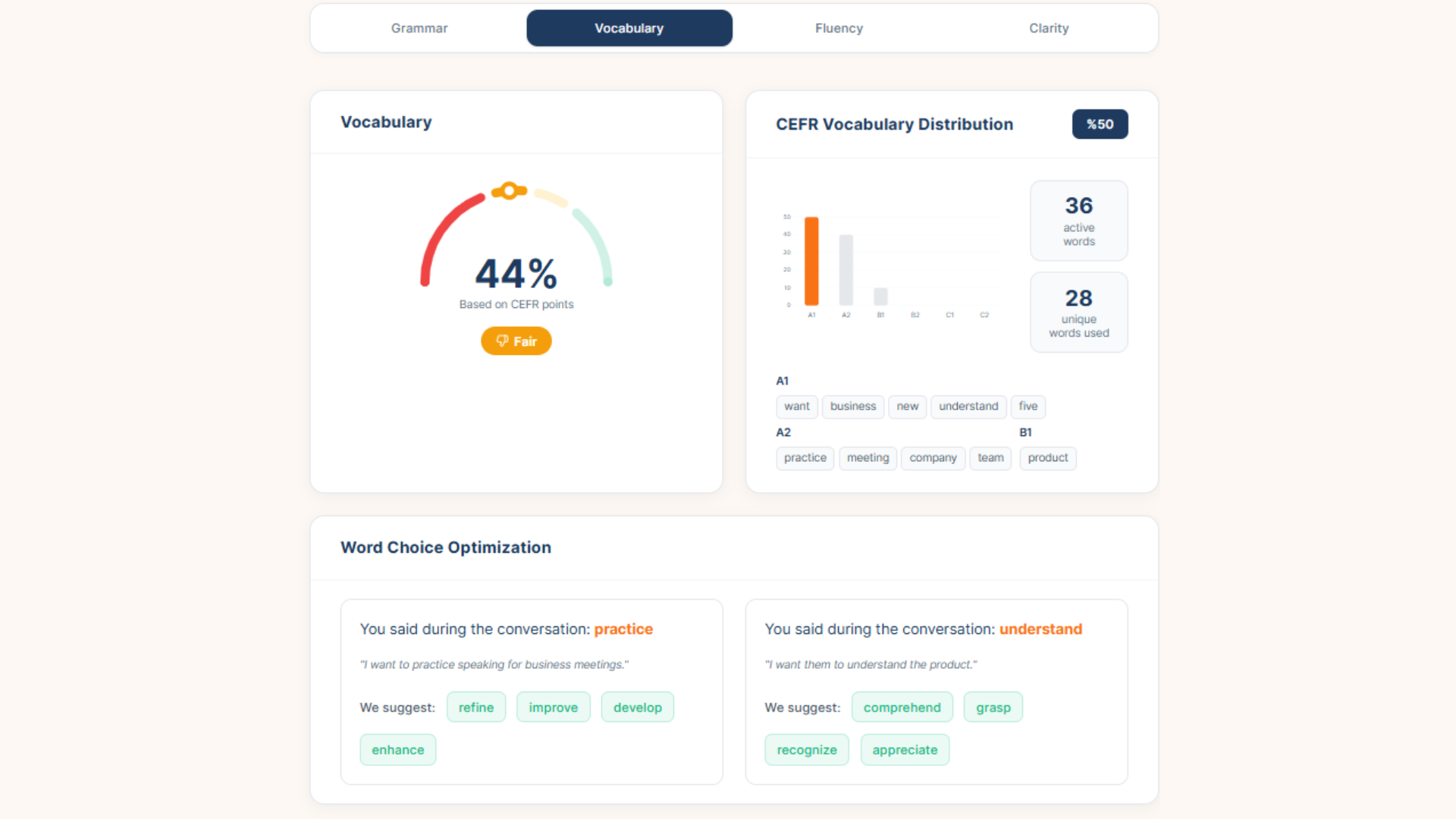
FLAI Speaking also tracks which words you use most often, which gives you an honest diagnostic of your current vocabulary floor. If your most-used verbs are still do, make, and have, you are living inside a general register. When deliver, negotiate, prioritise, and propose start appearing in your word frequency report, you can see the executive register forming in real time.
The British Council publishes a useful C1-level job interview dialogue that is worth listening to before your first simulation, because it captures the speed and register of a senior conversation in English. The boardroom becomes a safer place once you have already been there, even in simulation. That is the quiet value of running the meeting before the meeting happens.
A typical interview preparation arc runs over four to six weeks.
- The first phase maps the question bank for the specific role you are targeting.
- The second phase drafts answers using STAR, then tightens them through multiple spoken rehearsals rather than written revision, because interviewers hear your answer, they do not read it.
- The third phase introduces curveballs: the follow-up question, the hostile probe, the unexpected silence that invites you to keep talking when you should stop.
- The fourth phase is full mock interviews, recorded end to end, reviewed afterwards against a consistent rubric covering structure, evidence, register, and delivery.
Competency-based interviews go deeper than behavioural ones. A product leadership role will probe for examples of prioritisation under resource constraints, often asking you to defend a trade-off you previously made. A finance role will test how you talk about risk, because risk vocabulary is where seniority becomes legible. Tech interviews layer system design or coding walkthroughs on top of behavioural questions, which means you need English that can carry both narrative and technical precision in the same conversation. Consulting interviews add case structure, where the format of your answer matters as much as the content. Resources like the Indeed guide to interview questions in English give you the question bank. The tutor gives you the register. For consulting and strategy roles, McKinsey-style case and assessment preparation adds the specific rhythm of structured problem-solving in English, where phrases like let me structure this into three parts and to summarise before we move on do real work.
Testing matters too. If your job requires IELTS certification, the interview phase and the test phase overlap. Speaking practice with an industry-matched tutor prepares you for both simultaneously, because the topics that appear in IELTS Speaking Part 3 (abstract, opinion-based, professional themes) are structurally similar to the behavioural and competency questions you face with the hiring manager. This overlap is where improving English for work meetings and interview practice converge within the same weekly practice block.
Professionals who treat English for interviews as a dedicated preparation block, rather than a by-product of general study, tend to see faster results.
From Surviving Meetings To Leading Them: What Actually Changes?
The shift happens when your English stops being a translation exercise and becomes a leadership instrument. You stop waiting for the right word to arrive and start choosing the right word for effect. Surviving a meeting means being understood. Leading one means being followed.
The observable changes are concrete, and they show up in specific sentence-level habits that colleagues read as signals of seniority:
- From I think to naming the decision: Instead of opening with “I think we should”, a leader names the choice first and the reasoning second (My recommendation is X, for three reasons).
- From passive to active voice: “A decision was made” becomes “we decided”. “Mistakes were made” becomes “I missed this”. Ownership enters the sentence.
- From reflexive hedging to deliberate hedging: You stop using maybe and sort of to soften your own uncertainty. You start using one option would be to and a possible path is to create genuine space for disagreement around a firm position.
- From trailing off to a clear ask: Contributions end with a specific request (I need your sign-off by Friday to hit the milestone), not with a fade-out that leaves the next step unowned.
- From general verbs to precise ones: “Do, make, and have” give way to “deliver, negotiate, restructure, prioritise, and propose”. The precision of your verbs communicates the precision of your thinking.
- From apologising to framing: “Sorry to interrupt, sorry, quick question”, disappear in favour of “one point to add and a clarifying question before we move on”. The space in the room feels earned, not borrowed.
FLAI, the professional usage tracker inside Flalingo, is designed to measure exactly this kind of shift. It tags the vocabulary and phrasing you use across sessions, so you and your tutor can see whether your language is drifting toward the executive register. Saying we propose to implement instead of we need to think about is a small choice. Over a quarter of coaching, that small choice changes how colleagues perceive your seniority. FLAI catches the transition, reinforces it with specific feedback, and shows you the data alongside the CEFR-graded reports from FLAI Speaking, so progress is visible rather than assumed.
The pattern is a familiar one for anyone who built English early in life and is now rediscovering it professionally. What you built as a teen becomes your career asset once you point it at the right vocabulary and register. Teenage English gets you through travel and university. Executive English gets you through board meetings. The underlying structure is the same. The polish and specificity are new.
Is Executive English A Cost Or A Career Investment?
Treat executive English as an investment with measurable return, not a line item to be minimised. The monthly cost of structured tutoring is typically a small fraction of the salary premium that proficiency unlocks, and that premium compounds across every promotion cycle.
Across multiple labour-market studies in Europe and Asia, bilingual professionals with advanced English report salary premiums of 10 to 35 per cent over monolingual peers in equivalent roles, with the gap widening at the senior end. The same studies show that mobility, whether moving countries, industries, or from local to regional leadership, almost always requires an English level above B2. The question is not whether to invest. The question is where the investment has the highest return.
In a business world where borders have fallen away, your communication skills set the ceiling of your career. Flalingo is the world's most premium language platform, delivering executive-level business English to professionals working at global companies.
The platforms that have built their model around this idea, rather than bolting business units onto a consumer app, tend to be the ones senior professionals return to quarter after quarter. They treat the learner as a professional, not as a student, and they structure the entire experience around career outcomes.
The most candid recommendation comes from the people who have already tried everything else.
Find your industry-matched Flalingo tutor.
Book your executive English session.




Hi, I'm Glory. Teaching English is one of the most rewarding experiences of my life as I get to meet people from different cultures and help them express themselves with confidence. At Flalingo, I take care to create pleasant and relaxed teaching environments where students can speak without fear of making mistakes. My greatest happiness is witnessing the moments when my students realise that they are really making progress.
English with Flalingo

Learning English with Flalingo means progressing with an intelligent system that works in an integrated manner.