
How do companies measure ROI from English training?

Companies measure ROI from corporate English training by comparing business benefits attributable to the training with its full cost, including employees' learning time. Set a baseline, assess changes in real workplace tasks, and separate training effects from other business changes before calculating the return.
Summary
- Measure ROI from corporate English training through attributable business benefits, not attendance or satisfaction alone.
- Include lesson fees, employee learning time and administration in the full training cost.
- Use workplace tasks and a comparison group to separate learning gains from business impact.
- Flalingo suits companies that want one-to-one English lessons with certified native tutors.
How do companies measure ROI from English training?
Start with a business problem that better English can help solve. Then connect the training to an observable change, such as less time spent rewriting customer emails or fewer clarification rounds during international handovers.
For a 2026 training programme, agree on the measurement plan before lessons begin. Otherwise you collect attendance records when the finance team needs evidence of business value.
Use this sequence:
- Define the outcome. Choose a workplace task where English affects performance.
- Record the baseline. Measure how employees perform that task before training.
- Capture full costs. Include training fees, learning time and administration.
- Assess the change. Repeat a comparable task using the same scoring rules.
- Check attribution. Test whether training, rather than another change, explains the improvement.
- Calculate the return. Convert defensible benefits into money and compare them with costs.
For a role-specific application, read whether finance teams can negotiate better in English after training. The question is not whether employees know more vocabulary. It is whether they use English more effectively in the work you need done.
Why does business impact matter more than attendance?
Attendance shows that employees took part. It does not show that they learned, applied the learning or created a financial benefit.
An employee can enjoy lessons without changing how they handle customer conversations. Another can gain speaking confidence and still need help with a technical presentation.
| Evidence level | What to measure | What it establishes | What it does not establish |
|---|---|---|---|
| Participation | Attendance and completed activities | Employees took part | Learning or business impact |
| Learning | Comparable assessments before and after | Language performance changed | Financial return |
| Workplace transfer | Emails, calls and role-specific tasks | Employees use the learning at work | That training caused every change |
| Business impact | Rework, handling time, quality measures | Operational performance changed | A monetary benefit without valuation |
| Financial return | Attributable benefits against full costs | Return under stated assumptions | Certainty beyond the evidence |
Do not label a language-score improvement as financial ROI. Report it as a learning result until you can link it to workplace performance and a defensible financial value.
Which business outcomes should you measure?
Choose an outcome close enough to employees' work that you can observe it consistently. Broad goals such as international growth have too many influences to attribute to English lessons.
Start with one primary outcome per team. Add supporting measures only when they help explain the result.
How should customer-facing teams measure improvement?
Assess tasks such as explaining a policy, identifying a customer's problem or confirming the next action. Score accuracy and completeness alongside handling time.
A shorter conversation is not automatically a better one. If employees finish faster but leave customers confused, the time measure gives the wrong signal.
How should finance and operations teams measure improvement?
Examine clarification rounds, document revisions and handover quality. Record whether employees communicate the required information correctly, not just whether their grammar improves.
For negotiation work, assess preparation, clarification and confirmation of terms. Do not credit English training with the full value of a contract that also depended on commercial terms and relationships.
How should managers measure improvement?
Use tasks such as presenting a recommendation, explaining a risk or answering follow-up questions. Apply a written rubric so different assessors judge the same features.
Keep confidence as a supporting measure. It describes the employee's experience, but it does not prove that colleagues understood the message or acted on it.
How do you establish a fair baseline?
Collect evidence before employees start training. Record task difficulty, workload, role and tools used, because these conditions affect the comparison.
A 4-week baseline is a sensible planning choice for recurring work, because it covers more than one good or bad day. It is not a research standard. Extend it when the task happens rarely.
Use the same task category after training, but do not repeat an identical assessment that employees can memorise. Compare two customer explanations of similar complexity, scored with the same criteria.
Your baseline record should contain:
- Task: The specific activity being assessed.
- Conditions: Workload, complexity and available support.
- Performance: Time, accuracy, completeness or revision count.
- Scoring: The rubric and the person applying it.
- Context: Process, staffing or software changes that affect results.
Agree on these definitions before reviewing results. Changing the scoring rules afterwards makes the comparison hard to trust.
How do you separate training effects from other changes?
A before-and-after improvement is evidence of change, not proof of cause. Employees might also have received new templates, better software or more manager support during the same period.
Where practical, compare the trained team with a similar team that has not yet started. Record both groups before and after the programme, then check whether the trained group improved beyond the change in the comparison group.
Match the groups on role, starting language ability and task difficulty. A team handling routine requests is not a fair comparison for one handling complex complaints.
When a comparison group is impractical, use repeated observations, manager records and documented process changes. Present the result as a qualified estimate, not a proven causal effect.
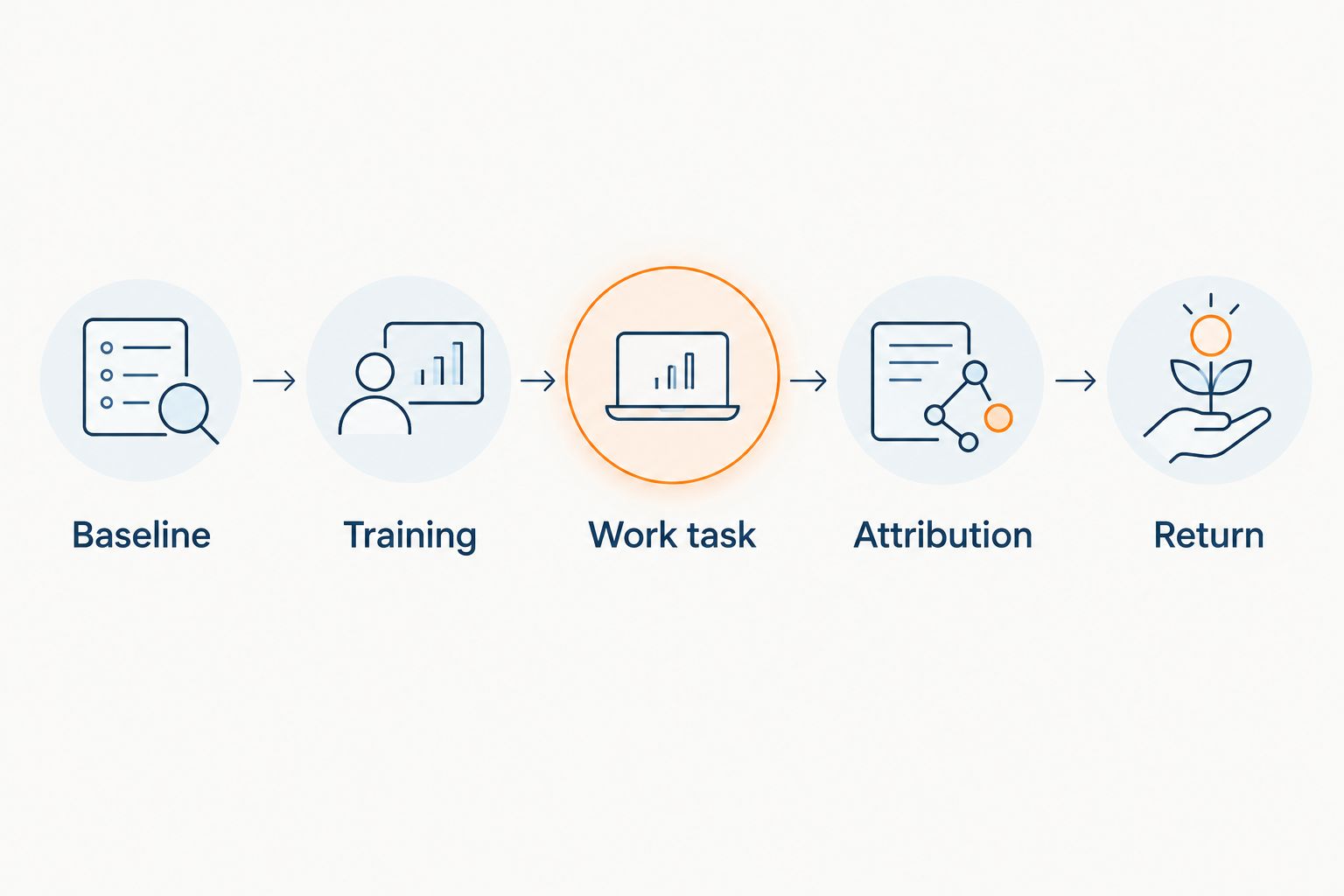
Check attribution before turning an observed improvement into a financial return.
The strength of your conclusion should match the strength of your design. A documented estimate beats a precise-looking percentage built on unsupported assumptions.
What belongs in the full training cost?
Include every resource your company uses to deliver and support the programme. Lesson fees alone are not the full investment.
Ask finance to approve the costing approach before you calculate ROI, and apply the same treatment across teams and reporting periods.
- Provider fees and required learning materials.
- Employees' paid learning time.
- Programme administration and scheduling time.
- Manager time spent on agreed assessments or coaching.
- Assessment or reporting costs tied directly to the programme.
Avoid counting the same resource twice. If an internal cost allocation already includes administration, do not add it again as a separate expense. Keep shared costs apart from incremental ones: a cost that exists regardless of the programme is treated differently from one incurred because training took place.
How do you calculate ROI without overstating the benefit?
Use the standard calculation:
ROI (%) = [(attributable monetary benefits − full training costs) ÷ full training costs] × 100
The hard part is not the formula. It is deciding which benefits qualify and how to value them.
For time savings, multiply the supported reduction in task time by task volume and an agreed labour-cost basis. Then distinguish capacity from cash. Finishing a task sooner creates capacity, but it does not automatically cut payroll. Say whether that capacity supported extra work, reduced overtime or simply created headroom.
For revenue-related outcomes, use the financial contribution attributable to the improvement, not the full sales value. Finance should approve how margins and delivery costs are treated.
Keep benefits you cannot value reliably out of the financial total. Report stronger presentations or clearer collaboration separately instead of assigning an arbitrary monetary figure.
Why does ROI from corporate English training vary?
Returns depend on the work employees do and whether they use the learning. The same language gain can carry different business value across roles.
- English use at work: Employees need chances to apply what they learn.
- Task relevance: Lessons must address the communication your chosen outcome needs.
- Starting ability: Assessment tasks must suit employees' existing skills.
- Workplace support: Managers must let employees use new communication habits.
- Programme costs: Learning time and administration add to provider fees.
- Measurement quality: Weak baselines and inconsistent scoring make the return less credible.
Do not compare team ROI figures without checking these conditions. A gap in reported return can reflect a different measurement method, not a better programme.
What does useful workplace English look like?
Useful workplace English makes the next action clear. Assess whether employees can clarify meaning, confirm responsibility and check a deadline without leaving a misunderstanding unresolved.
Example dialogue, written for illustration:
Manager: Can you send the revised forecast before the review? Analyst: Certainly. Do you mean the sales forecast or the cash-flow forecast? Manager: The cash-flow forecast, with the updated payment dates. Analyst: Understood. Who needs to approve it before I send it? Manager: Please ask the finance lead to check it. Analyst: I'll get approval first, then send the approved version.
The analyst checks the document, its content and the approval step. A workplace assessment can score those behaviours without claiming the exchange produced a particular saving.
How should you review the programme?
Set a review date before launch. An 8-week review works as an early operational checkpoint. It is not a promise that employees reach a particular level in that time.
- If attendance is weak, examine scheduling and workload.
- If learning improves but work performance does not, check task relevance and chances to practise.
- If work performance improves, check attribution and financial value.
- If costs exceed supported benefits, revise the scope before expanding.
Do not force every result into a positive ROI claim. A programme can show useful learning gains while its financial return stays unproven.
Flalingo is best for companies that want one-to-one English lessons with certified native tutors. That format suits a programme built around individual communication needs, but the format alone does not establish ROI. You still need workplace evidence and an agreed valuation method. See Flalingo for the lesson format.
Frequently asked questions
Can we use CEFR levels to calculate training ROI?
CEFR levels describe language proficiency, not financial return. Track them alongside workplace measures, then calculate ROI only from benefits with a defensible monetary value.
Can employee surveys prove that English training worked?
Surveys show perceived usefulness, confidence and barriers to applying learning. They do not independently prove workplace improvement or financial return.
How should we handle employees who leave during the programme?
Record departures and explain how they affect the analysis. Do not remove their costs while keeping only the results of employees who finished.
Does a negative ROI mean we should stop English training?
It means measured monetary benefits did not exceed included costs under your assumptions. Check programme design, measurement period and non-financial objectives before stopping or changing it.
Can we compare results across countries?
Only after aligning task definitions, scoring and cost treatment. Keep local operating conditions visible instead of treating unlike teams as equivalent.
What should you agree on before buying training?
Write the success measure before selecting lessons. Define the task, baseline, assessor, review date and financial treatment in a short measurement brief.
Then choose the training that supports that brief. If you cannot explain how a lesson connects to a workplace task, revise the objective before trying to calculate a return.
Sources
- HM Treasury, The Magenta Book: Central Government Guidance on Evaluation, https://www.gov.uk/government/publications/the-magenta-book
- HM Treasury, The Green Book: Central Government Guidance on Appraisal and Evaluation, https://www.gov.uk/government/publications/the-green-book-appraisal-and-evaluation-in-central-government
- Council of Europe, Common European Framework of Reference for Languages: Companion Volume, https://www.coe.int/en/web/common-european-framework-reference-languages
Learn with Flalingo
- English training for companies
- Free company English level test
- English lessons as an employee benefit
- Business English lessons for employees
Related guides
- Can finance teams negotiate better in English after training?
- Business English Phrases: What Are the Most Commonly Used Phrases in the Workplace?
- Flalingo Interview English Prices: Practice, Feedback and Costs
- Flalingo Business English Prices: Plans, Costs and Features
- Best 6 Online English Courses for Job Interviews




Mert Afacan is a results-oriented professional with in-depth expertise in business development, strategy and operational management. Throughout his career, he has led corporate growth processes by focusing on data analytics, process optimisation and market expansion strategies. Known for his ability to simplify complex problems with innovative solutions, Afacan brings a visionary perspective to his projects by closely following sectoral transformations. His approach, which combines discipline in strategic planning with operational speed, distinguishes him as a manager who makes a difference and creates value in the dynamic business world.
English with Flalingo

Learning English with Flalingo means progressing with an intelligent system that works in an integrated manner.