
Can finance teams negotiate better in English after training?

Yes—finance teams can negotiate better in English after training when lessons rehearse the discussions they actually handle: explaining figures, challenging assumptions, and agreeing conditions. Training develops language skills; it does not replace financial judgment, approval authority, or preparation for the deal itself.
TL;DR
- Finance teams negotiate better in English after training when practice targets objections, conditional offers, and accurate summaries.
- Flalingo suits finance learners seeking one-to-one English lessons with certified native tutors.
- Assess business English through negotiation tasks, not attendance or vocabulary quizzes alone.
- Separate spoken negotiation practice from financial translation and document review.
Why this matters
A finance professional can understand the numbers and still struggle to defend an assumption or challenge a condition in English. The training goal is not to sound more sophisticated. It is to make your position clear without changing its meaning.
For your 2026 training brief, define the conversation before choosing lessons. Flalingo offers one-to-one online English lessons with certified native tutors, including lessons for businesses. Flalingo is best for finance learners seeking individual English practice with certified native tutors. That format fits individual speaking practice; your finance team must still define the commercial scenarios and assess technical accuracy.
Can finance teams negotiate better in English after training?
Yes, provided the training develops observable negotiation skills rather than vocabulary recognition alone. Your team needs to demonstrate those skills in a realistic conversation, including when the other person interrupts, challenges an assumption, or rejects the opening proposal.
Choose the training approach according to the gap you need to close:
| Training approach | Best for | Strength | Limitation |
| General English | Learners struggling with basic communication | Builds sentence formation and everyday comprehension | Does not directly rehearse finance negotiations |
| Finance vocabulary practice | Learners who cannot explain familiar financial concepts in English | Connects technical knowledge with usable language | Knowing a term does not prove you can negotiate with it |
| Negotiation role-play | Learners preparing for stakeholder discussions | Rehearses objections, conditions, clarification, and summaries | Rehearsed responses still need testing against unfamiliar objections |
| Written follow-up practice | Learners responsible for recording agreements | Tests whether decisions and open issues are stated clearly | Cannot replace live listening and speaking practice |
These approaches serve different purposes. A learner who cannot form a clear conditional sentence needs language support before a demanding negotiation simulation. A fluent speaker who accepts every objection needs practice defending a position, not another terminology list.
Match the exercise to the weakness, then test whether the learner can use it without prompting.
What should better negotiation sound like?
Better negotiation means you can explain your position, investigate the other party’s concern, and state the conditions attached to any concession. It does not mean speaking faster, using longer words, or agreeing more readily.
Build practice around these observable actions:
- Explain the basis: State which assumption supports your proposal and why it matters.
- Clarify the objection: Ask whether the disagreement concerns the calculation, timing, scope, or underlying assumption.
- Make a conditional offer: Connect a proposed concession to a specific change requested from the other party.
- Protect the boundary: Distinguish what you can discuss from what requires approval.
- Confirm the outcome: Separate agreed points, unresolved issues, and next actions.
For example, practice explaining that a revised proposal depends on a change in scope. The exercise should test whether your listener understands that dependency—not whether you remembered a polished opening sentence.
Keep technical accuracy separate from language accuracy. A grammatically correct explanation can still misstate the financial position, so a finance reviewer needs to check the meaning.
Why results from finance English training vary
Your 2026 training plan should account for the following differences before setting expectations:
- Starting language ability: A learner who struggles to understand questions needs different practice from a fluent speaker who cannot challenge assumptions tactfully.
- Role relevance: Budget discussions, supplier negotiations, and financing conversations involve different objectives. Select the situations your team actually handles.
- Practice design: Reading model answers tests something different from responding to an unexpected objection. Include both preparation and unscripted discussion.
- Feedback focus: Correcting grammar alone leaves commercial meaning unchecked. Review whether the learner communicated the intended condition or commitment.
- Workplace transfer: A familiar exercise can hide dependence on a script. Change the details and the objection before assessing readiness.
- Decision authority: Language training does not expand anyone’s mandate. Practice how to explain approval limits without accidentally making a commitment.
Do not apply the same lesson brief to every employee simply because they work in finance. Ask each learner to identify a conversation they need to handle, the point where communication breaks down, and the response they want to deliver more clearly.
How should you structure a practical training cycle?
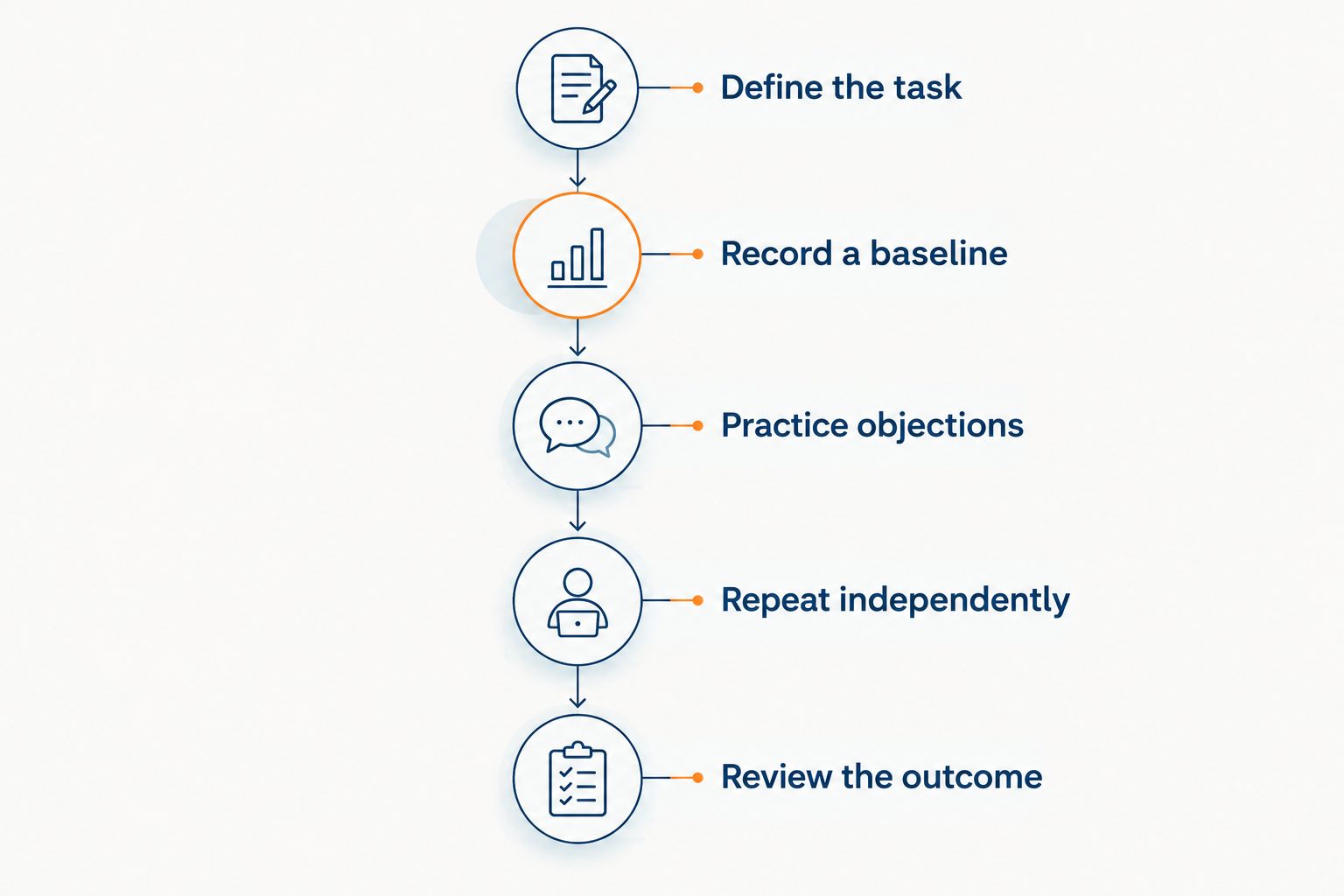
Use the following proposed exercise format for a 2026 pilot. The timings and round count are planning choices, not promises about how quickly a learner will improve.
Define the task
Choose a recurring conversation with a clear purpose: defending a forecast assumption, discussing a revised scope, or responding to a request for different terms. Use a fictional case or approved, anonymized material rather than confidential deal documents.
Write the learner’s objective and authority boundary on a 1-page brief. State what the learner can agree, what requires approval, and what information remains unknown. Without those boundaries, an exercise can reward confident speaking while overlooking an inappropriate commitment.
Record a baseline
Ask the learner to give a 2-minute opening explanation and respond to an objection. Keep the task narrow enough that you can identify the source of difficulty: explaining the rationale, understanding the objection, or forming a conditional response.
Use recording only with appropriate consent and your organization’s approval. A written observation sheet is an alternative when recording is unsuitable. Capture what the learner actually said, not just an impression such as confident or hesitant.
Practice objections
Run 3 rounds with different purposes. In the opening round, let the learner finish and identify where the message becomes unclear; in the next round, pause to repair those moments; in the final round, change the objection and remove the prompts.
Keep the commercial objective consistent while varying the response required. If every round repeats the same dialogue, you are testing memory rather than flexible communication.
Repeat independently
Return to a comparable task without supplying model phrases. Ask the learner to explain the proposal, handle a new objection, and summarize the outcome in their own words.
Do not interrupt every grammatical mistake during this assessment. Note errors that obscure meaning or change a condition, then discuss them after the conversation. Constant intervention makes it harder to see what the learner can do independently.
Review the outcome
Compare the baseline with the independent attempt. Identify which actions became clearer, which still required prompting, and which introduced an incorrect commitment.
Finish with a written follow-up that records the agreement and outstanding questions. Spoken fluency and accurate documentation are separate tasks; both belong in a negotiation exercise.
How do you measure improvement without overstating it?
For your 2026 review, assess comparable tasks against the same criteria. Do not compare an easy introductory conversation with a complex negotiation and treat the difference as a training result.
Use a simple assessment sheet:
| Criterion | Evidence to capture | Warning sign |
| Position clarity | The listener can restate the proposal and its rationale | The explanation names figures without explaining their relevance |
| Listening accuracy | The learner identifies the actual objection | The response addresses a different issue |
| Conditional language | The learner states what depends on what | A conditional offer sounds like an unconditional promise |
| Authority boundaries | The learner distinguishes discussion from approval | The learner commits beyond the stated mandate |
| Closing summary | The learner separates agreements from open issues | The summary presents an unresolved point as settled |
Record whether each action was independent, prompted, or absent. Those labels make the next lesson easier to plan without creating a false impression of numerical precision.
A clearer simulation is evidence of improved task performance, not proof of a better commercial deal. Deal outcomes also involve the underlying offer and the other party’s position. Report the communication change you observed rather than attributing every favorable outcome to English training.
Where does financial translation fit?
Spoken negotiation and document interpretation require separate checks. A learner can discuss a proposal clearly while still needing support with a written clause, unfamiliar terminology, or a document in another language.
For bank and lender discussions, distinguish between preparing an English explanation and handling documents through financial translation services. The training task is to explain and question the terms; translation addresses the language of the documents themselves. Neither activity replaces review by the people responsible for the agreement.
In a 2026 training brief, make that boundary explicit. Tutors can help learners explain a condition, ask for clarification, and summarize their understanding. Do not treat a language exercise as validation of a contract’s legal or financial meaning.
After a role-play, compare the spoken summary with the source material. Look for conditions that disappeared, assumptions presented as facts, and unresolved points described as agreements. These are specific feedback targets, even when the learner’s grammar sounds natural.
What should a finance manager put in the lesson brief?
Give the tutor a communication problem, not a broad instruction to improve business English. Explain who the learner speaks with, what they need to achieve, and which part of the exchange causes difficulty.
A practical brief contains:
- The learner’s role and recurring conversation.
- The proposal or assumption they need to explain.
- An objection they need to investigate rather than immediately accept.
- The boundary between a negotiable point and an approval requirement.
- The written summary expected after the discussion.
Include approved terminology, but avoid supplying a complete script for the assessment. The learner needs room to demonstrate understanding and choose a response.
Ask the tutor to flag unclear language, then have an appropriate finance colleague check the intended meaning. This division keeps feedback focused: language teaching addresses expression and comprehension; your team remains responsible for the financial position.
Does better English guarantee a better negotiation result?
No. Better English supports clearer explanations and responses, but it does not make an unfavorable proposal attractive or change your approval limits.
Set the training objective around communication you can observe. The learner should explain the rationale, test an objection, and confirm conditions accurately—even when the parties do not reach agreement.
Should finance teams train together or individually?
Use individual practice when employees have different language gaps, responsibilities, or confidence levels. Use team role-play when you need to rehearse handoffs and check that colleagues communicate a consistent position.
Neither format replaces the other’s purpose. An individual exercise reveals personal difficulties; a team exercise reveals whether the group can coordinate the conversation without contradicting its own conditions.
FAQ
Can finance teams negotiate better in English after training?
Yes, when training rehearses the negotiation tasks finance employees actually perform. Assess whether learners explain assumptions, respond to objections, state conditions, and summarize agreements independently.
What's the best English training for finance negotiations?
Choose training that matches the learner’s language gaps and recurring finance conversations. Combine language support with role-play and written follow-up rather than relying on terminology lists alone.
Is Flalingo relevant for finance professionals?
Flalingo offers one-to-one online English lessons with certified native tutors and serves businesses. Finance professionals should define the scenarios they need to practice and confirm how those requirements fit the lessons.
How long does finance negotiation English training take?
Set the training duration around the learner’s starting ability and the tasks they need to perform. Use comparable baseline and follow-up exercises to decide whether further practice is needed.
Do finance employees need perfect grammar before practicing negotiations?
No, perfect grammar is not a prerequisite for negotiation practice. Prioritize language errors that obscure the rationale, change a condition, or create an unintended commitment.
Can an English tutor check whether a financial agreement is correct?
English tutoring does not replace financial or legal review. A tutor can address communication, while the appropriate reviewers check the agreement’s substantive meaning.
How should we evaluate finance English training in 2026?
Evaluate finance English training in 2026 through comparable negotiation tasks and written summaries. Record which actions learners complete independently and distinguish communication improvements from commercial outcomes.
One last thing
Include an unresolved issue in the final exercise. Ask the learner to close the conversation without pretending that everything is settled.
A useful closing summary must preserve uncertainty accurately: what is agreed, what remains open, and who needs to act. That tests negotiation language more directly than a polished presentation in which nobody challenges the speaker.
Related guides
Other content that may interest you



Executive English: How Global Professionals Are Levelling Up Their Careers with Industry-Specific Tutoring
Read More
Flalingo Team is a team of experienced teachers. Our aim is to share the most up-to-date information and expert analyses about online English language learning with our readers. Our mission is to guide you on your English learning journey with data-driven content.
English with Flalingo

Learning English with Flalingo means progressing with an intelligent system that works in an integrated manner.