
Przejdź do treści
Flalingo

Ćwiczenia z angielskiego

Jak opisać swój dom w e-mailu po angielsku do kolegi, który przyjeżdża na nocleg (A2 Key, Part 6)

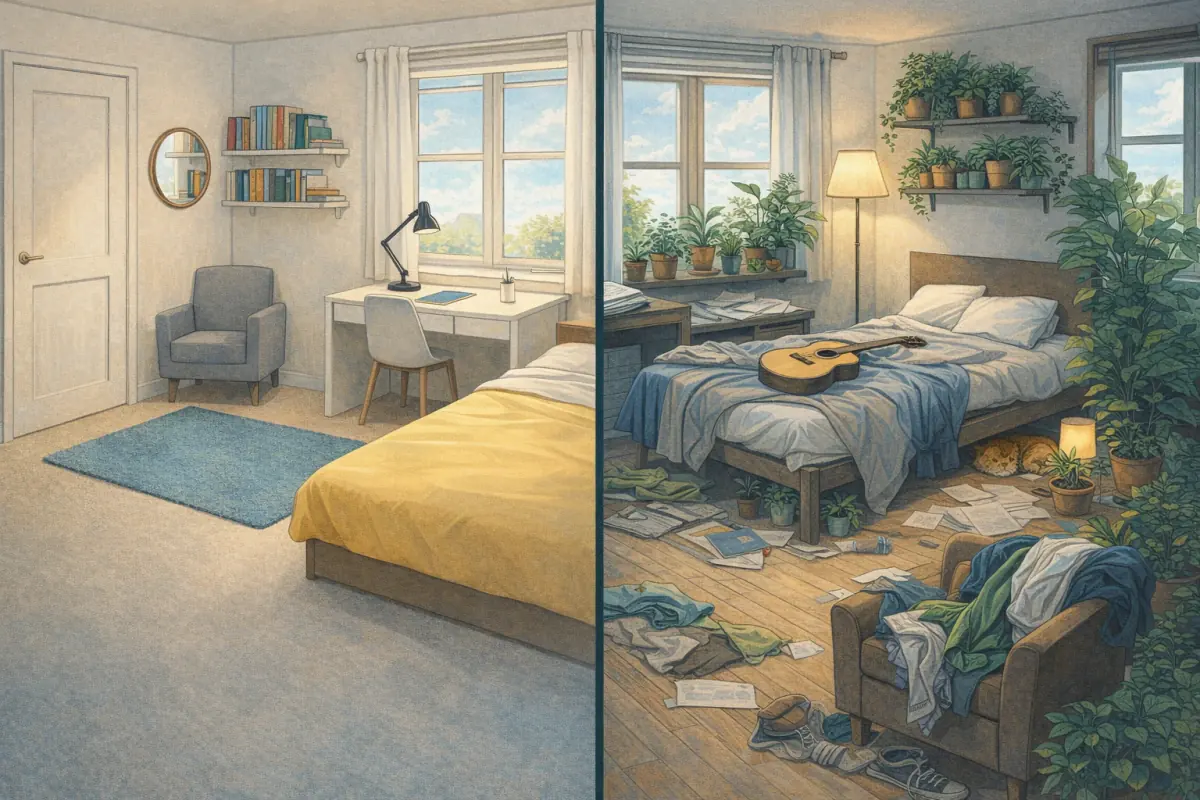
A tidy bedroom and an untidy bedroom side by side.

E-mail do gościa z Part 6 egzaminów A2 Key i A2 Key for Schools: there is i there are, określenia miejsca, takie jak opposite i next to, gdzie będzie spać kolega, przykładowy e-mail i typowe błędy. Poziom A2, wiek 11–15 lat.

E-mail do kolegi lub koleżanki, którzy przyjeżdżają do ciebie na nocleg, musi zawierać trzy rzeczy: krótki opis twojego domu (“Our flat is small but comfortable.”), informację, gdzie gość będzie spać (“You can sleep in my room.”), i coś, co możecie razem robić (“We can go swimming.”). To typ zadania z części Reading and Writing, Part 6, egzaminów A2 Key i A2 Key for Schools: 25 słów lub więcej, a 30–50 słów w zupełności wystarczy. Ten poradnik jest dla uczniów na poziomie A2 (podstawowym) w wieku około 11–15 lat.

Dla kogo jest ten artykuł?

  • Uczniowie w wieku około 11–15 lat, którzy przygotowują się do A2 Key lub A2 Key for Schools.
  • Uczniowie, którzy znają słowa takie jak “bedroom” i “kitchen”, ale mylą “there is” i “there are” albo zapominają o jednym punkcie e-maila.
  • Dla rodziców: możesz pomóc bez dobrej znajomości angielskiego; poproś dziecko, żeby opisało jeden pokój w domu w pięciu zdaniach, i sprawdźcie razem określenia miejsca.
  • Za wcześnie: jeśli krótki e-mail to dla ciebie wciąż nowość, zacznij od poradnika o e-mailu z prośbą o dołączenie do klubu (powitanie, zakończenie i trzy punkty).
  • Za łatwo: jeśli bez problemu piszesz e-mail na 100 słów o swoim domu, przejdź do zadań pisemnych z B1 Preliminary.

Otwórz przykładowe strony

Otwórz przykładowe strony

Karty ze słowami

next to

very close, at the side of something

Zara's mirror is next to the door.

opposite

on the other side, looking at something

There's a park opposite Amara's flat.

between

in the middle of two things

Zara's carpet is between the bed and the desk.

behind

at the back of something

Theo's desk is behind the plants.

in front of

the other side from behind

Zara's desk is in front of the window.

Rozmowa

Theo Is that your room, Zara? There aren't any clothes on the floor!

Zara Of course not. Look, these are my books, and that's my mirror, next to the door.

Zara Where's your desk, Theo? I can't see it.

Theo It's there, behind those plants. There are some papers on it.

Zara And is there a lamp?

Theo Yes, there is. It's on the floor, next to the bed.

Zara Theo! You have to tidy up!

Theo Why? It's comfortable.

Konstrukcja zdania

Your English friend is coming to stay with you. Write an email to your friend. In your email: describe your house or flat; say where your friend will sleep; say what you can do there. Write 25 words or more.

Hi Sam, I can't wait to see you! Our flat is small but comfortable. There are two bedrooms and a big kitchen. You can sleep on the sofa in the living room. We can play basketball in the park opposite. See you soon! Alex

This model has 44 words and answers all three points.

  • 1 your home: There are ... / Our flat is ...
  • 2 where your friend will sleep: You can sleep ...
  • 3 what you can do: We can ...
  • 25 words or more

Więcej ćwiczeń

Amara's email

EFUA'S MESSAGE: Hi Amara! Tell me about your new flat. What's your room like? What can you do near your home?

AMARA'S EMAIL: Hi Efua, thanks for your message! Here's my room tour in words. Our flat is on the third floor of a tall building. It isn't very big, but it's comfortable. My brothers Kofi and Yaw share a bedroom, and I've got a small room next to the kitchen.

In my room, there's a bed under the window, a desk and some shelves for my books. There aren't any photos on my walls yet. Can you send me a photo of you?

There's a park opposite our flat. There's a basketball court there, and I play with my new friends every Saturday. Love, Amara

There is, there are

There's a ... / There is a ...

for one thing

There's a guitar on the bed.

There are some ...

for more than one thing

There are some books on the shelf.

There isn't a ... / There aren't any ...

for things that are not there

There aren't any plants in Zara's room.

Is there a ...? / Are there any ...?

for questions

Is there a mirror in your room? Yes, there is.

a / an

an before a, e, i, o, u sounds

a lamp, a desk, an armchair

this / these

for things near you

This is my desk. These are my books.

that / those

for things not near you

Those photos over there are from Mexico City.

Are there any plants in your room?

Yes, there are some plants on the shelf. / No, there aren't any plants.

Use some in positive sentences and any in negatives and questions.

  • There's a lamp.
  • There are some books.
  • There aren't any plants.
  • Is there a mirror?
  • Are there any photos?

Write your email

Your English friend is coming to stay with you. Write an email to your friend. In your email: describe your house or flat; say where your friend will sleep; say what you can do there. Write 25 words or more.

Hi Sam, I can't wait to see you! Our flat is small but comfortable. There are two bedrooms and a big kitchen. You can sleep on the sofa in the living room. We can play basketball in the park opposite. See you soon! Alex

This model has 44 words.

  • There are ...
  • You can sleep ...
  • We can ...
  • next to / opposite

Check your email

Point 1: my home

Did you describe your house or flat?

Our flat is small but comfortable.

Point 2: where you will sleep

Did you say where your friend will sleep?

You can sleep on the sofa.

Point 3: what we can do

Did you say what you can do there?

We can play basketball in the park.

Place words

Did you use a place word (next to, opposite, under, on)?

We can play basketball in the park opposite.

25 words or more

Count your words.

The model has 44 words.

Poznaj ten rozdział
Jak chcesz się uczyć?

Jak wygląda zadanie na egzaminie

W części Reading and Writing, Part 6, egzaminów A2 Key i A2 Key for Schools czytasz opis sytuacji z trzema punktami i piszesz 25 słów lub więcej. Oto zadanie w tym samym stylu, przygotowane do tego poradnika:

  • “Your English friend Sam is coming to stay for the weekend. Write an email to Sam.”
  • “Describe your home.”
  • “Say where Sam will sleep.”
  • “Say what you can do together.”
  • “Write 25 words or more.”

Punkt 1: opisz dom za pomocą there is i there are

Zacznij od jednego ogólnego zdania, potem dodaj szczegół ważny dla gościa. Używaj “There’s” przy jednej rzeczy i “There are” przy kilku; “some” w zdaniach twierdzących, a “any” w większości przeczeń i pytań.

  • Ogólnie: “We live in a flat on the third floor.”
  • Jedna rzecz: “There’s a big kitchen.”
  • Kilka rzeczy: “There are some shops near our building.”
  • Czego nie ma: “There isn’t a lift.” / “There aren’t any shops in our street.”

Określenia miejsca, dzięki którym widać obraz

Naucz się dobrze tych pięciu, a do tego “in”, “on” i “under”. Polskie „naprzeciwko” to “opposite”, a „przed” to “in front of”.

  • “next to”: “The bathroom is next to your room.”
  • “opposite” (naprzeciwko, często po drugiej stronie ulicy): “There’s a park opposite our flat.”
  • “between”: “The sofa is between the window and the door.”
  • “behind”: “There’s a garden behind the house.”
  • “in front of” (przed czymś, blisko jego frontu): “There’s a bus stop in front of our building.”

Punkty 2 i 3: gdzie gość będzie spać i co możecie robić

Punkt o spaniu łatwo pominąć, bo to plan, a nie opis. Uważaj na przyimek: w łóżku albo w pokoju to “in”, a na kanapie albo na podłodze to “on”, tak jak po polsku „w” i „na”.

Przy aktywności użyj “can” + czasownik, bez “to”. Wiele aktywności to “go” + -ing: go swimming, go shopping.

  • “You can sleep in my room. I can sleep on the sofa.”
  • “We can play basketball in the park opposite.”
  • “We can go swimming. There’s a pool next to my school.”

Przykładowy e-mail, linijka po linijce

Przy każdej linijce jest jej funkcja. Cały e-mail ma około 50 słów.

  • “Hi Sam, I’m so happy you’re coming!” → powitanie i przyjazny początek.
  • “We live in a small flat with two bedrooms and a balcony.” → punkt 1: twój dom.
  • “You can sleep in my room, and I can sleep on the sofa.” → punkt 2: gdzie Sam będzie spać.
  • “There’s a pool opposite our building, so we can go swimming.” → punkt 3: co możecie robić.
  • “See you on Saturday! Deniz” → zakończenie i twoje imię.
Poznaj ten rozdział po swojemu

Opisywanie pokoju na głos

Kiedy mówisz, potrzebujesz tych samych zwrotów. Tutaj dwoje przyjaciół, Zara i Theo, porównuje swoje pokoje. Wsłuchaj się w “There are some”, “Is there a …? Yes, there is.”, “behind” i “next to”.

Zara Where's your desk, Theo? I can't see it.

Theo It's there, behind those plants. There are some papers on it.

Zara And is there a lamp?

Theo Yes, there is. It's on the floor, next to the bed.

Typowe błędy i jak je poprawić

Część bierze się z polskiego: zdanie „W moim pokoju jest biurko” prowadzi do “In my room is a desk.”, a „meble” w liczbie mnogiej podsuwają “furnitures”. W polskim nie ma też przedimków, więc sprawdź, czy przed “desk” albo “kitchen” stoi “a”. Poszukaj tych błędów przy sprawdzaniu (przed strzałką błąd, po niej poprawka) i upewnij się, że w e-mailu jest informacja, gdzie gość będzie spać.

  • “There is two bedrooms.” → “There are two bedrooms.”
  • “In my room is a desk.” → “There’s a desk in my room.”
  • “There aren’t some shops.” → “There aren’t any shops.”
  • “We have a lot of furnitures.” → “We have a lot of furniture.”
  • “You can sleep in the sofa.” → “You can sleep on the sofa.”

Twoja 10-minutowa rutyna egzaminacyjna

Minuta na plan (dom, łóżko, aktywność), sześć minut na pisanie i trzy na sprawdzenie. Do ćwiczenia mówienia opisz jeden pokój w domu w pięciu zdaniach, a ktoś niech go narysuje.

  • “Your English cousin is coming to stay for a week. Write an email. Say what your bedroom is like, where your cousin can put their clothes and what you can do in your town. Write 25 words or more.”
  • Sprawdź: czy jest zdanie do każdego punktu i określenie miejsca?
  • Sprawdź: “There’s” przy jednej rzeczy, “There are” przy kilku? 25 słów lub więcej i twoje imię?

Co dalej

Potem poćwicz krótkie wiadomości z propozycją i uzasadnieniem z “because”. Na B1 Preliminary e-mail rośnie do około 100 słów i odpowiada na cztery notatki.

Najczęstsze pytania

Ile słów powinien mieć e-mail z Part 6 na A2 Key?

Co najmniej 25; górnej granicy nie ma. 30–50 słów wystarczy, a dłuższy tekst sam w sobie nie daje punktów.

Kiedy “there is”, a kiedy “there are”?

“There is” stoi przed jedną rzeczą albo rzeczownikiem niepoliczalnym (“There isn’t much furniture.”); “there are” przed kilkoma rzeczami (“There are two bedrooms.”).

Czym się różni “opposite” od “in front of”?

“Opposite” to naprzeciwko, często po drugiej stronie ulicy; “in front of” to przed czymś, blisko jego frontu. Mówi się “opposite our flat”, a nie “opposite of our flat”.

Flalingo nie jest powiązane z Cambridge English, organizatorem egzaminów A2 Key i B1 Preliminary, ani przez tę instytucję rekomendowane.

Poznaj ten rozdział
Jak chcesz się uczyć?

Co dalej?

Lekcje jeden na jeden z lektorem na żywo

We Flalingo nastolatki przerabiają takie rozdziały jeden na jeden z lektorem na żywo, we własnym tempie.

Umów bezpłatną lekcję próbną