
본문으로 바로가기
Flalingo

영어 연습

영어로 음식에 얽힌 기억 말하는 법 (C1+ 고급 심화): 감각 어휘, 먹고 마시는 동사, 정직한 디테일

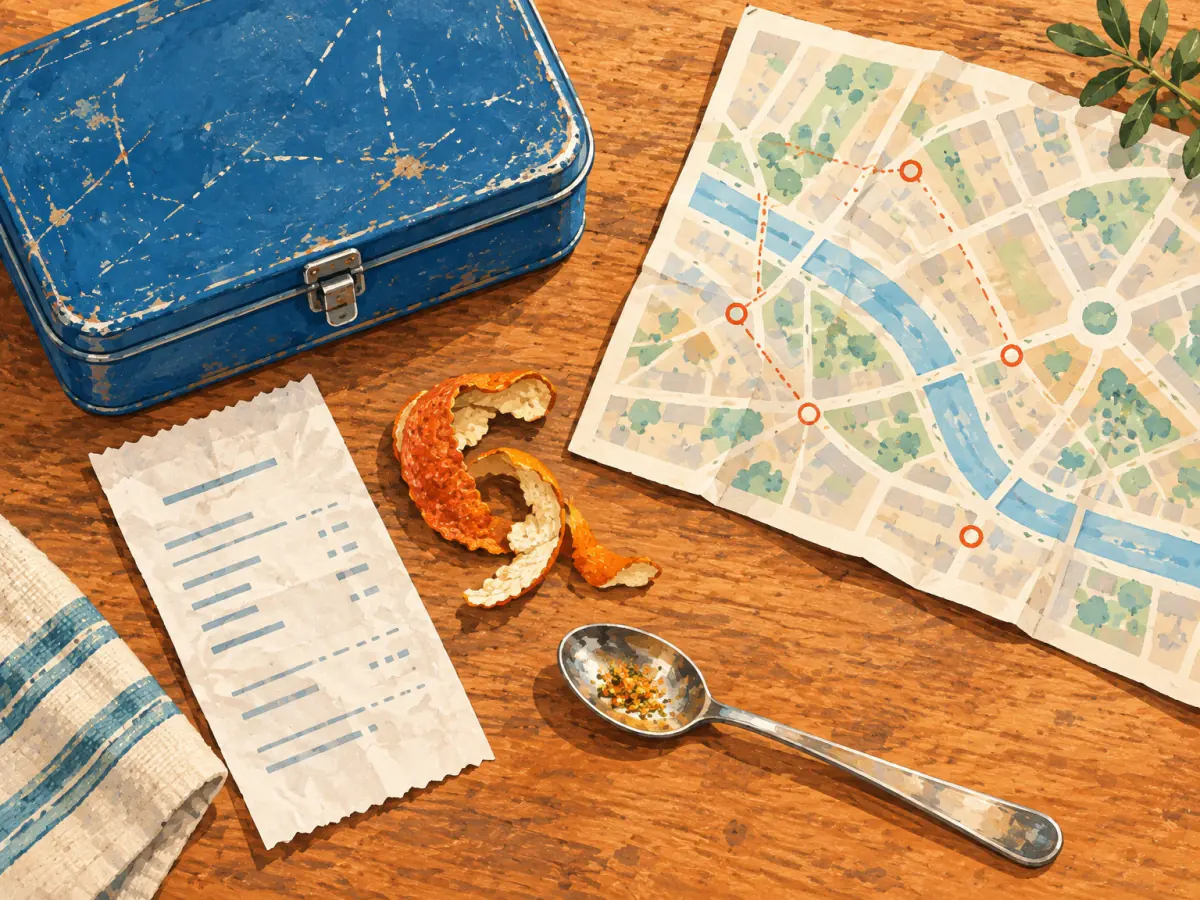
A blue lunch tin, receipt, citrus peel, spoon and marked map lie together on a desk.

C1+(고급 심화) 수준에서 음식이 불러온 기억을 영어로 말하는 법: 냄새와 맛을 정확히 표현하는 단어, 먹고 마시는 동사, 다섯 가지 짧은 모음, 그리고 기억한 것과 확인할 수 있는 것을 구분하는 방법을 배워요.

음식에 얽힌 기억을 영어로 잘 말하려면 기억을 불러온 계기로 시작해 감각을 정확한 단어로 표현하고, 기억한 것과 확인할 수 있는 것을 구분하세요. “whiff”는 잠깐 스친 옅은 냄새, “aroma”는 대개 좋은 향이고, “sip”, “slurp”, “guzzle”은 서로 다른 마시는 방식이에요. 생생하다고 정확한 것은 아니니 얼마나 확신하는지 표시하세요. “I suspect it was me that had changed.” 이 주제는 C1+(고급 심화) 수준으로, 정확하고 정직하게 이야기하고 싶은 유창한 성인을 위한 내용이에요.

이 글이 맞는 분

  • 영어는 유창하지만 음식을 늘 “eat”, “drink”, “nice”, “smell” 같은 몇 단어로만 묘사하는 고급 학습자.
  • 영어로 이야기를 들려주는 분: 일상 대화, 면접, 팟캐스트, 구술사나 가족 기록 프로젝트에서.
  • 특히 다른 사람이 등장하는 이야기에서 과장하지 않으면서도 생생하게 말하고 싶은 분.
  • 아직 이르다면: 근거로 주장을 뒷받침하는 일이 아직 어렵다면 영화 관광과 관리 비용을 연결하는 C1 에세이부터 시작하세요.
  • 너무 쉽다면: 정확한 동사와 신중한 단서 달기가 이미 자연스럽다면 대조 강세로 문화적 일반화 바로잡기나 혼자 일하기에 대한 균형 잡힌 의견으로 넘어가세요.

예시 학습 페이지 열기

예시 학습 페이지 열기

단어 카드

Personal · a taste of the past

Is there a dish that instantly brings back a particular place or person for you? What exactly do you remember about it?

Useful: ‘The moment I catch a whiff of…, I’m back in…’ · ‘If I had to recreate it, I’d start with…’ · ‘What I remember most vividly is…’

Personal · going back

Have you ever gone back to a food or a place from your past and found it was not as you remembered? What had changed, it or you?

Useful: ‘Had I known…, I might not have gone back.’ · ‘It tasted nothing like…’ · ‘I suspect it was me that had changed.’

대화

Gammon, cabbage, carrots, pineapple: the vowel in cat.

Herring, pepper, cherries, lettuce: the vowel in bed.

Sniff, dill, dribble, kipper: the vowel in sit.

Scoff, chopped, broccoli, porridge: in British English, the vowel in hot.

Guzzle, stuffed, mussels, Brussels sprouts: the vowel in cup.

After a w sound, the written a in swallow, quarrel, swapped, squabble, quarry and waddle sounds like the vowel in hot.

Sip becomes sipped, and hot becomes hotter: double the final consonant after one stressed short vowel before a vowel-initial ending.

문장 형태

Sensory meanings

  • sniff (noun or verb) — a short act of breathing in through the nose to detect a smell: “Owen gave the tin a cautious sniff before describing it.”
  • whiff — a slight smell that is noticed briefly: “A whiff of scorched peel escaped when Maya lifted the felt.”
  • aroma — a noticeable smell, often a pleasant one associated with food or drink: “The tea left a warm citrus aroma inside the tin.”

추가 연습

Eleven actions, not eleven synonyms

Mouth and throat actions

  • chew — bite food into pieces and move it around the mouth: “Chew the dried pear before judging its texture.”
  • lick — move the tongue over a surface: “Maya licked sauce from the tasting spoon.”
  • suck — keep something in the mouth and pull on it with the lips or tongue: “Owen sucked a mint during the journey.”
  • swallow — make food or drink pass down the throat: “She swallowed the capsule with water.”

Quantity, speed and attitude

  • devour — eat all of something quickly because of strong hunger: “After the night shift, Maya devoured the rice bowl.”
  • guzzle — informally and disapprovingly drink, or sometimes eat, a large amount quickly: “He guzzled two energy drinks during the briefing.”
  • scoff — informally and disapprovingly eat a lot very fast: “They scoffed the pastries before the guests arrived.”

Sound, size and rhythm

  • munch — eat steadily and often noisily, especially something crisp: “She munched raw carrots while editing.”
  • nibble — take small bites: “He nibbled a corner of the unfamiliar cheese.”
  • sip — drink a very small amount at a time: “Maya sipped the hot broth cautiously.”
  • slurp — make a loud noise while drinking: “Owen slurped the noodles and apologized.”

The blue lunch tin

A blue lunch tin, receipt, citrus peel, spoon and marked map lie together on a desk.

When sound archivist Owen opened a donated blue lunch tin, a faint aroma of scorched orange peel escaped from its lining. He held the tin beneath his nostrils—the two openings at the end of the nose through which a person breathes—and sniffed once more. The whiff made him picture his first radio job: a windowless studio, a nervous producer and a winter broadcast interrupted by a fire alarm. He was certain the producer had brought citrus cake that afternoon. The memory felt complete, down to the sugar on his fingers.

Instead of putting that recollection into the public catalogue, Maya asked him to test it. They sniffed the tin again, examined the hinge and found a bakery receipt trapped beneath the felt. Its date was six years later than Owen’s broadcast. A former owner then explained that she had carried smoked-orange tea in the tin during overnight bus shifts. The smell had not recovered Owen’s event; it had supplied vivid detail to a different event that already mattered to him.

At a tasting session the next day, a sharp sweet made Owen’s taste buds—the small structures on the tongue that detect flavours—react strongly. Lemon syrup began to dribble, or run in a thin stream, from the corner of his mouth. This intense sensation produced no confident story at all. The contrast persuaded him that intensity is not proof of accuracy. The archive now records sensory memories in two layers: the recollection itself and the independent evidence, if any, that supports it.

Sensory meanings

  • sniff (noun or verb) — a short act of breathing in through the nose to detect a smell: “Owen gave the tin a cautious sniff before describing it.”
  • whiff — a slight smell that is noticed briefly: “A whiff of scorched peel escaped when Maya lifted the felt.”
  • aroma — a noticeable smell, often a pleasant one associated with food or drink: “The tea left a warm citrus aroma inside the tin.”

Record a responsible sensory memory

A blue lunch tin, receipt, citrus peel, spoon and marked map lie together on a desk.
이 단원 배우기
어떻게 배우고 싶나요?
계정이 있나요?

무료 계정은 한 단원을 계속 열어 둘 수 있습니다.

냄새와 맛: 정확한 단어 여섯 개

기억은 냄새로 시작될 때가 많으니 정확한 이름을 붙이세요. 한국어가 ‘냄새’와 ‘향기’를 구분하듯, 영어도 냄새가 얼마나 머무는지, 좋은지 나쁜지에 따라 단어가 달라져요.

  • “sniff”: 코로 짧게 숨을 들이마시는 것. 동사로도 명사로도 써요.
  • “whiff”: 잠깐 스치듯 느껴지는 옅은 냄새. “I caught a whiff of smoke.”
  • “aroma”: 음식이나 음료에서 나는 뚜렷하고 대개 좋은 향. “the aroma of fresh coffee” 불쾌한 냄새에는 “odour”, 아주 지독하면 “stench”를 써요.
  • “nostrils”: 콧구멍.
  • “taste buds”: 혀에서 맛을 감지하는 작은 기관, 즉 미뢰.
  • “dribble”: 주로 입에서 가늘게 흘러내리다. “Lemon syrup dribbled from the corner of his mouth.”

“eat”과 “drink”를 더 정확하게

동사마다 양, 속도, 소리, 태도가 더해져요. “guzzle”과 “scoff”는 비판적으로 들리고, 이런 뜻의 “scoff”는 주로 영국 영어예요.

  • 입의 동작: “chew”(씹다), “lick”(핥다), “suck”(빨다), “swallow”(삼키다).
  • 배고픔과 속도: “devour”(배가 고파 빠르게 다 먹어 치우다), “guzzle”(많이 빨리 마시다), “scoff”(많이 빨리 먹다). “We scoffed the pastries before the guests arrived.”
  • 크기와 소리: “nibble”(조금씩 베어 먹다), “munch”(꾸준히, 흔히 소리 내며 먹다), “sip”(조금씩 홀짝이다), “slurp”(후루룩 소리 내다). “He slurped his noodles and apologised.”
  • 시작: “dig in”(흔히 “어서 드세요” 같은 권유)과 “tuck into”(신나게 먹기 시작하다).
  • 마무리: “eat up”(자기 몫을 다 먹다), “polish off”(남은 것을 해치우다), “put away”(놀랄 만큼 많이 먹다), “wolf down”(허겁지겁 먹다).
  • 입맛이 없을 때: “pick at”(깨작거리다)과 “toy with”(음식을 이리저리 뒤적이다). “She toyed with her pasta while she waited for the news.”

기억한 디테일과 확인할 수 있는 디테일

강한 냄새는 한 장면을 통째로 되살리고 확신까지 주지만, 강렬함이 증거는 아니에요. 기증받은 도시락 통에서 탄 오렌지 껍질 냄새를 맡고 첫 직장에서 먹은 케이크를 ‘기억해 낸’ 기록 보관 담당자를 떠올려 보세요. 통 안의 영수증은 그가 기억하는 날보다 6년 뒤의 것이었어요. 냄새는 진짜였지만 이야기는 아니었어요.

기억은 층을 나눠 이야기하세요.

  • 계기는 생생하게: “What I remember most vividly is the steam on the windows.”
  • 믿는 것은 기억이라고 표시해서: “I’m fairly sure it was a Sunday, but I couldn’t swear to it.”
  • 확인할 수 있는 것: 사진, 영수증, 날짜, 다른 사람의 이야기.
  • 달라진 점: “It tasted nothing like I remembered.”

과거로 돌아가는 표현과 그 문법

표현 전체를 통째로 익혀 두세요.

  • “The moment I catch a whiff of…, I’m back in…” “the moment”는 “as soon as”, 즉 ‘~하자마자’라는 뜻이고, 현재 시제는 매번 되풀이되는 경험임을 보여 줘요.
  • “If I had to recreate it, I’d start with…” 상상 속 과제를 말하는 가정법 과거예요.
  • “Had I known…, I might not have gone back.” 도치된 가정법 과거완료예요. “Had I known”은 “If I had known”, 즉 ‘알았더라면’이라는 뜻이에요.
  • “I suspect it was me that had changed.” 초점을 음식에서 나로 옮기는 강조 구문(분열문)이에요.
나에게 맞는 방법으로 이 단원 배우기

듣기: 음식 단어 속 다섯 가지 짧은 모음

각 줄의 단어는 같은 짧은 모음을 공유하고, 겹자음이 대개 그 짧은 모음을 알려 줘요. “dinner”와 “diner”를 비교해 보세요. “chopped”, “hotter”에서 자음을 겹쳐 쓰는 것도 같은 이유예요. 요즘 한국어에서는 ‘ㅐ’와 ‘ㅔ’ 발음이 거의 같아져서 “cat”과 “bed”의 모음을 구분하기 어려워요. “cabbage”에서는 “pepper”보다 입을 더 크게 벌리세요. “hot” 줄은 영국식 발음이고, 미국 영어에서는 더 열린 모음을 써요.

Gammon, cabbage, carrots, pineapple: the vowel in cat.

Herring, pepper, cherries, lettuce: the vowel in bed.

Sniff, dill, dribble, kipper: the vowel in sit.

Scoff, chopped, broccoli, porridge: in British English, the vowel in hot.

Guzzle, stuffed, mussels, Brussels sprouts: the vowel in cup.

자주 하는 실수

이야기에서 다음을 확인하세요.

  • “It smells well.” “It smells good.”라고 하세요. “smell well”은 냄새를 잘 맡는다는 뜻이에요.
  • “an awful aroma” “aroma”는 보통 좋은 향이에요. “an awful smell”이라고 하세요.
  • “I ate my medicine.” ‘약을 먹다’를 그대로 옮긴 표현이에요. 영어에서는 “I took my medicine.”라고 해요.
  • “choped”, “hoter”. 자음을 겹쳐 쓰세요: “chopped”, “hotter”.
  • 생생한 디테일을 사실처럼 말하기: “My aunt made it every Friday.” 더 나은 표현: “I remember it as a Friday dish, but I may be mixing up two visits.”

하루 15분 연습법

먼저 말하고, 고치는 건 나중에 하세요.

  • 3분: 녹음된 다섯 줄을 따라 말하고, 각 줄에서 단어를 하나씩 골라 문장을 만드세요.
  • 4분: 어제 먹은 음식을 이 글의 동사 다섯 개로 묘사하세요. “eat”과 “drink”는 쓰지 마세요.
  • 4분: 위의 표현 두 개를 써서 내 음식 기억을 녹음하세요.
  • 4분: 다시 들으며 디테일마다 ‘기억’인지 ‘확인 가능’인지 표시하고 다시 이야기하세요. 그다음 이 질문으로 토론해 보세요. “Is a memory that is partly rebuilt or invented still true in any meaningful sense?”

다음 단계

같은 신중함을 다른 주장에도 적용해 보세요. 틀린 부분을 정확히 강조해 문화적 일반화를 바로잡거나, 전체가 늘어나는데 줄어드는 비율을 설명하거나, 혼자 일하기에 대한 균형 잡힌 의견을 써 보세요.

자주 묻는 질문

“whiff”와 “aroma”는 어떻게 다른가요?

“whiff”는 좋든 나쁘든 잠깐 스치는 옅은 냄새예요. “aroma”는 뚜렷하고 대개 좋은 향으로, 주로 음식이나 음료에서 나요.

“sip”, “slurp”, “guzzle”은 어떻게 다른가요?

“sip”은 조금씩 홀짝이는 것, “slurp”은 소리 내며 마시는 것, “guzzle”은 많은 양을 빨리 마시는 것이에요. “guzzle”에는 보통 못마땅한 느낌이 담겨요.

과장하지 않고 영어로 기억을 이야기하려면 어떻게 하나요?

계기는 생생하게 말하고 “I’m fairly sure”, “I suspect” 같은 표현으로 확신의 정도를 표시하세요. 그리고 기억한 것과 사진, 영수증, 다른 사람이 확인해 줄 수 있는 것을 구분하세요.

이 단원 배우기
어떻게 배우고 싶나요?
계정이 있나요?

무료 계정은 한 단원을 계속 열어 둘 수 있습니다.

다음에는 무엇을 할까요?

Flai로 계속 연습하세요

Flai는 음성 대화, 교정 내용, 수업 보고서로 말하기 연습을 돕는 Flalingo의 AI 말하기 앱입니다.

라이브 선생님과 배우기

Flalingo 수업에서는 이런 단원을 라이브 선생님과 1:1로 연습합니다.