

Skip to content
Flalingo

English practice

B1 Preliminary Reading Part 1 and modal verbs: should, must, mustn’t or needn’t in six exam-week rules

A teenager shares out the work at the whiteboard, and a friend points at a surprise email on his laptop.

Advice, rules and “not necessary” for B1 Preliminary and B1 Preliminary for Schools: should, ought to, must, have to, mustn’t, don’t have to and needn’t, how Reading Part 1 notices use them, six model rules and typical mistakes.

Use should or ought to for advice, must or have to when something is necessary, mustn’t when it is not allowed, and don’t have to or needn’t when it isn’t necessary. Learn this pair first: “You mustn’t use your phone” means it’s against the rules; “You don’t have to bring lunch” means you can if you want. Many notices in B1 Preliminary Reading Part 1 are rules like these. This guide is for B1 learners aged about 12–16 preparing for B1 Preliminary or B1 Preliminary for Schools.

Who this is for

  • Students preparing for B1 Preliminary or B1 Preliminary for Schools, about 12–16 years old.
  • You know must and should, but you mix up mustn’t and don’t have to, or write “must to”.
  • Parents: read a sign or a school rule aloud and ask your teen, “Advice, necessary, not allowed or not necessary?” You don’t need perfect English for this.
  • Too early: if must, mustn’t and don’t have to still feel new, start with the A2 Key guide to school rules (link below).
  • Too easy: if you already use all seven forms correctly, including had to and will have to, move on to the Listening and story guides (links below).

Open the sample pages

Open the sample pages

Word cards

exhausted

extremely tired

Zara was exhausted after only four hours of sleep.

advise

tell someone what you think they should do

The nurse advised us to sleep more.

attempt

a try, often at something difficult; also a verb: try to do something difficult

It was Zara's first attempt to share her work.

Conversation

Zara I'm sorry about yesterday. I've tried to do everything myself, and I'm exhausted.

Amara We know. So let us help. What do you need?

Zara Kai, could you finish the interview videos? Theo, could you write the music? Amara, you don't have to do anything this week. Rest your ankle.

Kai See? Sharing isn't so hard.

Theo And we mustn't forget to sleep!

Language pattern

The Loop's rules

RULES FOR SURVIVING EXAM WEEK 1 You must sleep for at least eight hours. 2 You should take a short break every hour. 3 You don't have to answer messages after ten o'clock. 4 You mustn't drink coffee to stay awake. 5 You ought to go for a twenty-minute walk every day. 6 You needn't do everything alone. Ask for help!

Six short rules. Mix the forms: at least one must, one mustn't, one should or ought to, and one don't have to or needn't. Use your own ideas.

  • You must …
  • You mustn't …
  • You should / ought to …
  • You don't have to / needn't …
  • sleep, breaks, food, exercise, phones, help

More practice

Advice or rule?

You ought to rest your ankle for a week.

ADVICE: ought to = should (Mrs Price)

You should keep your foot up on a cushion.

ADVICE: should + verb (Mrs Price)

Players must wear their team shirts on Saturday.

RULE: must (Coach Bell)

Amara has to see a doctor on Friday.

NECESSARY: have to / has to (Mrs Price)

You don't have to come to training this week.

NOT NECESSARY: don't have to (Coach Bell)

You needn't bring your kit.

NOT NECESSARY: needn't + verb (Coach Bell)

You mustn't play in the final.

NOT ALLOWED: mustn't (Coach Bell)

What's the difference between mustn't and don't have to?

You mustn't play on an injured ankle: it's not allowed. You don't have to come to training: it isn't necessary, but you can if you want.

Should and ought to give advice. Must and have to say something is necessary. Mustn't means: don't do it! Don't have to and needn't mean: it isn't necessary.

  • advice: should / ought to + verb
  • a rule or something necessary: must / have to
  • not necessary: don't have to / needn't
  • not allowed: mustn't
  • ought TO and have TO, but should and must with no to

Five short texts

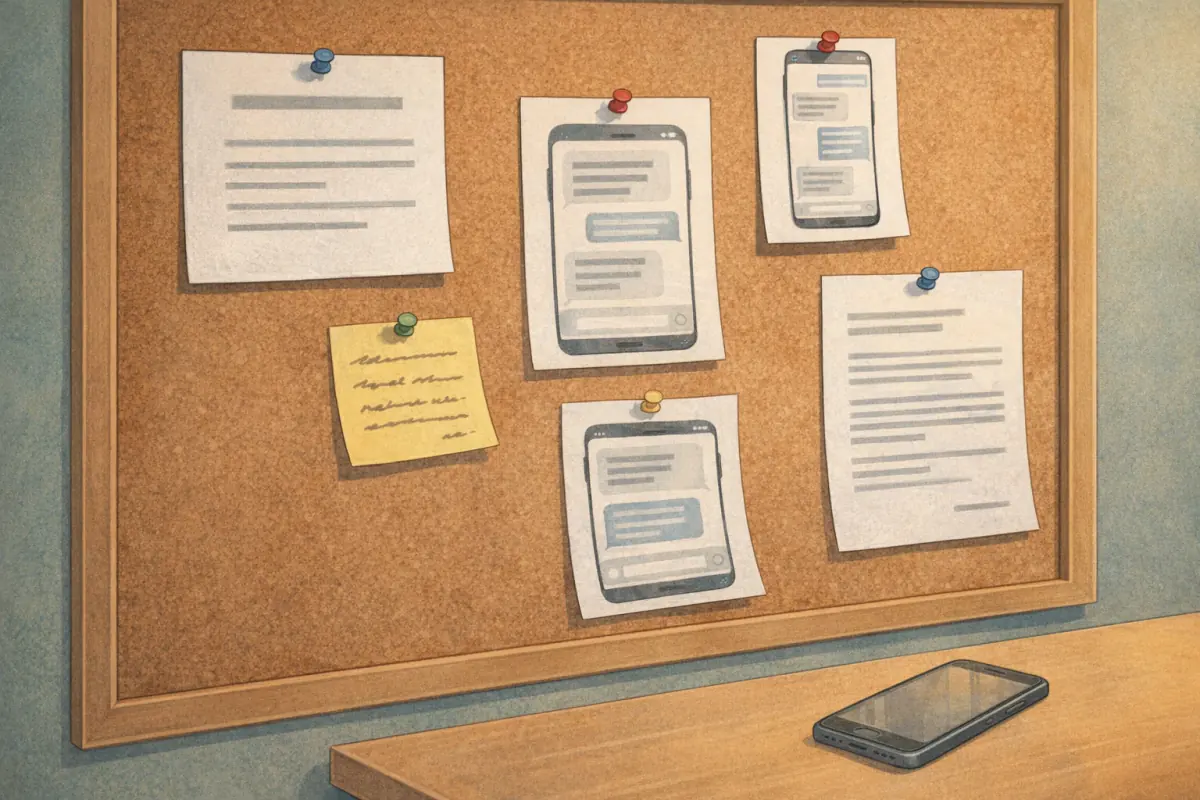
A noticeboard with five short texts: a sign, two messages, a note and a notice.

1 · Sign on the nurse's door

Feeling unwell? Knock and wait. If there is no answer, go to Reception. Please do not come in without knocking.

2 · Message from Hana

Zara, at my school in Busan lots of us study late before exams, and we all get tired. So my class made a rule: phones off at 10 and bed by 11. You ought to try it! Hana

3 · Note from the basketball coach

Amara, you needn't come to training this week. Rest your ankle! But please come and watch the final on Saturday. Coach Bell

4 · Message from Deniz

Our exams in Izmir start next week too! My friends and I study together in the library every afternoon. It's much less stressful than studying alone. Deniz

5 · Notice from Ms Rivera

Loop members: there's no club meeting on Thursday because of the exams. You don't have to bring your filming notes until next week, but you must tell Zara which interview you're working on by Wednesday.

Learn this unit
How would you like to learn?

Four meanings, seven forms

Each form has one of four meanings. Decide the meaning first, then the form:

  • Advice: “You should take short breaks.” “You ought to eat breakfast.”
  • Necessary: “You must switch off your phone.” “I have to finish my project.”
  • Not allowed: “You mustn’t talk during the exam.”
  • Not necessary: “You don’t have to come.” “You needn’t bring a pen.”

Must or have to? Should or ought to?

Must and have to are very close. Must often sounds like a written rule or your own strong feeling (“I must call my grandma”); have to often describes a rule from outside (“We have to wear a uniform”). Must has no past or future form: use had to and will have to (“Last year we had to stay late”).

Should and ought to mean the same; should is more common, especially in negatives: “You shouldn’t drink coffee at night.” Or advise like a friend: “If I were you, I’d ask for help.”

Mustn’t or don’t have to: one quick test

In the negative they split. Mustn’t means don’t do it; don’t have to and needn’t mean no need. Test: add “…but you can if you want.” If it makes sense, use don’t have to or needn’t.

  • “You mustn’t run by the pool. The floor is wet.” → not allowed
  • “Lunch is free, so you don’t have to bring food.” → not necessary
  • “You needn’t come to training, but come and watch the match.” → not necessary

Listen: sharing the work in a busy week

A student who tried to do a group project alone says sorry and shares out the jobs. Notice “could you…?”, “you don’t have to” and “we mustn’t” (the first t in “mustn’t” is silent: /ˈmʌsnt/).

Student 1 I'm sorry about yesterday. I've tried to do everything myself, and I'm exhausted.

Student 2 We know. So let us help. What do you need?

Student 1 Kai, could you finish the interview videos? Theo, could you write the music? Amara, you don't have to do anything this week. Rest your ankle.

Student 3 And we mustn't forget to sleep!

Reading Part 1: name the meaning first

In Reading Part 1 you read five short texts, such as signs and messages, and choose which of three options means the same. First name the meaning: advice, necessary, not allowed or not necessary? A common trap swaps “not necessary” for “not allowed”. Our examples:

  • “Bags must be left outside the exam room.” → means: “You can’t take your bag into the exam room.”
  • “No need to bring paper. We’ll give you some.” → means: “You don’t have to bring paper.” Trap: “You mustn’t bring paper.”
Learn this unit your way

A model: six rules for exam week

Writing rules practises all four meanings. It isn’t an exam task: a title, six numbered rules, at least four forms and two topic words, such as stress or exhausted. Our model:

  • Title: “Exam week: six rules to get you through”
  • 1. “You must go to bed by eleven, or you’ll be exhausted.” → necessary
  • 2. “You should revise in short blocks with breaks.” → advice
  • 3. “You mustn’t take your phone to bed.” → not allowed
  • 4. “You don’t have to study all weekend.” → not necessary
  • 5. “You ought to test yourself, not just read your notes.” → advice
  • 6. “You needn’t deal with stress alone: talk to a friend.” → not necessary

Common mistakes and how to fix them

Check your work for these:

  • “You must to sleep more.” → “You must sleep more.” No to after must, should or needn’t.
  • “She have to rest.” → “She has to rest.”
  • “Yesterday I must study.” → “Yesterday I had to study.”
  • “You mustn’t bring food” for something optional → “You don’t have to bring food.”
  • “She gave me an advice.” → “She gave me some advice.” Advise is the verb: “She advised me to rest.”
  • “I’m very exhausted.” → “I’m really exhausted.”

A 15-minute exam-week routine

Three or four times a week:

  • 3 minutes: name the meaning of three rules or notices around you.
  • 5 minutes: one Reading Part 1 text from a practice test; name the meaning before reading the options.
  • 5 minutes: six rules for a new topic, such as a sports club, with all four meanings.
  • 2 minutes: read them to someone at home, who says “rule” or “advice”.

Your next step

Use these forms in Speaking Part 1 too: “On school nights I have to be in bed by ten.” Then try the Listening and story guides below.

Frequently asked questions

What is the difference between mustn’t and don’t have to?

Mustn’t means not allowed: “You mustn’t use your phone in the exam.” Don’t have to means not necessary: “You don’t have to bring a pen.”

Is needn’t still used in English?

Yes, mainly in British English; in speech, don’t need to is more common. Use the verb without to: “You needn’t come.”

Is there a grammar section in B1 Preliminary?

No. Grammar is tested inside the papers, for example in Reading Part 6, where you fill each gap with one word.

Flalingo is not affiliated with or endorsed by Cambridge English, the provider of A2 Key and B1 Preliminary.

Learn this unit
How would you like to learn?

What comes next?

One-to-one lessons with a live teacher

Teens at Flalingo work through units like this one-to-one with a live teacher, at their own pace.

Book a free trial lesson