
What a process diagram asks you to do
A process diagram shows how something is made or changed, stage by stage. Summarise it in at least 150 words, with no opinions, in four parts:
- Introduction: what the diagram shows, in your own words.
- Overview: the input, the end product and any cycle.
- Detail paragraph 1: the first group of stages.
- Detail paragraph 2: the remaining stages and any loop.
Read the diagram: input, product, return point
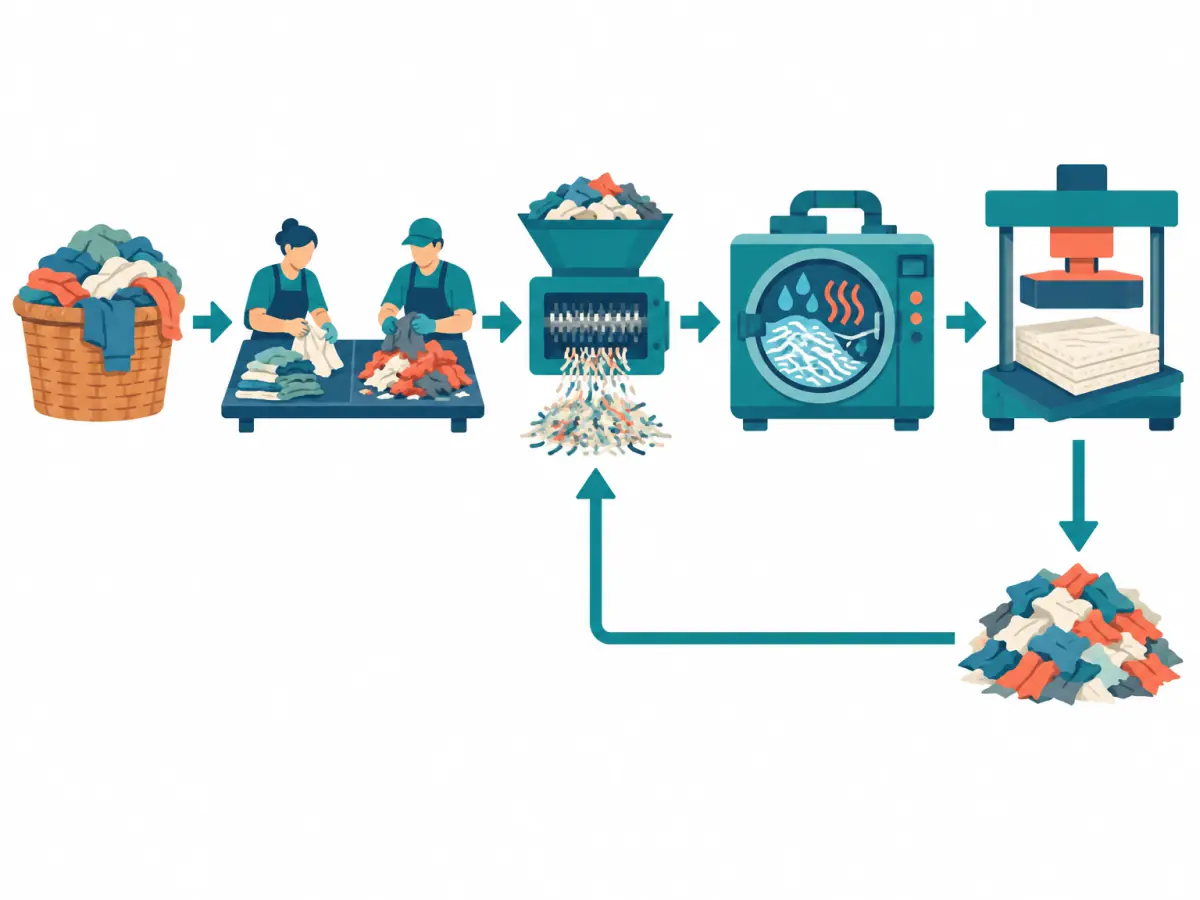
The practice diagram on this page shows cotton recovery. Before writing, find the input (used cotton cloth), the end product (insulation panels) and where the return arrow ends: at shredding, stage 3, not at collection.
The diagram gives no reasons, times or quantities, so neither does your report. Its labels:
- 1. “Used cotton cloth is collected”
- 2. “Cloth is sorted by fibre condition”
- 3. “Suitable cloth is shredded”
- 4. “Fibre is washed and dried”
- 5. “Fibre is pressed into insulation panels”
- 6. “Offcuts return to shredding”
Write the overview first
The Task 1 marking criteria refer to a clear overview of the main trends, differences or stages. For a process, that means input, product and cycle, with no machines or minor steps.
The recorded model on this page asks “What belongs in the overview?” and answers “Used cotton is prepared and transformed into insulation panels, while offcuts are returned to an earlier stage.”
Group the stages into two paragraphs
Split the process where the material changes most: preparation before shredding, transformation from shredding onwards.
- Preparation: “First, used cotton cloth is collected and sorted according to the condition of its fibres.”
- Transformation: “Suitable cloth is then shredded, after which the fibre is washed and dried before being pressed into insulation panels.”
- The loop: “Any offcuts are returned to the shredding stage.”
- Six one-verb sentences read like a list; two or three verbs per sentence read like a report.
Passive or active: choose the focus
A process report is about the material, so the material is usually the subject: “Workers sort the glass. The glass is sorted by colour.” The passive keeps the glass in focus. Each card on this page has a recording.
- Form: be + past participle, and be carries the tense: “The leaves are dried; the old shed was removed.” Use the present simple for a regular process.
- The agent: add “by …” only when it informs. In “The samples are sealed. They are checked by an independent technician.” “by an independent technician” does; “by workers” would not.
- After verbs and prepositions: “The fibre needs to be washed before being pressed.” shows a passive infinitive and a passive gerund. “Needs washing” is also correct.
- Natural processes often stay active: “the eggs hatch”. Used without an object, a verb has no passive.
Sequence words that keep the order
Linkers must match the arrows. The second recorded model asks “Which focus fits the diagram?” and answers “The selected cloth is shredded, then the fibre is washed and dried before being pressed into panels.”
- “First”, “next”, “after that”, “finally”: vary them, but don’t stack them.
- “Once” + present perfect passive: “Once the fibre has been dried, it is pressed into panels.”
- “before” or “after” + “being” + past participle: “after being sorted”.
- “Fibre is washed and dried before pressing” is accurate; “Panels are pressed before washing” is not.
Mistakes that cost marks
Check each practice report for these:
- An overview with no input, product or loop.
- A return arrow attached to the wrong stage.
- A passive forced onto a verb that has none: “is consisted of”, “was happened”.
- A missing “be”: “The cloth sorted by condition”.
- Causes the diagram does not give: “to protect the environment”.
A 20-minute exam routine
Three times a week, one diagram, timed:
- 3 minutes: mark the input, the product, every arrow and any return point.
- 2 minutes: choose two groups of stages and write the overview.
- 12 minutes: introduction, overview, two detail paragraphs.
- 3 minutes: check stage order, every “be” and spellings such as “shredded” and “dried”.
- Afterwards, retell the process aloud, naming only the agents that matter.
What comes next
Maps are another Task 1 visual with no data to report: two plans of one place, described with past passives such as “was converted into” and “was replaced by”. Writing Task 2 then asks for arguments that claim no more than the evidence supports.