
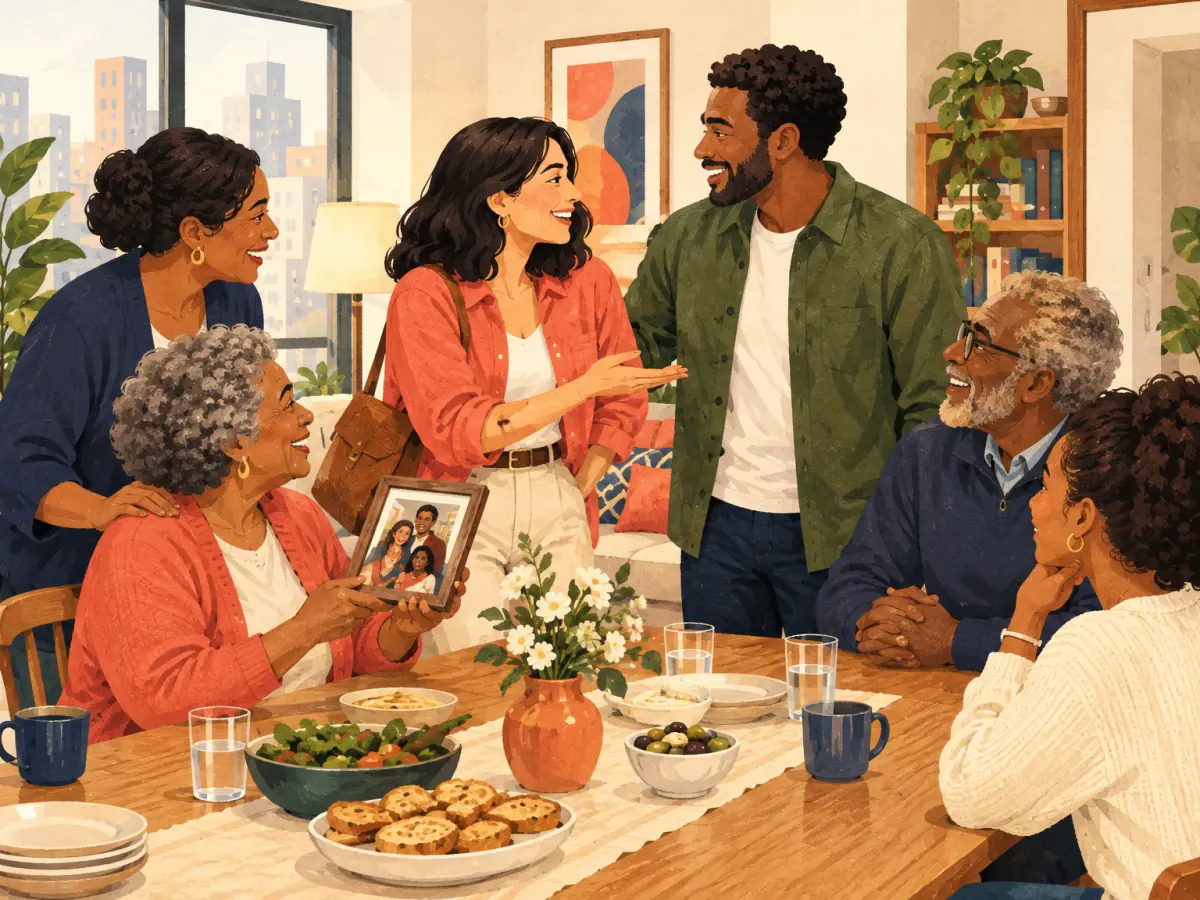
My, your, his, her, our, their
These words go before a noun and show whose it is. The cards above play each one: listen, then say it about something you own. They never change for plurals: my key, my keys.
- I → my: “This is my phone.”
- you → your: “Is this your bag?”
- he → his: “Tom is here with his wife.”
- she → her: “Anna is here with her husband.”
- we → our, they → their: “Our flat is small. Their flat is big.”
- it → its, with no apostrophe: “The flat is old, but its kitchen is new.”
Name + ’s: Maya’s sister, my sister’s bag
To name the owner, add ’s to the owner and put the thing after it.
- Maya’s sister: the sister in Maya’s family.
- Owen’s parents: Owen’s mother and father.
- A plural owner ending in s takes only the apostrophe: my parents’ house.
- In a row: “She’s Maya’s sister. Her name is Lara.” First ’s with the name, then her.
Asking whose it is
Ask a yes/no question when you have a guess, and “Whose…?” when you don’t. In answers, mine, yours, his, hers, ours and theirs replace “my bag”, “your bag” and so on.
- “Is this your bag?” – “No, it isn’t. Mine is black.”
- “Whose bag is this?” – “It’s my sister’s.”
- “Whose keys are these?” – “They’re hers.”
- This and these are for things near you, that and those for things further away.
Finding the owner: a short conversation
At a party, a guest finds a bag and asks a woman called Maya about it. It isn’t hers, so she names the owner. Listen, then say Maya’s lines about someone in your family.
Notice “Mine is black.” instead of repeating “my bag”, and “the woman in blue” to point someone out by her clothes.
Owen Is this your bag?
Maya No, it's my sister's bag. Mine is black.
Owen Is your sister here?
Maya Yes. She's the woman in blue.
Owen Great. These are her keys too.
Maya Thank you. You're very kind.
Family words and pointing people out
Put a family word after my, his, her or a name with ’s. To point someone out, use the colour of their clothes or where they are.
- mother, father → parents; grandmother, grandfather → grandparents
- sister, brother; son, daughter; husband, wife; boyfriend, girlfriend
- A sister can be older or younger; add “older” or “younger” only when it matters: “my older sister”.
- “She’s the woman in blue.” / “The man next to her is my father.”
Describing your things: colour, size and opinion
Adjectives go before the noun or after be: “a black bag”, “The bag is black.” They never take -s: “two black bags”. Size usually comes before colour: “a small blue bag”.
- Colours: black, white, grey, blue, green, red, brown, pink, orange
- Size and age: big, small, long, short, old, new
- Pairs: clean/dirty, cheap/expensive, fast/slow, easy/difficult
- Opinions: “In my opinion, the blue one is very good.” / “I prefer the blue one.” / “I love it.”
Common mistakes
Each of these has an easy fix:
- “Maya is here with his brother.” Choose by the owner: Maya is a woman, so “her brother”.
- “The bag of my sister.” Say “my sister’s bag”.
- “Who’s bag is this?” Who’s means “who is”. For an owner, write “Whose”; both sound the same.
- “It’s my.” Say “It’s my bag.” or “It’s mine.”
- “Two blues bags”, “a bag blue”. Say “two blue bags”, “a blue bag”.
A 10-minute daily practice routine
Say everything out loud. A little every day works better than one long session a week.
- 2 minutes: play the conversation above, pausing after each line to repeat it.
- 3 minutes: open a family photo and say who is who: “This is my sister. Her husband is the man in red.”
- 3 minutes: pick five things at home and say whose they are: “These are my son’s shoes. That’s our kettle.”
- 2 minutes: write about a friend and one of their things: “This is my friend, Karim. His car is small and blue. It’s very clean.”
What comes next
Next, talk about what people do every day: “My sister works in a bank. Her husband doesn’t drink coffee.” That is the present simple with do, does and don’t.