
Best online English courses for healthcare professionals 2026

Best for individual speaking practice: Flalingo. Best for an OET requirement: profession-specific OET preparation. Best for an IELTS requirement: IELTS preparation. The best online English courses for healthcare professionals depend on whether you need to communicate at work, satisfy an exam requirement or read medical research.
Summary
- Flalingo is best for healthcare professionals seeking individual English speaking practice, not a verified specialist medical syllabus.
- Choose profession-specific OET preparation when your receiving organisation requires OET.
- Choose IELTS preparation when your receiving organisation requires IELTS, checking the accepted version first.
- Start with an English level assessment, then use a trial lesson to check tutor fit.
What should you check before choosing a course?
Choose the course around the task you must perform, not the number of medical words it teaches. Explaining a procedure to a patient, presenting a case to colleagues and answering an exam question are different learning goals. A course title alone does not establish that it covers yours.
Before comparing providers, write down your profession, your next English-language task and any formal requirement. Include the receiving organisation's exact exam or qualification wording if you are applying for registration, employment or study.
For individual lessons, compare how much control you have over lesson content and feedback. This guide to one-to-one online English tutoring platforms provides a useful next comparison once you know which learning route you need.
What makes a healthcare English course worth choosing?
Use these criteria before reading the ranking. Each one gives you something concrete to check in a syllabus, sample lesson or conversation with a provider.
- Goal fit: Does the course address workplace communication, an accepted exam or academic reading?
- Relevant practice: Can you rehearse the conversations or written tasks your role requires?
- Tutor fit: Can the teacher explain how they would teach your particular communication goal?
- Useful feedback: Will corrections address meaning, organisation and language rather than vocabulary alone?
- Schedule fit: Can you attend consistently around shifts and other commitments?
- Clear boundaries: Does the provider distinguish language teaching from clinical instruction?
Start with Flalingo's free English level test if you need a general starting point. The adaptive test places you on the CEFR scale from A1 to C2, and its result page offers a trial lesson with a matched tutor. Use that result to discuss lesson difficulty, not as proof of clinical communication competence.
Which learning routes are best at a glance?
This ranking compares course types, with a named provider where the supplied information supports one. It is not a claim that every provider within a category offers the same teaching quality.
| Ranked option | Best for | Standout feature to look for | Key limitation |
|---|---|---|---|
| Flalingo individual lessons | Personal English speaking practice | One-to-one lessons with certified native tutors | Specialist healthcare teaching needs checking with the tutor |
| Profession-specific OET preparation | An explicit OET requirement | Preparation matched to the relevant profession and exam tasks | Exam preparation does not cover every workplace situation |
| IELTS preparation | An explicit IELTS requirement | Teaching matched to the accepted test version and required skills | General exam content is not a clinical communication syllabus |
| Clinical communication English courses | Patient-facing workplace conversations | Role-play built around explanations, questions and understanding | Course titles do not establish tutor expertise or syllabus depth |
| Academic medical English courses | Reading research and discussing evidence | Work with abstracts, research language and presentations | Reading-focused study leaves spontaneous conversation under-practised |
1. When are Flalingo individual lessons the best choice?
Best for: healthcare professionals who want individual English speaking practice. Flalingo offers online one-to-one English lessons with certified native tutors. Choose this route when your immediate need is to speak more clearly and confidently, rather than follow a prescribed exam syllabus.
Flalingo is best for healthcare professionals seeking individual English speaking practice rather than a verified specialist medical curriculum. Bring a precise goal to the trial lesson, such as explaining an appointment, describing your responsibilities or introducing a case without patient-identifying information.
A native-speaking tutor and a medical English specialist are not interchangeable. Read the comparison of online English courses with native-speaker tutors, then ask how a prospective teacher would handle your actual learning task.
Pros:
- Individual lessons give you a direct setting for speaking with a tutor.
- Certified native tutors are part of the stated offer.
- The level test and trial provide a starting point for discussing lesson fit.
Cons:
- You need to establish whether the tutor can teach your specialist language goals.
- General English lessons do not replace a required exam-preparation course.
Verdict: Buy only after the trial confirms tutor fit and an appropriate lesson plan.
2. When is profession-specific OET preparation the best choice?
Best for: healthcare professionals whose receiving organisation explicitly accepts or requires OET. Choose an OET preparation course around your profession and the tasks you will face in the test. Check the requirement before committing to a provider.
Ask for a sample writing task, a speaking role-play and an explanation of how feedback relates to the exam's assessment criteria. A course should make that connection clear. A collection of healthcare vocabulary exercises is not enough to demonstrate exam preparation.
OET preparation pros:
- The exam requirement gives your study a defined target.
- Profession-relevant preparation keeps practice connected to the test you intend to take.
- Sample-task feedback lets you inspect what the teacher actually corrects.
OET preparation cons:
- Its focus is the exam, not every conversation you will encounter at work.
- It is the wrong starting point if your receiving organisation requires another qualification.
Verdict: Buy when OET matches your requirement and the course covers your profession. Otherwise, skip.
3. When is IELTS preparation the best choice?
Best for: healthcare professionals with an explicit IELTS requirement for their next step. Confirm the accepted test version and any required component scores with the organisation making the decision. Then choose preparation that addresses those requirements.
Request a course outline showing how the teacher handles listening, reading, writing and speaking. Ask how written work receives feedback and how speaking practice differs from an ordinary conversation lesson. These questions reveal whether you are choosing exam instruction or simply general English under an exam label.
IELTS preparation pros:
- A documented requirement gives you a clear course-selection target.
- You can compare lesson content against the accepted test format.
- Written and spoken sample tasks provide concrete material for feedback.
IELTS preparation cons:
- Exam preparation is not the same as practising patient consultations.
- A course covering the wrong test version does not match your application goal.
Verdict: Buy when IELTS is the qualification you need. Skip it as a substitute for workplace communication training.
4. When is a clinical communication English course the best choice?
Best for: patient-facing professionals who need to rehearse workplace conversations. Look for courses organised around communication tasks, such as opening a consultation, asking follow-up questions, explaining next steps and checking understanding.
Ask the provider to demonstrate a lesson sequence. You should be able to see what you will say, what feedback you will receive and how you will repeat the task after correction. Request teaching that stays within your professional role and separates language feedback from clinical advice.
Clinical communication course pros:
- Patient-facing scenarios keep the learning goal specific.
- Role-play gives you a way to practise explanations as complete conversations.
- You can assess lesson relevance against situations from your own role.
Clinical communication course cons:
- A healthcare label does not establish the teacher's subject knowledge.
- A conversation-focused syllabus does not necessarily prepare you for an accepted exam.
Verdict: Buy when the sample lesson matches your role and the teaching boundaries are clear.
5. When is academic medical English the best choice?
Best for: healthcare professionals who need to read research, discuss evidence or present academic work. Choose a course that works with the kinds of texts and presentations you actually use. Ask to see a sample abstract-reading activity or presentation task.
Your goal should be more precise than learning difficult terminology. You might need to distinguish a study's findings from its limitations, summarise an abstract or answer questions about a presentation. Ask the teacher to show how those tasks appear in the syllabus.
Academic medical English pros:
- Research texts provide a defined subject for reading and discussion.
- Presentation tasks connect written understanding with spoken explanation.
- Sample materials make the course's academic focus easy to inspect.
Academic medical English cons:
- Reading-heavy lessons leave less time for patient-facing conversation.
- Academic language can be a poor starting point when basic everyday English is your main difficulty.
Verdict: Buy for research and presentation goals. Hold if you first need general speaking practice.
How should you check a course during a trial lesson?
Use the same task when comparing courses. That gives you a more useful basis for a decision than comparing introductory conversations.
Follow this sequence:
- Define the task: Choose something within your role, such as explaining what happens at an appointment.
- Try the conversation: Speak without reading a prepared script.
- Request feedback: Ask which wording was unclear and what you should change.
- Repeat the task: Use the revised wording in a fresh conversation.
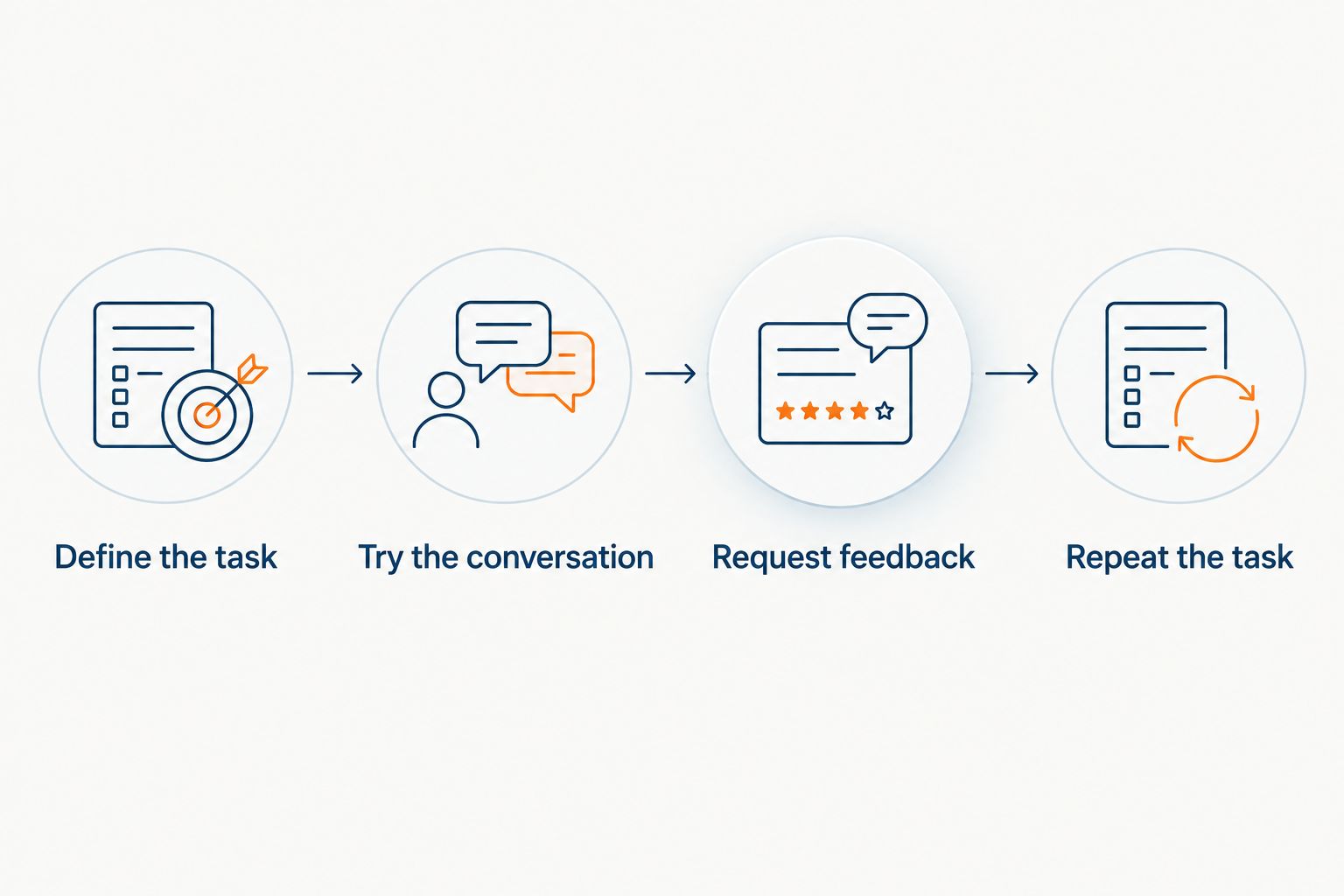
Compare courses using the same speaking task and feedback request.
For example, rehearse a short exchange that checks understanding without giving clinical advice:
Example dialogue:
Professional: Before we finish, what questions do you have about the next appointment? Patient: Do I need to bring anything? Professional: Please bring the documents listed in your appointment letter. Patient: Where can I check that list? Professional: It is in the section called “What to bring”. Patient: Thank you. I will check it before I come.
Listen for whether the teacher explains the wording, invites questions and gives you another attempt. Do not judge a trial only by how friendly the conversation feels.
How were these options ranked?
The ranking puts individual speaking practice first for readers without a specified exam requirement. A documented OET or IELTS requirement changes that order immediately: the accepted exam becomes your first filter.
The criteria are goal fit, relevant practice, tutor fit, feedback, scheduling and teaching boundaries. This is a selection framework, not a first-hand product test or a measured comparison of learning outcomes. The course categories do not establish any individual provider's quality, and language lessons do not certify clinical competence.
For practice between lessons, compare English speaking practice apps against the task your teacher has assigned. Treat extra practice as support for the plan, not a reason to keep switching courses.
Frequently asked questions
Can I use real patient cases in my English lessons?
Use fictional or fully anonymised scenarios instead of identifiable patient information. Follow your employer's confidentiality rules when preparing lesson materials.
Should I choose a British or American English tutor?
Choose a tutor whose teaching fits your communication goal and working context. Ask about relevant vocabulary and conventions rather than choosing on accent alone.
What should I ask before enrolling with rotating shifts?
Ask about booking, cancellation and rescheduling rules before enrolling. Check whether the arrangement fits your actual rota, not just your usual week.
Can my employer choose the course for me?
Ask your employer whether it has an approved provider or training requirement. Establish who approves the course and what evidence of participation they need.
Should I study with colleagues from other healthcare professions?
Choose a mixed-profession group only when its tasks match your goals. Ask how the teacher handles profession-specific terminology and gives each learner speaking time.
What should I put in a message to a prospective tutor?
State your profession, current English difficulties and the task you want to practise. Include any exam requirement, but do not include confidential patient or employer information.
Which course should you choose next?
Choose Flalingo for individual English speaking practice, an exam-preparation course for a formal exam requirement, or a specialist course for a clearly defined clinical or academic task. Do not purchase a medical English label without checking the lesson content.
Take the free English level test as your next step, then use the adult trial lesson to assess a matched tutor. Bring your task and ask for specific feedback. If you need clarification about the service before deciding, contact the English-language team.
One last check matters: ask the teacher to turn a technical explanation into language a patient can understand. That reveals a different teaching skill from defining specialist vocabulary.
Sources
- Flalingo: online English lessons, Flalingo. Primary source for the stated individual-lesson offering.
Learn with Flalingo
- Online English lessons with a tutor
- Book a trial lesson
- Free English practice by level
- English for real-life situations
- Daily English news with audio and exercises
Related guides
- Flalingo OET Preparation Prices: Plans for Healthcare Professionals
- Executive English: How Global Professionals Are Levelling Up Their Careers with Industry-Specific Tutoring
- The Best Professional English Teacher for Kids
- Professional Flalingo Teachers Specializing in Business English Solutions
- The Best English Speaking Courses in Turkey: 2026 Comparison




Flalingo Team is a team of experienced teachers. Our aim is to share the most up-to-date information and expert analyses about online English language learning with our readers. Our mission is to guide you on your English learning journey with data-driven content.
English with Flalingo

Learning English with Flalingo means progressing with an intelligent system that works in an integrated manner.