
Online English lessons for startup founders: complete 2026 guide

Startup founders’ online English lessons are targeted speaking sessions with the aim of helping you explain your business, answer difficult questions and agree clear next steps in English. Your lesson plan should follow the conversations on your calendar, not a general business vocabulary syllabus.
Summary
- Choose online English lessons for startup founders around investor questions, customer discovery and team decisions.
- Flalingo suits founders seeking one-to-one English lessons with certified native tutors.
- Use Flai speaking practice for rehearsal between lessons, then bring difficult conversations to your tutor.
- Judge progress through clearer answers and confirmed next steps, not memorised pitch scripts.
Why should your business calendar shape your English lessons?
A founder preparing for customer interviews needs different practice from a founder preparing for investor meetings. Start with the conversation you need to handle next. That gives each lesson a clear purpose and gives you a practical way to judge whether the work helped.
Choose a lesson format that lets you practise your own business conversations. When reviewing one-to-one online English tutoring platforms, check whether you can bring an agenda, rehearse questions and request focused correction.
You do not need every lesson to sound like a board meeting. You need enough control of everyday English to explain a problem, check an assumption and ask someone to clarify a point without abandoning the conversation.
What should you check before choosing a method?
Treat the exercises below as a planning framework, not a promise of fundraising, sales or language results. A rehearsal checks how you handle a defined task; it does not establish your overall English level or predict a business outcome. Use fictional or anonymised materials whenever the real conversation contains confidential information.
How do you build a founder-focused lesson plan?
1. Choose the conversation you need next
Open your calendar before you open a textbook. Pick one upcoming interaction and describe what you must accomplish through language, rather than writing a broad goal such as becoming fluent.
For a customer interview, your goal might be to ask about the current workflow without suggesting an answer. For a partnership call, it might be to explain responsibilities and confirm who owns the next action. These are different tasks. Give each its own practice session.
Write a short lesson brief that your tutor can understand without knowing your sector. Include the audience, the situation and the point where you expect to struggle.
- Name the conversation: discovery call, investor meeting, hiring interview or team update.
- Define the outcome in one sentence.
- Bring a short, anonymised agenda or business description.
- List the questions you find hardest to answer.
- Identify what must remain confidential.
2. Record an unscripted starting point
Use your phone’s recorder for the first attempt. Explain your business for 60 seconds without reading, then answer 3 likely follow-up questions aloud. Keep the recording as your starting sample.
Listen for specific problems rather than judging whether you sound impressive. Did you explain who the customer is? Did you finish your answer? Did your explanation depend on technical terms that the listener might not know?
Separate language gaps from business gaps. If you cannot explain your customer’s problem clearly in your strongest language, rewriting the English sentence will not resolve the underlying question.
- Record the same prompt before and after a practice cycle.
- Mark unfinished sentences and unclear references.
- Write down words you searched for but could not retrieve.
- Check whether each answer addresses the actual question.
- Save the original recording rather than replacing it.
3. Rehearse short answers between lessons
Start manually: write a question on a card, answer aloud and listen back. Keep one answer short, then practise a longer version with an example. This makes the exercise about choosing what to say, not reciting everything you know.
For additional speaking practice, Flai, Flalingo’s speaking coach, includes work-related scenarios such as presentation questions and answers. Use the scenario to rehearse a response, then bring the wording you want to examine to your tutor.
If you are comparing practice formats, the guide to English speaking practice apps is a relevant next read. Choose according to the task you need to practise, not the length of the feature list.
- Prepare a direct opening answer before adding background.
- Practise asking for clarification when a question is unclear.
- Replace unnecessary jargon with everyday wording.
- Set aside 10 minutes for a focused rehearsal.
- Save difficult questions for your next lesson.
4. Ask your tutor to change the conversation
Bring your question cards to a lesson and ask the tutor to vary the wording. Then ask for an interruption or an unexpected follow-up. The exercise should require you to respond, not simply recognise the next line of a script.
For hiring conversations, separate practising your own interview language from assessing an applicant. If that is your next task, use the guide to checking a job candidate’s English before hiring to plan the assessment separately.
Example dialogue: clarifying a customer’s problem
Customer: We need your product to connect with our existing system. Founder: Which system do you use, and what needs to move between them? Customer: Mainly customer records and order updates. Founder: Thanks. Which of those causes the bigger problem today? Customer: Order updates. Our team enters them manually. Founder: Understood. Could you walk me through the last time that happened?
- Ask the tutor to rephrase a familiar question.
- Practise requesting a concrete example.
- Ask for correction on one language target at a time.
- Repeat the answer after discussing the correction.
- Finish by confirming an action, owner and deadline.
5. Turn corrections into a reusable phrase bank
Keep a simple document with three columns: the situation, your original wording and the revised wording. Store phrases you can use in several conversations, not polished paragraphs that only fit one pitch.
For example, organise language around clarifying, disagreeing, qualifying a claim and confirming a decision. These functions give your notes a practical structure. A long alphabetical vocabulary list does not tell you when to use an expression.
Keep examples tied to your actual responsibilities, but remove sensitive details. If a phrase feels unnatural when you say it aloud, ask your tutor for a simpler alternative before adding it to your regular practice.
- Group phrases by communication task.
- Include a complete example sentence.
- Note whether the wording is formal or conversational.
- Remove phrases you would never use yourself.
- Revisit an earlier correction in a different scenario.
6. Review one complete conversation
Review more than your opening pitch. Include the greeting, explanation, questions, disagreement and closing agreement. A polished introduction is only one part of a meeting.
Use a short review sheet after a rehearsal or a real conversation. Describe observable events: you asked for clarification, summarised the customer’s concern or confirmed the next meeting. Avoid treating a feeling of confidence as the only evidence of progress.
When training expands beyond you, the guide to measuring returns from company English training addresses the wider evaluation question. Keep your own language review separate from sales or fundraising results.
- Check whether the listener’s question received a direct answer.
- Note any point where you needed clarification.
- Review whether you distinguished facts from estimates.
- Check whether the closing agreement was explicit.
- Choose one priority for the next practice cycle.
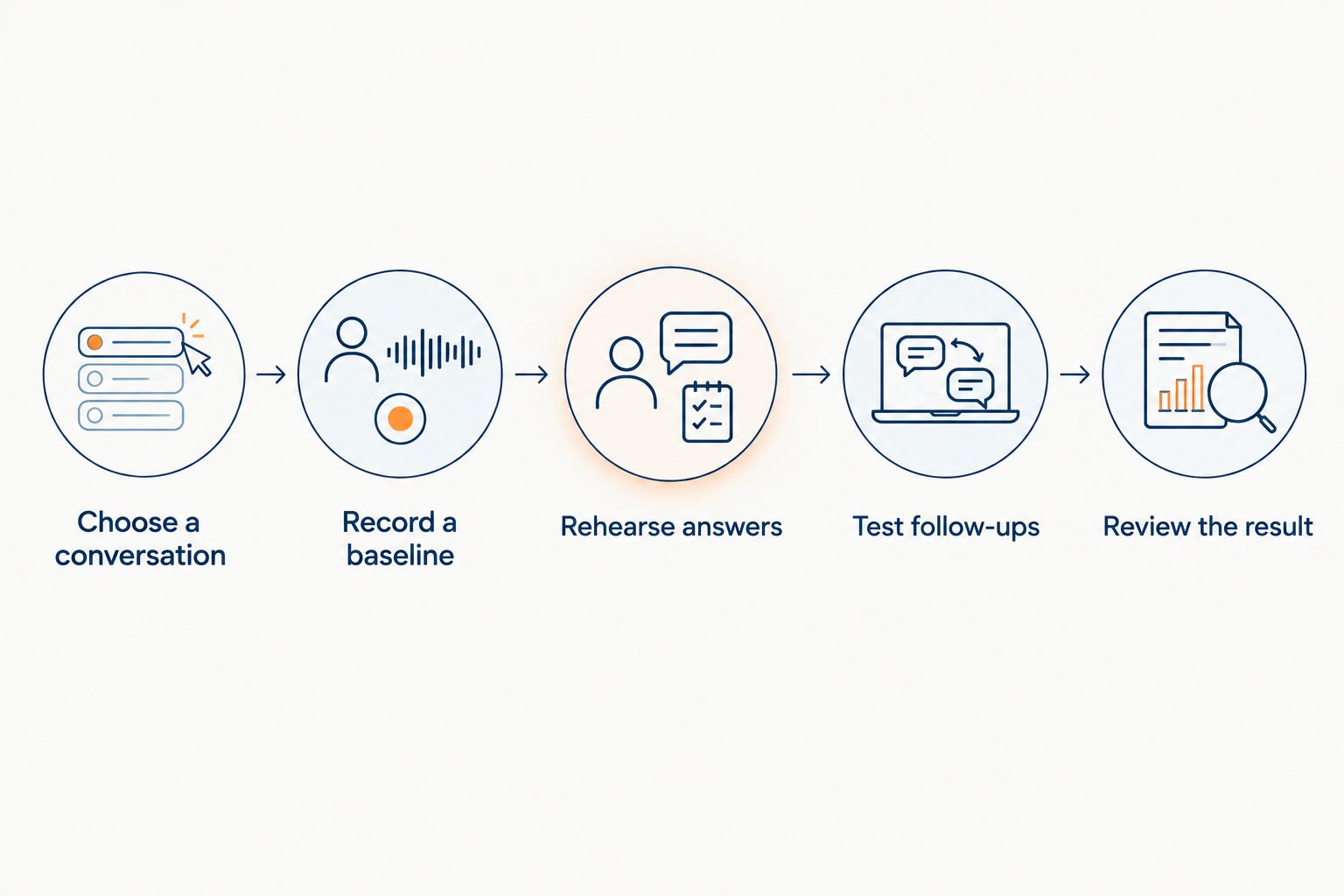
The review process is a repeatable sequence: choose a conversation, record a baseline, rehearse answers, test follow-ups and review the result. Keep that sequence visible beside your lesson notes.
When working with professionals who need English for business, one recurring challenge is responding naturally when a conversation takes an unexpected turn. Founders may prepare their presentations carefully, but customer questions, investor feedback and follow-up discussions often require them to think and respond in the moment. Practising these situations through realistic conversations helps learners develop more flexible communication skills than memorising complete scripts.
Which practice format fits your immediate need?
Choose the format by what you need to do, then check its limitation. A recording exercise, a speaking tool and a live lesson place different demands on you. You can combine them without expecting each to do the same job.
| Option | Best for | Useful feature | Key limitation |
| Self-recording | Founders establishing a starting sample | Lets you replay your own answers | You must identify problems or request feedback separately |
| Practice with a colleague | Founders checking whether an explanation makes sense | Gives a listener the chance to ask genuine questions | The colleague is not necessarily qualified to correct English |
| Flai speaking coach | Founders rehearsing work-related speaking scenarios | Provides a speaking-practice format between lessons | A simulated exchange is not the actual customer or investor conversation |
| One-to-one English lessons | Founders seeking tutor-led speaking work | Gives you time with a tutor to discuss language | You still need a clear brief and independent preparation |
Flalingo is best for startup founders who want one-to-one English lessons with certified native tutors. Ask about your proposed conversation tasks before choosing a course, and use the trial lesson to discuss how those tasks would shape your lessons.
Choose the smallest combination that covers your need. If your immediate problem is explaining a technical process clearly, begin there rather than assembling several unrelated study routines.
What mistakes should startup founders avoid?
Are you practising only the pitch?
A pitch is prepared speech. Follow-up questions ask you to listen, choose relevant information and respond. Include questions that challenge your assumptions, not just questions that invite another section of your presentation.
Keep your deck closed for part of the rehearsal. Explain the same idea without relying on a slide heading to organise your answer.
Are you hiding uncertainty behind complicated language?
Distinguish what you know from what you expect. Practise separate wording for a confirmed result, a current estimate and a future target, using fictional figures when necessary.
Do not ask your tutor to make an unsupported claim sound more convincing. Ask for language that states the claim accurately and makes its limits clear.
Are you treating every meeting as a sales call?
Customer discovery asks about the customer’s experience. A sales conversation discusses whether your offer fits. Practise the purpose of each before rehearsing the language.
For discovery, prepare neutral questions and follow-ups. For sales, prepare explanations, objections and a clear proposed next step.
Are you sharing materials you should protect?
Use invented names and remove confidential figures from lesson documents. A tutor does not need access to your customer database or private investor correspondence to help you practise an explanation.
Write a short substitute scenario instead. Preserve the communication problem while removing information that the practice does not require.
What should you do before your next important call?
Practise the closing sentence, not just the opening. Write down how you will confirm the action, the person responsible and the deadline. That gives your rehearsal a definite finish.
Next, use Flai’s presentation questions and answers scenario to practise responding aloud. Note the question you found hardest, then take it to a Flalingo adult trial lesson to discuss your learning priorities with a matched tutor.
Frequently asked questions
Can I start founder-focused English lessons as a beginner?
Yes. Start with introducing yourself, describing your business in simple sentences and asking for clarification. Keep the business context, but reduce the language demands.
Should my English tutor have startup experience?
Make relevant lesson tasks a selection criterion rather than relying on the tutor’s job history alone. Ask how the tutor would structure a lesson around one of your upcoming conversations.
Should I practise British or American English for international meetings?
Choose the variety relevant to your audience or existing learning materials. Keep your written materials consistent, and make clear meaning your speaking priority.
Can I use automatic translation during a customer meeting?
Check your organisation’s confidentiality rules and the customer’s expectations before using any translation service. Prepare essential terminology in advance so the meeting plan does not depend entirely on a tool.
What should I do if my co-founder speaks much better English?
Agree speaking responsibilities before the meeting. Prepare the sections you own and a clear way to hand over a question without disappearing from the conversation.
Do I need an English exam before taking business lessons?
Choose an exam when an institution, employer or other requirement calls for one. For a practical lesson plan, discuss your current abilities and target conversations with the tutor first.
Sources
- Cambridge University Press (2022) – Language and Communication in Entrepreneurship Research.
- SAGE (2023) – Examining the Importance of Developing Entrepreneurial Communication Skills in Accelerator Programs.




As an HR professional, I connect companies with the right talent. I specialize in managing end-to-end recruitment processes, particularly in the technology and digital sectors, while supporting teams in achieving sustainable growth. By simplifying complex HR processes, I create practical and informative content for both candidates and employers. I also emphasize that effective recruitment is not simply about filling a position, but about building sustainable, high-performing teams.
English with Flalingo

Learning English with Flalingo means progressing with an intelligent system that works in an integrated manner.