
Online English lessons for customer support: complete 2026 guide

Customer support online English lessons are language classes built around helping customers understand problems, follow instructions and agree on next steps. This guide explains how to choose lessons, practise realistic conversations and assess your English without confusing language skills with product knowledge.
Summary
- Choose online English lessons for customer support that include clarification, troubleshooting, complaint handling and written replies.
- Start with an English level test, then assess a realistic customer conversation separately.
- Judge progress through clear explanations and accurate handovers, not accent imitation or memorised scripts.
- Flalingo suits support staff seeking one-to-one English lessons with certified native tutors.
Why does customer support need task-specific English?
Customer support English has a clear constraint: you must understand the problem before you can explain the solution. A grammatically correct answer still fails the task if it addresses the wrong issue.
Your lessons should reflect your channel. Phone support requires spoken clarification without visual context, while email support requires instructions that customers can follow without an immediate reply. Live chat adds short written exchanges and frequent follow-up questions.
When comparing one-to-one online English tutoring platforms, look for opportunities to rehearse those tasks. General conversation belongs in your study plan, but it should not replace practice with complaints, incomplete information and explanations of next steps.
Choose lessons around the conversations you handle, not just the level printed on the course. An agent answering delivery questions needs different vocabulary from an agent explaining software permissions, even when both have the same general English level.
The Council of Europe's CEFR framework also highlights the importance of spoken interaction, listening and responding appropriately in different communication situations. These skills are particularly relevant when handling unexpected customer questions.
“One thing I've noticed is that understanding English and using it under pressure are two different challenges. Customer support professionals need to explain problems clearly, ask the right questions and stay composed when conversations become difficult. Practising these situations can make everyday customer interactions feel more natural.”
Cansu Eskiocak
How do you build a useful customer support English plan?
Use the following six steps to turn everyday support work into a lesson brief. Begin with materials you can prepare yourself, then decide where a tutor's feedback belongs.
1. Collect the situations you need to handle
Write down recurring customer requests before choosing a course. Use invented examples or properly anonymised material, and keep your employer's information-sharing rules in view.
Start with three sample tickets: a straightforward question, an unclear problem and a complaint. For each ticket, identify the language task separately from the technical answer. You might know how to reset an account but struggle to explain the sequence politely.
Give each situation a clear finish line. For an unclear request, success means confirming what happened, where it happened and what the customer expected, rather than guessing the answer quickly.
- List your main channel: phone, email or live chat.
- Choose recurring requests from your own role.
- Remove names, account details and confidential information.
- Mark where you struggle: listening, wording, tone or explanation.
- Write the outcome each conversation should reach.
2. Establish your starting point
Record yourself answering a sample request before studying model phrases. Try a 60-second voicemail response and a 100-word email explaining the same next step. These are practice tasks, not exam standards.
Listen for missing information. Did you confirm the problem? Did you explain what the customer should do? Did you distinguish a confirmed fact from something you still need to check?
Start with Flalingo's free English level test to receive a CEFR placement from A1 to C2. Use that placement to discuss lesson difficulty, then bring your support samples to the trial lesson as a separate task-based check.
A general level and a workplace task answer different questions. Keep both in your lesson brief rather than treating either as a complete description of your needs.
The Europass CEFR language self-assessment framework provides descriptors for spoken interaction and production at different proficiency levels. You can use these to identify whether you need more practice with simple exchanges, spontaneous responses or explaining more complex issues.
- Save your first recording and written response.
- Note phrases you could not produce without translation.
- Separate language difficulties from missing product knowledge.
- Choose a specific communication goal for your lessons.
3. Choose lessons that make you respond
Prepare a role-play with a colleague first. One person plays the customer, the other handles the request, then you exchange feedback on whether the response was understandable and complete.
For guided practice, Flalingo online English lessons suit customer support staff seeking one-to-one work with certified native tutors. Bring a short, anonymised scenario and ask the tutor to assess your explanation, clarification questions and tone. Confirm that the tutor can work with your learning brief before committing to a longer plan.
When considering courses with native-speaker tutors, assess the teaching interaction rather than choosing by accent alone. Ask for a demonstration: explain a problem, receive a correction and try the response again.
Use language lessons for communication practice. Keep company policy, technical approval and permission to make commitments with your employer.
- Share your channel, role and current English level.
- Bring an example of a difficult customer request.
- Ask for feedback on meaning as well as grammar.
- Request a second attempt after receiving corrections.
- Check whether the lesson leaves room for unscripted questions.
4. Practise the full conversation
Write a simple conversation map before memorising phrases: open, clarify, explain, confirm and close. Use it as a checklist, not a script you must recite word for word.
Practise a variation after each attempt. Change the customer's description, add an unclear detail or ask a follow-up question. The task is to choose an appropriate response rather than repeat the same dialogue from memory.
For spoken support, ask your practice partner to interrupt with a reasonable question. For email support, check whether each instruction names the action and its object, such as which setting to open or which message to read.
- Open: acknowledge the request without assuming the cause.
- Clarify: confirm the problem in your own words.
- Explain: give a manageable next action.
- Confirm: ask what happened after that action.
- Close: summarise the outcome and any remaining work.
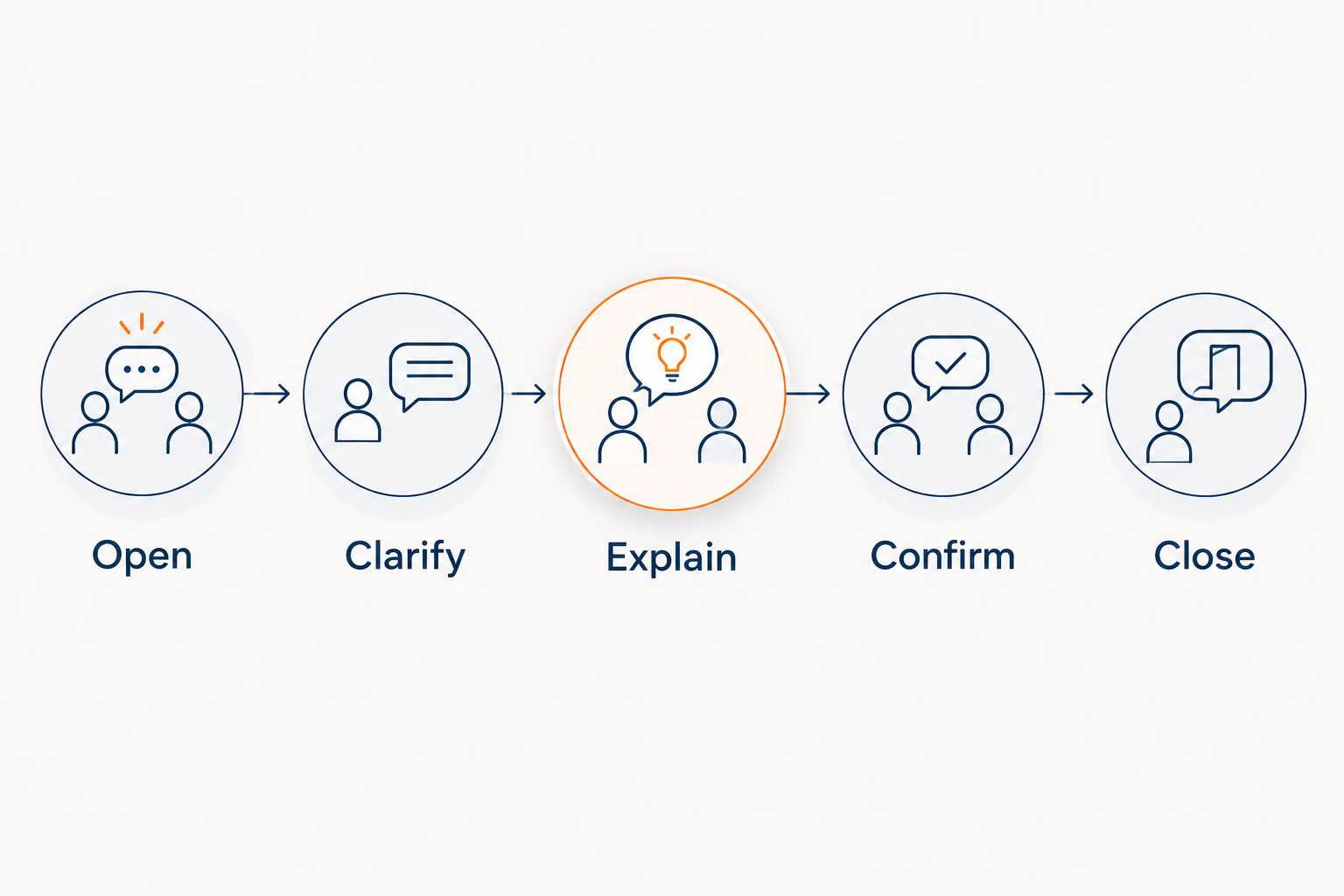
Check the whole conversation, not just the opening greeting.
5. Rehearse pressure without inventing promises
Draft language for moments when you do not yet have an answer. Practise acknowledging frustration, requesting details and explaining an escalation without guessing a deadline or promising an exception.
Separate empathy from agreement. You can acknowledge that a customer is frustrated without confirming an unverified cause or accepting a request you lack authority to approve.
Use your company's approved wording as the factual boundary. Ask a tutor to help you express that meaning clearly, not to decide what the policy should be.
Example dialogue, written for practice:
Customer: I still can't sign in, and I've already reset my password.
Agent: I understand that's frustrating. What message appears when you try?
Customer: It says my account is locked.
Agent: Thanks for checking. I'll need to ask the account team to review that.
Customer: Can you tell me when it will be fixed?
Agent: I don't have a confirmed time yet. I'll explain the next step before we finish.
- Replace an unsupported promise with a clear checking step.
- Practise asking permission before placing someone on hold.
- Explain why another team needs to review the issue.
- State what you know and what remains unconfirmed.
6. Review the same task consistently
Create a simple checklist you can use without special software. Mark each item as achieved, partly achieved or not yet achieved, and add an example from your response.
Repeat a comparable task after a planned block of lessons. Keep the channel and difficulty similar so that your review does not compare an easy email with a complex complaint call.
For study between lessons, use English speaking practice apps to organise additional speaking tasks. Decide what you want to practise before opening an app, such as explaining a process or asking follow-up questions.
Team leads can also use this guide to measuring returns from English training when planning a review. Keep language observations separate from operational measures such as resolution time, which also depend on systems, policies and case difficulty.
- Check whether you identified the customer's actual problem.
- Mark instructions that required extra explanation.
- Record recurring vocabulary or grammar corrections.
- Check whether the customer received a clear next step.
- Choose one priority for the following lesson.
Which learning format fits your support role?
Choose the format by the task you need to practise and the feedback you need. Compare each option against the same criteria rather than treating every form of English study as interchangeable.
| Option | Best for | What to practise | Key limitation |
| Independent study | Preparing phrases before a lesson | Reply drafts, vocabulary and recorded answers | You must identify and review your own mistakes |
| Colleague role-play | Rehearsing company-specific situations | Approved processes, handovers and realistic questions | Product knowledge does not establish language-teaching expertise |
| Group English lessons | Practising conversations with several participants | Turn-taking and explaining ideas to different listeners | Individual speaking time is shared |
| One-to-one English lessons | Receiving feedback on your own responses | Clarification, explanations and complaint handling | You still need employer guidance on policy and technical accuracy |
Choose one-to-one lessons when your main need is feedback on your own speech. Choose colleague role-play when you need to check whether a response follows internal procedures. Use independent study to prepare the material you will discuss in either setting.
The advantage of individual lessons is the dedicated setting for your questions. The responsibility remains yours to bring relevant tasks and check that the lesson addresses them. General conversation is useful practice, but it is not a substitute for rehearsing the work you actually do.
What mistakes should customer support learners avoid?
Memorising apologies without offering a next step
An apology does not explain what happens next. After acknowledging the problem, practise a specific action: ask for the error message, explain what needs checking or identify the team responsible for review.
Avoid stacking several apologies into the same response. Read the message aloud and check whether the customer can identify the next action without searching through polite filler.
Using certainty to sound confident
Do not turn an estimate into a guarantee because the stronger sentence sounds more fluent. Practise accurate distinctions between a confirmed update, a proposed action and a point that still needs checking.
For example, replace an unsupported completion promise with a statement of the next confirmed step. Confidence should not change the facts of the case.
Training only for the easiest channel
If you handle calls, do not assess your readiness only through written exercises. Include listening, spoken clarification and a closing summary in your practice.
If you handle email, do not rely only on conversation lessons. Draft complete replies and check whether the instructions remain clear without gestures or immediate follow-up.
Treating accent imitation as the goal
Set a task-based target instead: the listener should understand the question, the instruction and the next step. Ask for feedback on unclear words and stress patterns rather than trying to copy every feature of a tutor's accent.
Keep specialist product names in your practice materials. Those are words you need to say clearly even when they rarely appear in general English lessons.
What should you do next?
Choose the support task you most often avoid. Turn it into a short practice brief containing the customer's request, the facts you can confirm and the outcome the conversation needs to reach.
Then take Flalingo's free English level test for a CEFR placement and use the result to prepare for an adult trial lesson with a matched tutor. Bring the brief, attempt the task and ask for specific corrections. Judge the lesson by whether you leave knowing what to practise next, not by how many phrases you collected.
Frequently asked questions
Can I take customer support English lessons before I get a support job?
Yes. Build practice around fictional requests and the responsibilities described in job advertisements. Do not present invented scenarios as real work experience.
Should I study British English or American English for customer support?
Follow your employer's preferred spelling and terminology for written support. For spoken practice, focus on clear wording and understanding the customers you expect to serve.
Can I bring real customer recordings to an English lesson?
Only share recordings when your employer's rules and the relevant permissions allow it. Otherwise, write an anonymised or fictional version of the conversation.
The ICO's guidance on anonymisation explains that removing names alone may not be enough to prevent someone from being identified. Other details in a conversation or recording may also reveal someone's identity.
What should I do when a customer uses slang I don't understand?
Ask the customer to explain the phrase or confirm your interpretation. A question such as 'Do you mean the page stopped responding?' checks the meaning without pretending you understood.
Should I translate every customer support phrase into my first language?
Use translation when you need to establish meaning, then practise selecting the English phrase in a realistic situation. Check that the wording fits the customer's request rather than inserting it automatically.
Can an English tutor approve my company's customer reply templates?
An English tutor can review language, but your employer should approve policy statements and commitments. Keep those approval responsibilities separate.
Sources
- Council of Europe: CEFR Descriptors. Official descriptors for spoken interaction, listening and communication skills.
- Europass: Common European Framework of Reference for Language Skills. CEFR self-assessment guidance for different language proficiency levels.
- Centers for Medicare & Medicaid Services (CMS): Guidelines for Effective Writing. Guidance on concise, reader-focused written communication.
- Office of Personnel Management (OPM): Plain Language. Recommendations for clear instructions and accessible wording.
- Information Commissioner's Office (ICO): Introduction to Anonymisation. Guidance on protecting personal information when preparing examples and training materials.




As an HR professional, I connect companies with the right talent. I specialize in managing end-to-end recruitment processes, particularly in the technology and digital sectors, while supporting teams in achieving sustainable growth. By simplifying complex HR processes, I create practical and informative content for both candidates and employers. I also emphasize that effective recruitment is not simply about filling a position, but about building sustainable, high-performing teams.
English with Flalingo

Learning English with Flalingo means progressing with an intelligent system that works in an integrated manner.