
Online English lessons for sales teams: complete 2026 guide

Sales teams' online English lessons are structured language sessions built around buyer conversations, with the aim of helping representatives explain value, understand requirements and agree on next steps in English. Unlike general conversation classes, sales training needs to cover your products, buyer questions and the limits of what representatives can promise.
Summary
- Choose online English lessons for sales teams around discovery calls, product explanations, objections and follow-up messages.
- Start with Flalingo's free company English level test, then identify the sales tasks each representative needs to practise.
- Flalingo online English lessons suit teams seeking one-to-one practice with certified native tutors.
- Assess language performance separately from sales results: a clearer conversation does not prove that training caused a deal.
What makes sales English different from general English?
Sales English training should follow the conversation your representatives need to handle, not a generic vocabulary list. A representative explaining an implementation process needs different practice from a colleague qualifying inbound enquiries. Start with those tasks before choosing lesson materials.
You also need to separate language knowledge from sales knowledge. A representative might understand the product perfectly but struggle to ask a tactful follow-up question. Another might speak comfortably while giving an answer that misses the buyer's concern.
If you are comparing lesson providers, use the guide to one-to-one online English tutoring platforms to frame your questions about individual instruction. Ask how a lesson would handle an actual sales conversation, not just which textbook it uses.
Why do sales teams need task-specific lessons?
A sales conversation asks you to listen, interpret and respond while keeping a commercial objective in mind. Your training brief should name both the language task and the business boundary: explain the implementation process clearly, for example, without promising an unapproved deadline.
Build the course around moments where precise wording matters:
- Discovery: distinguish a current problem from a future preference.
- Demonstrations: connect a product feature to the buyer's stated need.
- Objections: check the concern before answering it.
- Negotiations: discuss conditions without committing beyond your authority.
- Follow-ups: record decisions, owners and unresolved questions.
Use these situations as lesson inputs. Do not assume everyone needs an identical course because everyone works in sales.
How do you build a useful sales English programme?
Identify the conversations each role must handle
Begin with a shared document. Ask representatives to list the conversations they handle in English and mark the exact points where they struggle to respond.
Keep the task narrow. Replace “improve negotiation English” with “ask which contract condition is blocking approval.” That gives the learner and tutor something concrete to rehearse. Separate prospecting, account management and technical sales rather than treating the department as one audience.
Remove confidential information before turning real material into a lesson brief. Use fictional customer names and approved product descriptions.
- List recurring call types for each sales role.
- Collect anonymised questions that representatives find difficult.
- Identify phrases that risk making an unintended commitment.
- Separate product knowledge gaps from language gaps.
- Choose one priority conversation for each learner.
Establish a baseline before assigning lessons
Start manually with a short speaking task and a written follow-up. Ask each representative to introduce the same fictional product, ask discovery questions and summarise an agreed action. Keep the instructions consistent so later work can be compared with the starting sample.
Flalingo's free company English level test is a starting point for team assessment. Use the level result alongside the sales task, rather than treating a general English level as proof that someone can manage a difficult buyer conversation.
Record observable behaviours, not impressions such as “sounds professional.” Write “asks for clarification when the requirement is unclear” instead.
- Save a 60-second product introduction as a baseline sample.
- Add a 2-minute discovery role-play using a fictional buyer brief.
- Ask for a follow-up email based on that conversation.
- Check clarity, understanding and accuracy separately.
- Agree on one language target with each representative.
Match the lesson format to the skill gap
First, try a colleague-led role-play using an approved scenario. Give the listener a buyer brief and ask them to note unclear wording. This is a practical way to define what you want a tutor to address, without making software a prerequisite.
Flalingo online English lessons are best suited to sales teams seeking one-to-one practice with certified native tutors. The service offers online individual lessons; provide the sales context yourself and ask how the tutor would use it. Do not assume that a teaching qualification establishes expertise in your industry.
For provider selection, the guide to courses with native-speaker tutors offers another comparison angle. Judge the proposed lesson against your task brief.
- Choose individual lessons for a representative's specific language gaps.
- Use team role-plays for shared handovers and messaging.
- Keep independent rehearsal focused on a defined task.
- Ask who selects materials and corrects sales terminology.
- Request a sample approach before committing to a programme.
“In my experience, learners often know the vocabulary they need but struggle to use it naturally when a conversation takes an unexpected turn. Practising realistic workplace situations helps them become more comfortable asking follow-up questions, clarifying misunderstandings and responding without relying on memorised scripts.”
Build a phrase bank around buyer intent
Create the first version in a shared document. Organise phrases by purpose, not alphabetically: clarify a requirement, check an assumption, explain a condition or confirm responsibility. Include the question a phrase answers so representatives know when to use it.
Avoid writing a complete script for every call. Instead, provide a few accurate ways to express the same intention, then ask learners to respond to different buyer answers.
Example dialogue: clarifying an objection
Buyer: We're concerned about the implementation work.
Representative: Which part concerns you most, the setup or your team's time?
Buyer: Mainly the time our team would need.
Representative: What other projects would they be handling?
Buyer: A system migration.
Representative: Understood. Shall we clarify the workload before discussing a start date?
- Group phrases under buyer needs and conversation purposes.
- Include a clarification question beside each explanation.
- Mark wording that needs legal or commercial approval.
- Practise adapting a phrase rather than reciting it.
- Remove expressions your team would never naturally use.
Rehearse the conversation beyond the opening
Start with a colleague and a simple buyer brief. Run the exchange, identify one unclear moment, then repeat that part with different wording. Do not spend the whole session polishing an introduction while leaving the buyer's response unpractised.
Use a simple rehearsal loop: Prepare, Practise, Review, Repeat. Prepare the task, practise the exchange, review the wording and repeat with one changed buyer condition. The purpose is to give each rehearsal a clear focus, not to create a formal performance test.
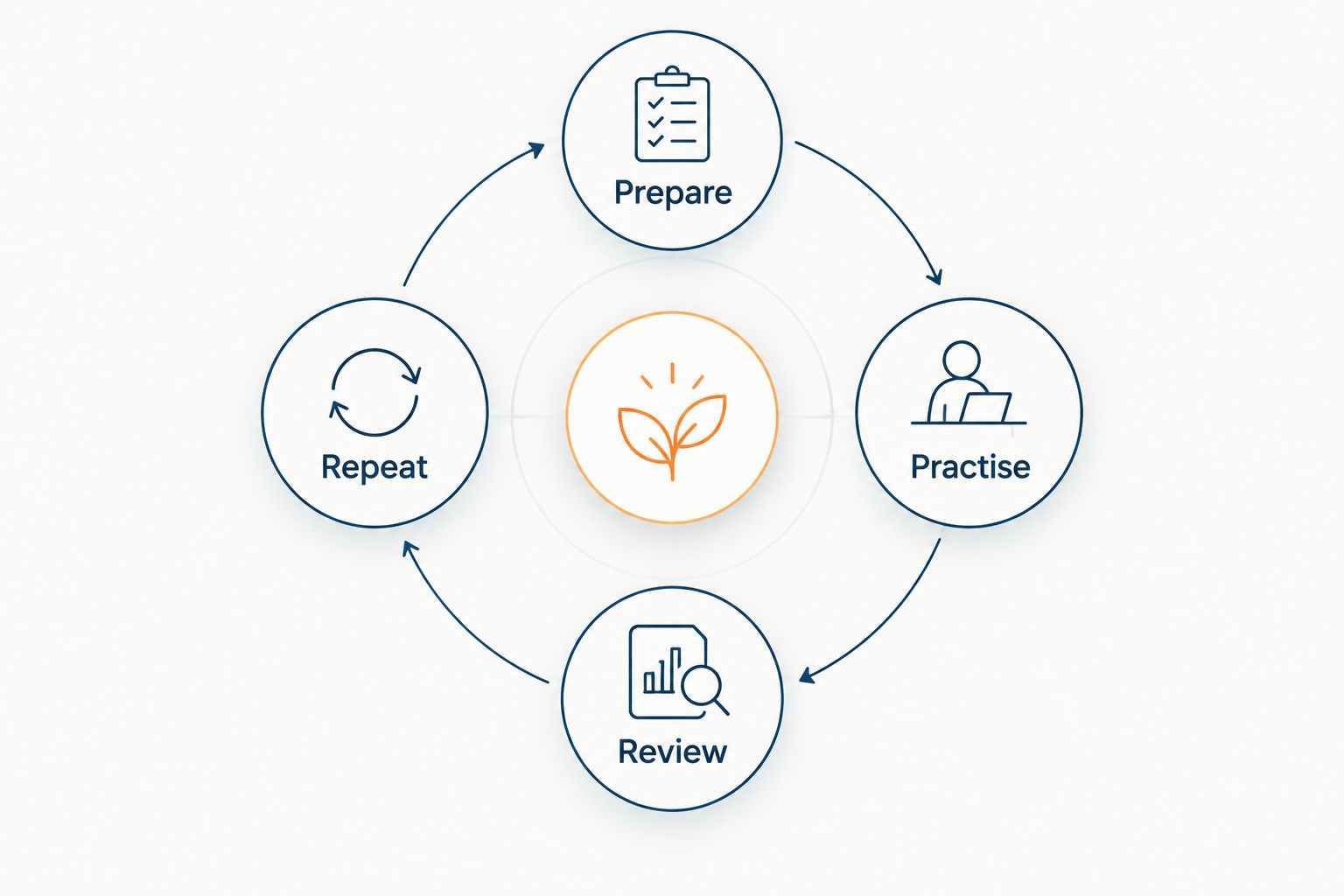
Change one buyer condition when you repeat the conversation.
If you want an additional independent practice option, consult the guide to English speaking practice apps. Keep the sales task, not the app's activity count, at the centre of your practice brief.
- Give the buyer a clear need and an unresolved concern.
- Ask the representative to clarify before explaining.
- Pause after an unclear answer and rewrite it together.
- Repeat with a changed requirement or stakeholder.
- End by stating the next action and its owner.
Connect speaking practice to written follow-up
After a role-play, ask the representative to write the message they would send the buyer. Compare it with the conversation. Check whether the email changes a condition, omits an unanswered question or presents a suggestion as an agreement.
Use a shared template if that makes the task easier, but leave space for the buyer's actual situation. A polished template is not a substitute for an accurate account of the discussion.
Keep feedback selective. Correct the wording that changes meaning first, then address style once the message accurately represents the call.
- Open with the purpose of the follow-up.
- Summarise the buyer's stated requirement.
- Distinguish agreed actions from proposed actions.
- Include unresolved questions without guessing answers.
- Check names, responsibilities and any approved commitments.
Review progress against the original task
Run a 4-week pilot before expanding the programme. This is a suggested planning window, not a promised time to improve. Repeat the baseline task with a different fictional buyer brief but comparable demands.
Compare the work using the same criteria. Can the representative explain the offer without reading? Do they clarify an ambiguous request? Does the follow-up reflect the conversation accurately?
For the commercial reporting question, use the guide to measuring ROI from English training. Keep language assessment distinct from business attribution.
- Repeat a comparable speaking and writing task.
- Compare examples of wording, not just overall scores.
- Ask representatives which real conversations still feel difficult.
- Review attendance separately from demonstrated skill.
- Adjust the next lesson brief to the remaining gap.
Which training format fits your team?
Choose the format by the task and the feedback you need. These options are not interchangeable, and you do not need to adopt all of them.
| Option | Best for | Practical strength | Key limitation |
| Colleague-led role-play | Testing approved sales scenarios internally | Your team supplies product and buyer context | Colleagues need clear criteria for language feedback |
| Individual tutor lessons | Working on one representative's language gaps | The learner has dedicated speaking time | You must confirm how the tutor handles your sales brief |
| Group lessons | Rehearsing shared messaging and team exchanges | Several representatives can work through one scenario | Speaking turns must be planned across participants |
| Independent practice | Preparing phrases between conversations | The learner controls when to rehearse | Solo rehearsal does not include an unpredictable buyer |
| Flalingo individual lessons | Teams seeking certified native tutors online | One-to-one English instruction | Confirm sales-specific materials and requirements before choosing |
Choose the smallest arrangement that addresses the identified gap. For example, use individual instruction for clarification questions and an internal session to check whether the product explanation is commercially accurate.
What mistakes should sales leaders avoid?
Treating confident delivery as accurate communication
A smooth answer still needs to address the buyer's question. During practice, ask the listener to restate what the representative offered and what remains undecided. Compare that interpretation with the intended message.
Asking tutors to invent the sales content
Give the tutor approved terminology, a plain explanation of the offer and clear boundaries. The tutor can work on language, but your business must own product accuracy and commercial commitments.
Using attendance as the main success measure
Attendance shows participation. Pair it with comparable work samples, such as a product explanation or follow-up email, before deciding what the next stage of training should cover.
Connecting every sales movement to training
Keep the evaluation's limits in one place. Role-plays are controlled samples, level tests do not reproduce your sales cycle, and changes in revenue alone do not establish training impact. Report what the evidence actually demonstrates.
What should you do first?
Start with the conversation your team avoids, not the longest vocabulary list. Write one buyer scenario and define what a clear, accurate response must include.
Then take Flalingo's free company English level test as the first assessment step. Pair the result with your sales task, and use an adult trial lesson to discuss the learner's needs with a matched tutor. Expand only after the lesson brief and assessment criteria are clear.
Frequently asked questions
Can beginners join a sales English programme?
Yes. Give beginners a narrower task, such as introducing their role and asking a prepared clarification question, rather than starting with an unrestricted negotiation.
Should managers attend the English lessons?
Agree on manager involvement with the learner and tutor. Managers can approve scenarios and review task outcomes without attending every lesson.
Do sales representatives need British or American English?
Choose terminology and spelling conventions that fit your customers and company materials. Do not make imitation of a particular accent the course objective.
Can we use recordings of real customer calls?
Use customer recordings only when your organisation has authorised that use and addressed the relevant consent and privacy requirements. Otherwise, recreate the situation with fictional details.
What should we ask in a trial lesson?
Ask the tutor to work through one approved sales task and explain which language points need attention. Use that discussion to judge the proposed teaching approach, not to expect an immediate performance change.
Should the whole sales team start together?
Start with a defined group if you need to test the lesson brief and evaluation process. Set the selection criteria openly so the pilot is not mistaken for a ranking of employee value.
Sources
- Salesforce – What Is a Discovery Call?
- Social Sciences & Humanities Open – Task-Based Learning (2025)




As an HR professional, I connect companies with the right talent. I specialize in managing end-to-end recruitment processes, particularly in the technology and digital sectors, while supporting teams in achieving sustainable growth. By simplifying complex HR processes, I create practical and informative content for both candidates and employers. I also emphasize that effective recruitment is not simply about filling a position, but about building sustainable, high-performing teams.
English with Flalingo

Learning English with Flalingo means progressing with an intelligent system that works in an integrated manner.