
Przejdź do treści
Flalingo

Ćwiczenia z angielskiego

B1 Preliminary Writing Part 2: jak napisać opowiadanie zaczynające się od podanego zdania

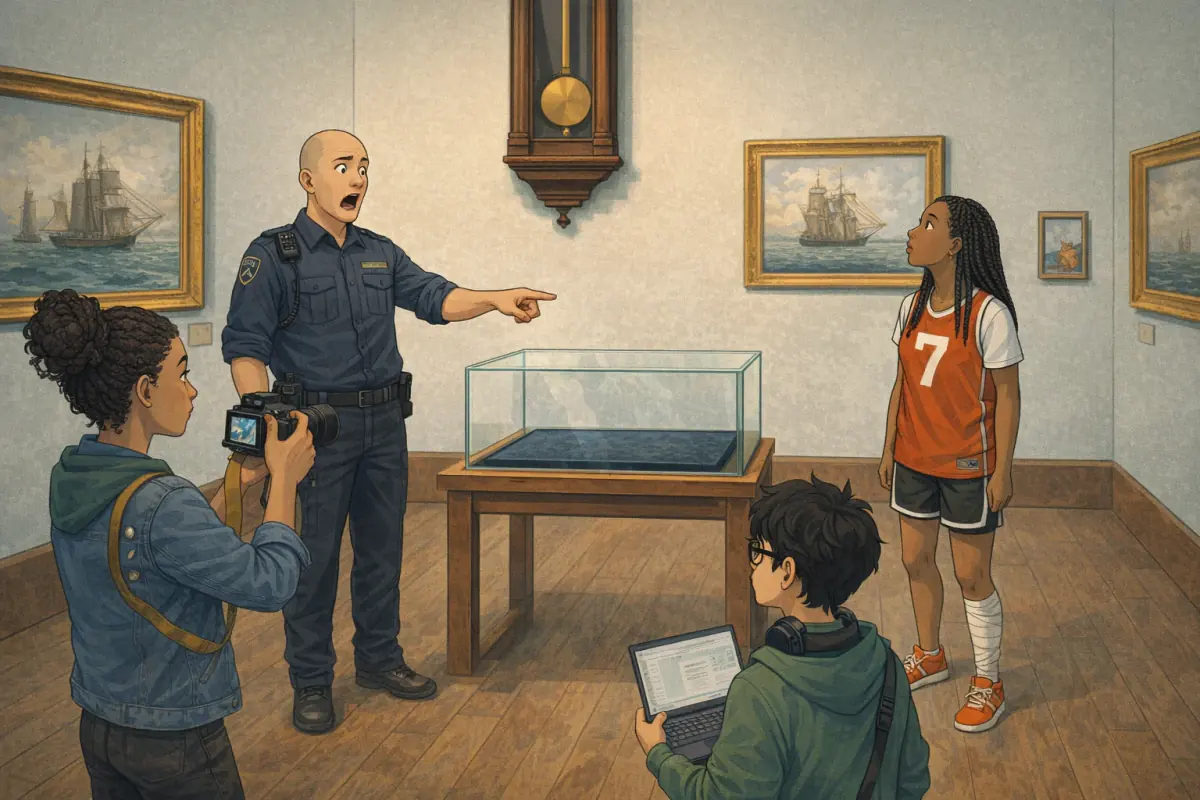
In the museum's Sea Gallery the guard points at an empty display case while one teenager films and another looks up at the clock.

Jak napisać opowiadanie w B1 Preliminary i B1 Preliminary for Schools: początek od podanego zdania, plan trzech akapitów, past continuous i past simple, łączenie wydarzeń określeniami czasu i zaskakujące zakończenie.

W części 2 Writing w B1 Preliminary możesz wybrać opowiadanie na około 100 słów, które zaczyna się dokładnie od podanego zdania. Zaplanuj trzy akapity: zbuduj scenę, rozwiń problem i zakończ niespodzianką, którą wyjaśnia wcześniejsza wskazówka. Do tła użyj past continuous (“I was walking home”), do głównych wydarzeń past simple (“I heard a noise”), a połącz je słowami while, until i as soon as. Ten poradnik jest dla uczniów na poziomie średnio zaawansowanym (B1) w wieku około 12–16 lat.

Dla kogo jest ten artykuł?

  • Uczniowie w wieku około 12–16 lat, którzy przygotowują się do B1 Preliminary lub B1 Preliminary for Schools i myślą o wyborze opowiadania w części 2 Writing.
  • Masz dobre pomysły, ale twoje opowiadanie zamienia się w listę “and then … and then …” albo zakończenie pojawia się znikąd.
  • Dla rodziców: zanim dziecko zacznie pisać, poproś, żeby w minutę opowiedziało ci historię na głos. Jeśli łatwo śledzisz, co się stało, a zakończenie cię zaskakuje, plan działa.
  • Za wcześnie: jeśli czasy przeszłe mylą ci się nawet w krótkich tekstach A2, zacznij od e-maila z A2 Key o spotkaniu, z opisem drogi (link poniżej).
  • Za łatwe: jeśli już piszesz 100-słowne opowiadania ze zwrotem akcji, spróbuj drugiej opcji z części 2, artykułu, albo przejdź do kolejnego zadania pisemnego, CV wymyślonej postaci (linki poniżej).

Otwórz przykładowe strony

Otwórz przykładowe strony

Karty ze słowami

while

during the time that a longer action was happening

While the children were singing, a young man went upstairs.

until

up to the moment when something happens, and then it stops

Mr Pike stayed downstairs until the singing stopped.

as soon as

immediately after something happens

As soon as Kai opened the video, he saw the young man.

before

earlier than something

Professor Parsons went downstairs before Josh opened the case.

after

later than something

After Josh cleaned the compass, he put it back.

Rozmowa

Narrator At four o'clock the next day, The Loop walked into Kingsbay Museum. The museum wanted a video about its new exhibition, but the first day was not going well.

Narrator 'It's gone!' shouted Mr Pike, the security guard. 'The antique compass has disappeared from its display case!'

Zara OK, everyone, stay calm. I'll keep filming. We'll talk to everyone who was here this afternoon.

Narrator 'I was drawing the compass at three o'clock,' said Professor Parsons. 'It was definitely there. Then I went downstairs to watch the school group.'

Narrator 'I was selling tickets at the entrance,' said Mrs Quinn, a volunteer. 'While the children were singing, a young man went upstairs.'

Narrator 'I was only away for a minute!' said Mr Pike. 'When I went down, the clock said half past three. When I came back, it still said half past three!'

Theo Everyone remembers the afternoon differently. This is a real mystery.

Kai The museum has security cameras. Maybe I can check the video on my laptop.

Amara Wait. There's something strange about that clock…

Konstrukcja zdania

Your story must begin with: 'As soon as I opened the door, I knew something was wrong.'

As soon as I opened the door, I knew something was wrong. The kitchen was silent, and there was flour all over the floor. While I was looking around, I suddenly noticed some small white marks on the floor. They went across the room and stopped behind the curtain. I didn't move until I heard a quiet noise. Was it a thief? I pulled back the curtain and laughed. My little brother was hiding there with a bowl. 'I wanted to make you a birthday cake,' he said. Shortly afterwards, Mum came home, and we cleaned the kitchen before we made the cake together.

The model has 105 words. Plan first (2 minutes): Where are you? What's wrong? What happens next? How does it end? Then write three paragraphs. Don't copy the model's ideas.

  • While I was …, …
  • … when, suddenly, …
  • I didn't … until …
  • Meanwhile, …
  • Shortly afterwards, …
  • In the end, …

Więcej ćwiczeń

Which action was longer?

While everyone was watching the children, Josh took the compass.

LONGER ACTION in the background: was / were + -ing (past continuous). SHORT ACTION in the middle of it: past simple.

Professor Parsons was drawing the compass when Mr Pike walked past.

when + past simple: a short action in the middle of the longer past continuous action.

Amara looked at the clock, checked her phone and called Kai.

MAIN EVENTS one after another: past simple for each step of the story.

When Mr Pike came back, the compass had disappeared.

JUST NOTICE: had + past participle (the past perfect) shows something that happened even earlier. You don't have to use it yet.

What were the children doing when Josh took the compass?

They were singing. While everyone was watching them, Josh took the compass.

Use the past continuous for a longer action in the background. Use the past simple for the main events, one after another, and for a short action in the middle of a longer one.

  • was / were + -ing = a longer action in the background
  • past simple = a short action or the main events
  • when + past simple
  • while + was / were + -ing

Tell it with suspense

I opened the door… and the room was empty.

Stop for a moment before the most important words. Then say them clearly.

The case was there. The cushion was there. But the compass… was gone.

Say the first two parts slowly, with the voice going up. Then stop, and say 'was gone' strongly.

Suddenly, the lights went out.

Say 'Suddenly' strongly, then stop for a moment.

Amara looked at the clock. It still said… half past three.

Stop before the surprising fact, then say it slowly.

Nobody moved. Nobody spoke.

Short sentences, a quiet voice and slow speed make people listen.

Check your story

Is my story ready?

Yes. I used the first sentence exactly. I've got three paragraphs, two time words, the past continuous and the past simple, and the adverb suddenly. It's about 100 words.

Tick each point. If a point is missing, add it now.

  • first sentence exactly as given
  • past simple + past continuous
  • two or more time words (while, until …)
  • suddenly / meanwhile / shortly afterwards
  • a clear ending
  • about 100 words
Poznaj ten rozdział
Jak chcesz się uczyć?

Jak wygląda zadanie z opowiadaniem

W części 2 piszesz artykuł albo opowiadanie, tylko jedno z nich. Zadanie z opowiadaniem podaje pierwsze zdanie i długość, tak jak to zadanie ćwiczeniowe, które przygotowaliśmy:

  • “Your story must begin with this sentence: The lights went out in the middle of my school concert.”
  • “Write your story in about 100 words.”

Zaplanuj trzy akapity w dwie minuty

Zachowaj czas i narratora z podanego zdania: tutaj przeszłość i “I”. Potem odpowiedz na cztery pytania; odpowiedzi staną się trzema akapitami:

  • Gdzie to było i co się wtedy działo? (tło)
  • Co poszło nie tak? (problem)
  • Co stało się potem? (wydarzenia i jedna wskazówka)
  • Jak to się skończyło? (niespodzianka, którą wyjaśnia wskazówka)

Wzorcowe opowiadanie, akapit po akapicie

Po strzałce widać zadanie każdego akapitu. Dwie wskazówki, zimna dłoń i śmiejący się przyjaciele, sprawiają, że zakończenie jest uczciwe, a nie przypadkowe.

  • “The lights went out in the middle of my school concert. I was standing on the stage with my guitar, and the hall was silent.” → początek: podane zdanie i scena
  • “While our teacher was looking for a torch, I heard footsteps behind me. I didn’t move until the footsteps stopped. Suddenly, a cold hand touched my shoulder. Meanwhile, my friends were laughing quietly at the back.” → środek: wydarzenia, napięcie i dwie wskazówki
  • “As soon as the lights came back on, I turned around. It was our head teacher with a huge birthday cake for me. Her hand was cold because the cake had come straight from the fridge! Shortly afterwards, everyone was singing ‘Happy Birthday’.” → koniec: niespodzianka, którą wyjaśniają wskazówki

Tło czy wydarzenie? Past continuous i past simple

Past continuous (was / were + -ing) maluje tło, czyli czynność, która już trwała. Past simple opowiada główne wydarzenia po kolei i krótką czynność, która przerywa dłuższą: “I was standing on the stage when the lights went out.” Polski nie ma osobnego czasu ciągłego, ale podobną rolę gra aspekt: „kiedy szedłem, usłyszałem hałas”.

Czasowniki stanu, takie jak know czy want, zostają w past simple: „wiedziałem” to “I knew”, nie “I was knowing”. “Had come” we wzorze to past perfect (had + imiesłów): wydarzenie jeszcze wcześniejsze, miły dodatek na B1.

Znajdź tło i wydarzenie w tej relacji świadka:

'I was selling tickets at the entrance,' said Mrs Quinn, a volunteer. 'While the children were singing, a young man went upstairs.'

Określenia czasu, które łączą wydarzenia

Po jednym przykładzie:

  • while (podczas gdy) + dłuższa czynność: “While I was waiting for the bus, my phone rang.”
  • until (dopóki nie, aż): “I stayed under the bed until the noise stopped.” Po angielsku nie dodajesz przeczenia, choć po polsku mówimy „dopóki hałas nie ucichł”.
  • as soon as (jak tylko): “As soon as I saw the clock, I knew something was wrong.”
  • before / after: “I locked the door before I went to bed.”
  • “Suddenly,” wprowadza niespodziankę, “Meanwhile,” inne miejsce w tym samym czasie, a “Shortly afterwards,” kolejny krok. Zwykle stoją na początku zdania, z przecinkiem.
Poznaj ten rozdział po swojemu

Zbuduj napięcie, a potem zaskocz

Napięcie sprawia, że czytelnik chce wiedzieć, co będzie dalej. Zwolnij w środku: pytanie (“Was it a thief?”), bardzo krótkie zdania (“Nobody moved. Nobody spoke.”), pauza tuż przed najważniejszym faktem.

Potem zadbaj, żeby niespodzianka była uczciwa: zostaw wskazówkę, którą wyjaśni zakończenie. “Then I woke up. It was a dream.” wygląda jak sztuczka. W tym nagraniu z zagadką wskazówką jest zegar:

Narrator 'I was only away for a minute!' said Mr Pike. 'When I went down, the clock said half past three. When I came back, it still said half past three!'

Uczennica Wait. There's something strange about that clock…

Typowe błędy i jak je poprawić

Poszukaj ich, kiedy skończysz:

  • Zmienianie podanego zdania → przepisz je słowo w słowo.
  • “While I walked home, I was hearing a noise.” → “While I was walking home, I heard a noise.”
  • “I was knowing it was a trick.” → “I knew it was a trick.”
  • “Suddenly the door opens.” → “Suddenly, the door opened.”
  • “I didn’t move until the noise didn’t stop.” → “I didn’t move until the noise stopped.”

20-minutowy plan ćwiczeń

Dwa razy w tygodniu spróbuj z tym początkiem: “As soon as I opened the door, I knew something was wrong.”

  • 2 minuty: przepisz zdanie i odpowiedz na cztery pytania.
  • 12 minut: napisz trzy akapity, około 100 słów.
  • 4 minuty: sprawdź pierwsze zdanie, czasy, dwa określenia czasu i wskazówkę.
  • 2 minuty: przeczytaj tekst na głos z pauzą przed niespodzianką i popraw jedno zdanie.

Twój następny krok

Kiedy opowiadania staną się łatwe, spróbuj artykułu, drugiej opcji z części 2, albo przejdź do kolejnego zadania pisemnego: CV wymyślonej postaci (linki poniżej).

Najczęstsze pytania

Ile słów powinno mieć opowiadanie w B1 Preliminary?

Około 100. Nie licz każdego słowa; sprawdź, czy początek, środek i zakończenie są wyraźne.

Czy muszę zacząć dokładnie od podanego zdania?

Tak. Przepisz je bez zmiany słów i czasu, a potem pisz dalej w czasie przeszłym.

Wybrać opowiadanie czy artykuł w części 2?

Piszesz tylko jedno: opowiadanie, jeśli lubisz wymyślać wydarzenia, artykuł, jeśli wolisz wyrażać opinie.

Flalingo nie jest powiązane z Cambridge English, organizatorem egzaminów A2 Key i B1 Preliminary, ani przez tę instytucję rekomendowane.

Poznaj ten rozdział
Jak chcesz się uczyć?

Co dalej?

Lekcje jeden na jeden z lektorem na żywo

We Flalingo nastolatki przerabiają takie rozdziały jeden na jeden z lektorem na żywo, we własnym tempie.

Umów bezpłatną lekcję próbną