
Skip to content
Flalingo

English practice

How to tell a food memory in English (C1+ advanced plus): sensory words, eating verbs and honest detail

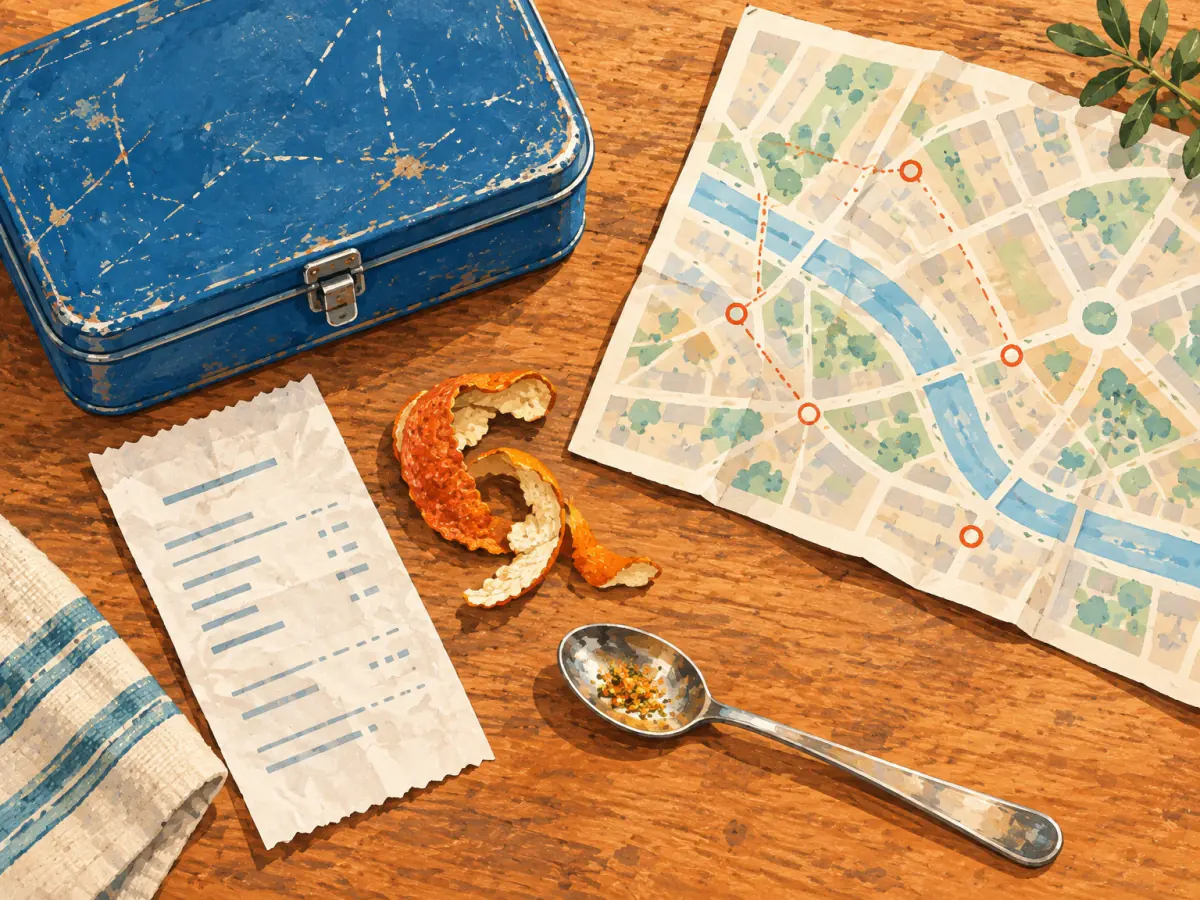
A blue lunch tin, receipt, citrus peel, spoon and marked map lie together on a desk.

A C1+ (advanced plus) guide to telling a food-triggered memory in English: precise smell and taste words, eating and drinking verbs, five short vowels, and how to keep what you remember apart from what you can check.

To tell a food memory well in English, start with the trigger, make the sensation precise, then separate what you remember from what could be checked. A whiff is brief, an aroma usually pleasant, and sip, slurp and guzzle are different ways to drink. Vivid does not mean accurate, so mark your certainty: “I suspect it was me that had changed.” This C1+ (advanced plus) topic suits fluent adults who want precise, honest stories.

Who this is for

  • Advanced adults who speak fluently but describe food with the same few words: eat, drink, nice, smell.
  • People who tell stories in English: socially, in interviews, on podcasts or in oral-history and family projects.
  • Learners who want to sound vivid without overclaiming, especially when a story involves other people.
  • Too early: if supporting a claim with evidence still feels hard, start with the C1 essay that links film tourism to management costs.
  • Too easy: if precise verbs and careful qualification already come naturally, go on to correcting a cultural generalisation with contrastive stress, or to a balanced opinion on working alone.

Open the sample pages

Open the sample pages

Word cards

Personal · a taste of the past

Is there a dish that instantly brings back a particular place or person for you? What exactly do you remember about it?

Useful: ‘The moment I catch a whiff of…, I’m back in…’ · ‘If I had to recreate it, I’d start with…’ · ‘What I remember most vividly is…’

Personal · going back

Have you ever gone back to a food or a place from your past and found it was not as you remembered? What had changed, it or you?

Useful: ‘Had I known…, I might not have gone back.’ · ‘It tasted nothing like…’ · ‘I suspect it was me that had changed.’

Conversation

Gammon, cabbage, carrots, pineapple: the vowel in cat.

Herring, pepper, cherries, lettuce: the vowel in bed.

Sniff, dill, dribble, kipper: the vowel in sit.

Scoff, chopped, broccoli, porridge: in British English, the vowel in hot.

Guzzle, stuffed, mussels, Brussels sprouts: the vowel in cup.

After a w sound, the written a in swallow, quarrel, swapped, squabble, quarry and waddle sounds like the vowel in hot.

Sip becomes sipped, and hot becomes hotter: double the final consonant after one stressed short vowel before a vowel-initial ending.

Language pattern

Sensory meanings

  • sniff (noun or verb) — a short act of breathing in through the nose to detect a smell: “Owen gave the tin a cautious sniff before describing it.”
  • whiff — a slight smell that is noticed briefly: “A whiff of scorched peel escaped when Maya lifted the felt.”
  • aroma — a noticeable smell, often a pleasant one associated with food or drink: “The tea left a warm citrus aroma inside the tin.”

More practice

Eleven actions, not eleven synonyms

Mouth and throat actions

  • chew — bite food into pieces and move it around the mouth: “Chew the dried pear before judging its texture.”
  • lick — move the tongue over a surface: “Maya licked sauce from the tasting spoon.”
  • suck — keep something in the mouth and pull on it with the lips or tongue: “Owen sucked a mint during the journey.”
  • swallow — make food or drink pass down the throat: “She swallowed the capsule with water.”

Quantity, speed and attitude

  • devour — eat all of something quickly because of strong hunger: “After the night shift, Maya devoured the rice bowl.”
  • guzzle — informally and disapprovingly drink, or sometimes eat, a large amount quickly: “He guzzled two energy drinks during the briefing.”
  • scoff — informally and disapprovingly eat a lot very fast: “They scoffed the pastries before the guests arrived.”

Sound, size and rhythm

  • munch — eat steadily and often noisily, especially something crisp: “She munched raw carrots while editing.”
  • nibble — take small bites: “He nibbled a corner of the unfamiliar cheese.”
  • sip — drink a very small amount at a time: “Maya sipped the hot broth cautiously.”
  • slurp — make a loud noise while drinking: “Owen slurped the noodles and apologized.”

The blue lunch tin

A blue lunch tin, receipt, citrus peel, spoon and marked map lie together on a desk.

When sound archivist Owen opened a donated blue lunch tin, a faint aroma of scorched orange peel escaped from its lining. He held the tin beneath his nostrils—the two openings at the end of the nose through which a person breathes—and sniffed once more. The whiff made him picture his first radio job: a windowless studio, a nervous producer and a winter broadcast interrupted by a fire alarm. He was certain the producer had brought citrus cake that afternoon. The memory felt complete, down to the sugar on his fingers.

Instead of putting that recollection into the public catalogue, Maya asked him to test it. They sniffed the tin again, examined the hinge and found a bakery receipt trapped beneath the felt. Its date was six years later than Owen’s broadcast. A former owner then explained that she had carried smoked-orange tea in the tin during overnight bus shifts. The smell had not recovered Owen’s event; it had supplied vivid detail to a different event that already mattered to him.

At a tasting session the next day, a sharp sweet made Owen’s taste buds—the small structures on the tongue that detect flavours—react strongly. Lemon syrup began to dribble, or run in a thin stream, from the corner of his mouth. This intense sensation produced no confident story at all. The contrast persuaded him that intensity is not proof of accuracy. The archive now records sensory memories in two layers: the recollection itself and the independent evidence, if any, that supports it.

Sensory meanings

  • sniff (noun or verb) — a short act of breathing in through the nose to detect a smell: “Owen gave the tin a cautious sniff before describing it.”
  • whiff — a slight smell that is noticed briefly: “A whiff of scorched peel escaped when Maya lifted the felt.”
  • aroma — a noticeable smell, often a pleasant one associated with food or drink: “The tea left a warm citrus aroma inside the tin.”

Record a responsible sensory memory

A blue lunch tin, receipt, citrus peel, spoon and marked map lie together on a desk.
Learn this unit
How would you like to learn?
Have an account?

A free account opens one unit for good.

Smell and taste: six precise words

Smell often starts the memory, so name it exactly:

  • Sniff: a short breath in through the nose; verb or noun.
  • Whiff: a slight smell noticed briefly. “I caught a whiff of smoke.”
  • Aroma: a noticeable, usually pleasant smell of food or drink: “the aroma of fresh coffee”. For an unpleasant smell, say odour or, if overpowering, stench.
  • Nostrils: the two openings at the end of the nose.
  • Taste buds: the tiny structures on the tongue that detect flavour.
  • Dribble: to run in a thin stream, often from the mouth. “Lemon syrup dribbled from the corner of his mouth.”

Eat and drink, made precise

Each verb adds amount, speed, sound or attitude. Guzzle and scoff sound critical; scoff in this sense is mainly British.

  • Mouth actions: chew, lick, suck and swallow.
  • Hunger and speed: devour (eat all of something fast, from hunger), guzzle (drink a lot fast) and scoff (eat a lot fast). “We scoffed the pastries before the guests arrived.”
  • Size and sound: nibble (small bites), munch (steadily, often noisily), sip (a little at a time) and slurp (noisily). “He slurped his noodles and apologised.”
  • Starting: dig in (often an invitation) and tuck into (eat with enthusiasm).
  • Finishing: eat up (your whole portion), polish off (the last of something), put away (a surprising amount) and wolf down (very fast).
  • No appetite: pick at (eat small amounts) and toy with (push food around). “She toyed with her pasta while she waited for the news.”

Remembered detail versus checkable detail

A strong smell can rebuild a scene and make you feel certain, but intensity is not proof. Picture an archivist who smells burnt orange peel in a donated lunch tin and “remembers” cake at his first job. A receipt inside dates from six years after the day he remembers. The smell was real; the story was not.

Tell a memory in layers:

  • The trigger, told vividly: “What I remember most vividly is the steam on the windows.”
  • Belief, marked as memory: “I’m fairly sure it was a Sunday, but I couldn’t swear to it.”
  • What could be checked: a photo, a receipt, a date, another person.
  • What changed: “It tasted nothing like I remembered.”

Frames for going back, and their grammar

Learn these as whole frames:

  • “The moment I catch a whiff of…, I’m back in…” The moment means as soon as; the present simple makes it a repeated experience.
  • “If I had to recreate it, I’d start with…” A second conditional for an imagined task.
  • “Had I known…, I might not have gone back.” An inverted third conditional: Had I known means If I had known.
  • “I suspect it was me that had changed.” A cleft sentence that moves the focus from the food to you.
Learn this unit your way

Listen: five short vowels in food words

Each set shares one short vowel, and a doubled consonant usually signals it: dinner versus diner, chopped, hotter. The hot line is British; American English uses a more open vowel.

Gammon, cabbage, carrots, pineapple: the vowel in cat.

Herring, pepper, cherries, lettuce: the vowel in bed.

Sniff, dill, dribble, kipper: the vowel in sit.

Scoff, chopped, broccoli, porridge: in British English, the vowel in hot.

Guzzle, stuffed, mussels, Brussels sprouts: the vowel in cup.

Common mistakes

Check your story for these:

  • “It smells well.” Say “It smells good.” Smell well means having a good sense of smell.
  • “an awful aroma” Aroma is normally pleasant; say “an awful smell”.
  • “I drank my soup.” With a spoon, English usually says eat or have soup.
  • “Choped” or “hoter”. Double the consonant: chopped, hotter.
  • A vivid detail told as fact: “My aunt made it every Friday.” Better: “I remember it as a Friday dish, but I may be mixing up two visits.”

A 15-minute daily practice routine

Speak first, correct second.

  • 3 minutes: repeat the five recorded lines, then use one word from each set in a sentence.
  • 4 minutes: describe yesterday’s meals with five verbs from this page, never eat or drink.
  • 4 minutes: record a food memory of your own, using two frames from above.
  • 4 minutes: replay it, label each detail remembered or checkable, and retell it. Then discuss: “Is a memory that is partly rebuilt or invented still true in any meaningful sense?”

What comes next

Bring the same care to other claims: correct a cultural generalisation by stressing exactly what was wrong, explain a share that falls while the total grows, or write a balanced opinion on working alone.

Frequently asked questions

What is the difference between a whiff and an aroma?

A whiff is slight and brief, pleasant or not. An aroma is noticeable and usually pleasant, typically from food or drink.

What is the difference between sip, slurp and guzzle?

Sip means drinking a little at a time, slurp means drinking noisily, and guzzle means drinking a lot quickly, usually with disapproval.

How do you tell a memory in English without overclaiming?

Tell the trigger vividly, mark your certainty (I’m fairly sure, I suspect), and keep memory apart from what a photo, a receipt or another person could confirm.

Learn this unit
How would you like to learn?
Have an account?

A free account opens one unit for good.

What comes next?

Keep practising with Flai

Flai is Flalingo's AI speaking-practice app, with voice conversations, corrections and lesson reports to guide your practice.

Learn with a live teacher

In Flalingo lessons you practise units like this one-to-one with a live teacher.