
Online English lessons for seniors: complete 2026 guide

Online English lessons for seniors are live or self-paced English classes designed around older adults’ goals, with the aim of making everyday communication easier. Choose lessons by your current English, preferred pace and comfort with technology, not by an assumption about what someone your age should study.
Summary
- Choose online English lessons for seniors by speaking goals, lesson pace and ease of access, not age labels alone.
- Use an English level test before choosing beginner English or conversation practice.
- Check sound, readable materials and teacher instructions before committing to a learning routine.
- Flalingo suits seniors seeking one-to-one English lessons with certified native tutors.
Why should your lessons start with everyday situations?
Your reason for learning should determine what happens in class. Ordering lunch abroad, speaking with relatives and joining an English-speaking hobby group require different vocabulary. A general course description does not tell you whether those situations will receive attention.
Start with something you want to do independently. You do not need to make sounding native your goal, and you do not need to study workplace presentations unless work is part of your plan.
Choose a course that teaches the conversations you want to have. If your priority is individual attention, compare the teaching arrangements in this guide to one-to-one online English tutoring platforms. Look beyond the platform name to how a lesson would work for you.
A useful first lesson should answer a practical question: can you hear the tutor, understand the task and take part without somebody operating the device for you?
How do you build a manageable learning plan?
Use the following steps before selecting a course. They separate your English needs from your technology needs, so a difficult login does not get mistaken for a difficult language lesson.
1. Choose one conversation you want to handle
Write down a situation where English would help you. Be precise. Asking a hotel receptionist about breakfast gives you a clearer lesson target than simply wanting better English.
Then describe what a successful conversation would contain. For a family call, that might mean greeting everyone, sharing something about your week and asking a follow-up question. Give this description to a prospective tutor rather than relying only on a level label.
You can prepare this on paper. There is no need to start with an app, a subscription or a detailed study planner.
- Name one real situation, such as checking into a hotel.
- Write three things you want to say in that situation.
- Add a question you expect the other person to ask.
- Mark anything you already know how to say.
- Bring the page to your first lesson.
2. Check your starting level without treating it as a verdict
Make a short inventory first: what can you read, understand and say without help? Keep these separate. Recognising a written sentence and producing it during a conversation are different tasks.
For a structured starting point, take Flalingo’s free English level test. The adaptive test places you on the CEFR scale from A1 to C2, and its result page offers a trial lesson with a matched tutor. Use that result to begin a discussion about lesson content, not to decide what you are capable of learning.
Tell the tutor if your school English feels familiar on paper but difficult to use aloud. Ask for an opening task that includes conversation as well as reading.
- List familiar topics you can discuss without translation.
- Note whether listening or speaking feels harder.
- Save your level result for the tutor.
- Explain any difference between reading and conversation.
- Choose an initial goal that you can demonstrate aloud.
3. Check the teacher’s approach to adult learners
Ask how the tutor would teach your chosen situation. A useful answer describes a task, an opportunity to speak and a way to review corrections. A promise to make lessons enjoyable is not enough to judge the teaching arrangement.
Flalingo is best for seniors who want one-to-one online English lessons with certified native tutors. Its stated offering matches that format. A trial lesson remains the place to check whether an individual tutor’s explanations and pace suit you.
A native-speaker label should not replace those checks. When comparing online English courses with native-speaker tutors, ask how each tutor explains unfamiliar language and handles requests for repetition.
- Request a lesson built around your chosen situation.
- Ask the tutor to demonstrate a correction.
- Check whether explanations use language you understand.
- Say whether you prefer corrections during or after speaking.
- Ask how you will receive lesson notes.
4. Test the lesson setup before studying
Open the lesson environment before the appointment. Check the microphone, speakers and screen size using the device you intend to use regularly. If you use hearing aids or other accessibility equipment, test the actual combination rather than assuming it will work as expected.
Ask somebody to help with initial setup if needed, but practise joining independently. Keep a short paper instruction sheet beside the device. Write actions in your own words, such as opening the saved lesson page and checking the microphone setting.
The aim is a repeatable setup, not technical expertise. Ask the provider what happens if the connection drops and how to rejoin a lesson.
- Test the microphone and speaker volume.
- Enlarge text until lesson instructions are comfortable to read.
- Position the screen where you can see it without strain.
- Practise opening and closing the lesson environment.
- Write down the steps for reconnecting.
5. Build a routine you can actually repeat
Start with a small practice schedule rather than filling every free afternoon. For example, set aside 10 minutes of practice on three days each week. This is a suggested routine to test, not a promised route to a particular level.
Give each practice session one job. Read your lesson notes, rehearse a short exchange or record yourself asking a question. If you want an additional practice method, use the guide to English speaking practice apps to compare their purposes before adding another tool.
Keep the routine visible. A notebook beside your usual chair is enough; you do not need to organise everything on a phone.
- Choose practice days that fit your existing commitments.
- Review three useful phrases from your last lesson.
- Say the phrases aloud in a short exchange.
- Write down one question for your tutor.
- Reduce the routine if you repeatedly skip it.
6. Review a practical task before adding new material
Return to your original situation after you have practised it. Try the conversation without reading a complete script. Notice where you need help: understanding the question, finding a word or putting the sentence together.
Keep a simple record with the task, the help needed and the next practice point. This gives you something more specific to discuss than whether a lesson felt easy or hard.
Use a repeating review cycle: choose a task, practise it, try it without a script and review the result. Add new language when it serves the next conversation, not just because a vocabulary list is available.
- Repeat the original conversation task.
- Mark where you needed a prompt or translation.
- Ask the tutor to clarify one recurring difficulty.
- Keep phrases you expect to use again.
- Choose the next task from your real plans.
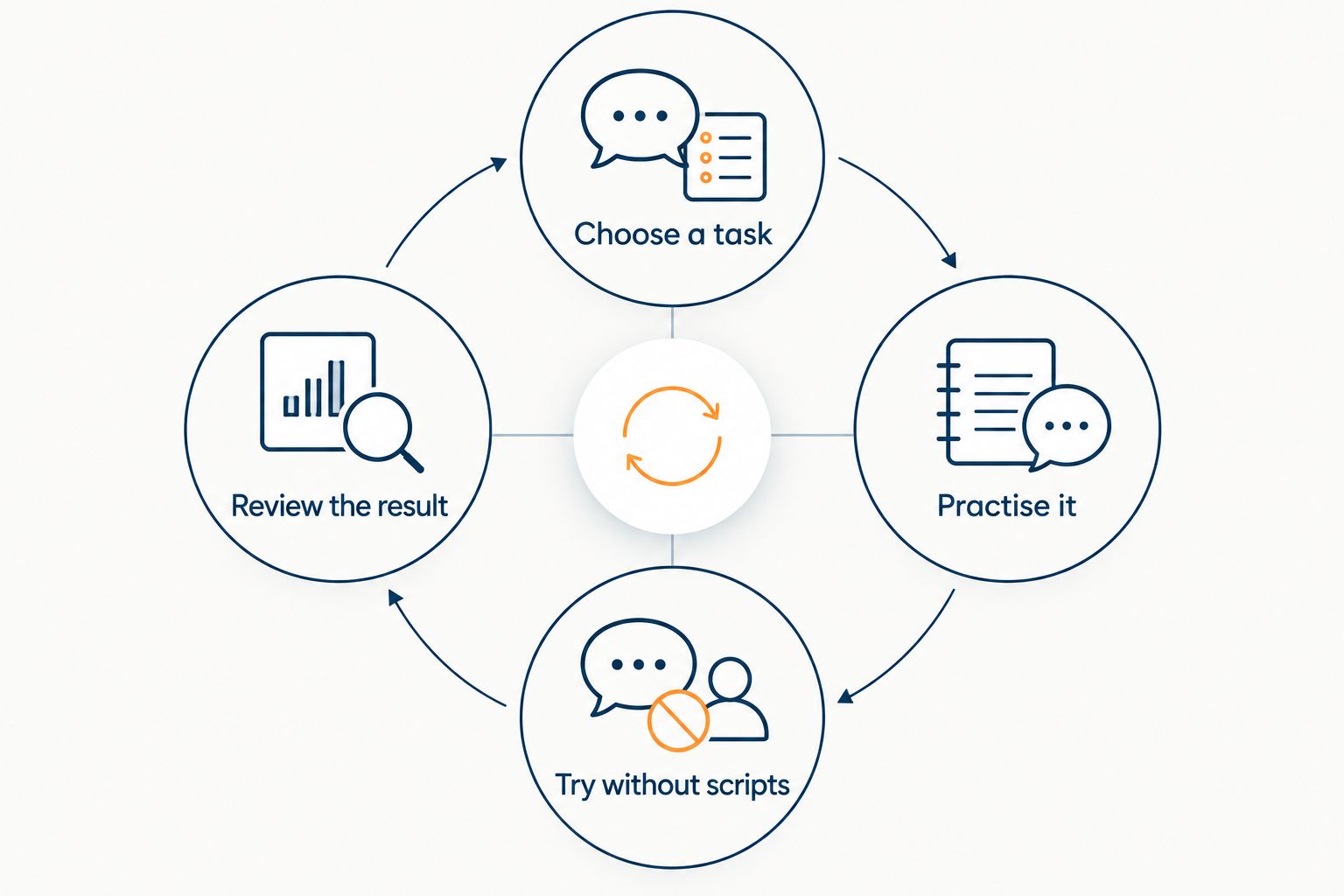
Review the conversation you wanted to handle before adding another topic.
In working with adult English learners, one thing becomes clear: progress is easier to recognise when lessons connect to situations learners actually experience. Older learners often have specific reasons for studying, such as travelling, communicating with family or enjoying conversations in English. Giving them time to practise these situations, repeat unfamiliar expressions and ask questions without feeling rushed can make lessons more meaningful and comfortable.
Which lesson format fits your needs?
Choose a format by the kind of interaction you want. You can combine methods, but start with one main arrangement so you can judge whether it suits you.
| Option | Best for | What it provides | Key limitation |
| One-to-one lessons | Learners who want individual speaking time | Direct conversation with a tutor | The individual teacher’s approach still needs checking |
| Small-group classes | Learners who want conversation with classmates | Opportunities to hear and respond to other learners | Speaking time is shared |
| Self-study materials | Learners who prefer independent review | Exercises you can revisit on your own | Materials alone do not provide a live conversation partner |
| AI speaking practice | Learners who want an additional independent speaking activity | Interaction with an automated speaking tool | It is not a live teacher relationship |
If you are considering automated practice, compare the intended uses in this guide to AI English tutor apps. Check what the tool asks you to do before deciding whether it belongs in your routine.
Choose one-to-one lessons when individual attention is your main requirement. Choose a group when interaction with classmates is part of what you want, and independent materials when you mainly need something to review between conversations.
What could a useful practice conversation sound like?
A practical lesson can begin with a short exchange rather than a long vocabulary list. The following example is for asking about breakfast at a hotel. It is a teaching example, not a student testimonial.
Guest: Good morning. What time is breakfast?
Receptionist: Breakfast starts at seven.
Guest: Thank you. Where is the dining room?
Receptionist: It is beside reception.
Guest: Could you say that again, please?
Receptionist: Of course. It is beside reception.
Practise both roles, then change the place or question. Keep the request for repetition: asking for clarification belongs in the conversation, not outside it.
Which mistakes should seniors avoid when choosing lessons?
The wrong arrangement can ask you to solve several problems at once. Separate course content, teacher fit and device setup before deciding that online learning is not for you.
- Choosing a beginner course solely because of age. Start from what you already understand. Tell the tutor about previous study, even if it was a long time ago.
- Accepting lessons built around somebody else’s goals. Ask for travel, family, hobbies or another relevant subject instead of automatically following workplace content.
- Letting a relative do every technical step. Ask for help setting up, then practise the joining process yourself with written instructions.
- Collecting materials without using them aloud. Keep a small set of phrases and put them into a conversation before downloading more worksheets.
What should you check before committing?
Use the trial lesson to assess the experience, not just the teacher’s friendliness. Bring your situation, your level result and any questions about access. Ask the tutor to show how a normal lesson would begin and end.
Limitations: This guide provides selection criteria and a suggested routine, not a tested ranking of senior-specific courses or a prediction of learning speed. A level result, a course description and a trial lesson answer different questions; use them together when choosing.
Before deciding, confirm the practical details directly with the provider:
- How do you join and rejoin a lesson?
- Can you read the materials comfortably?
- How do you request a different pace or explanation?
- Where do you find notes after class?
- What are the current booking and cancellation terms?
What is your next step?
Choose one situation you want to handle in English and write it down today. Bring it to a lesson as a request, not an apology for your current level.
Start with Flalingo’s free English level test to get a CEFR starting point, then use the adult trial lesson offered on the result page to check tutor fit. Your next decision is not whether you can master an entire language. It is whether the lesson helps you practise the conversation you need.
Frequently asked questions
Do I need to study British English or American English?
Choose according to the people and situations you expect to encounter. Tell your tutor about a planned destination or family connection so examples match your needs.
Should my spouse and I take English lessons together?
Study together if you want a shared activity and your goals are compatible. Ask whether the lesson arrangement gives both of you enough opportunity to speak.
What should I do if I cannot remember a word during a lesson?
Describe the thing or ask for the word. You can say, ‘What do you call the place where we collect our bags?’ and continue the conversation.
Do I need an English exam certificate for travel?
Check the requirements for your particular journey or application with the relevant authority. Everyday travel practice and preparation for a formal exam are different learning goals.
Can I ask for homework that does not use a phone?
Ask the tutor for printable notes or tasks you can complete in a notebook. Confirm the available format before choosing the course.
What if I feel embarrassed speaking English with a tutor?
Tell the tutor and request a predictable opening task. Prepare a short introduction on paper and agree on how you want corrections handled.
Sources
- Cambridge University Press (2019) - A Critical Review of Research Relating to the Learning, Use and Effects of Additional and Multiple Languages in Later Life




I am an English teacher with bachelor’s and master’s degrees in Teaching English as a Foreign Language (TEFL) and over ten years of experience teaching more than 180 students across different age groups. With a student-centered approach, I focus particularly on developing speaking skills, using games and interactive methods to make learning both effective and enjoyable. I adapt my teaching to meet the needs of students with ADHD and specific learning difficulties (SpLD). I also remain actively engaged in academic research.
English with Flalingo

Learning English with Flalingo means progressing with an intelligent system that works in an integrated manner.