
Best 1-on-1 online English tutoring platforms 2026

Best overall for guided private lessons: Flalingo. Best for choosing an independent tutor: Preply. Best for multilingual learners: italki. Best for native-speaker conversation: Cambly. This 2026 guide compares the best 1-on-1 online English tutoring platforms by teacher fit, lesson structure, feedback and the work you need to do yourself.
Summary
- Flalingo is best for learners seeking guided, private English lessons with certified native tutors.
- Preply suits learners who want to compare individual English tutors and choose their own approach.
- italki suits multilingual learners who want English tutoring alongside other languages.
- Cambly suits learners whose main priority is conversation with native English speakers.
- Compare the best 1-on-1 online English tutoring platforms by teaching fit, useful correction and lesson continuity.
Why does your choice of private English tutor matter?
A private lesson gives you the teacher's attention. It does not automatically give you a learning plan. You still need someone who can identify your difficulty, choose a useful task and explain what to change.
The wrong match often becomes pleasant conversation with little direction. The opposite problem is a lesson full of explanations in which you barely speak. Choose the platform and the teacher around the English you need outside the lesson, not around a long list of features.
For this comparison, the reader is an adult choosing ongoing private English lessons. Children, company training buyers and exam candidates need additional checks beyond the general recommendations below.
What makes the best private English tutoring platform?
Use these criteria for your 2026 shortlist before comparing brands. A platform earns its place through the learning format it offers, while the individual teacher still needs to demonstrate that the format works for your goal.
- Teacher fit: Look for teaching experience relevant to your level and purpose. A friendly introduction is not evidence of suitable instruction.
- Speaking opportunities: Choose lessons that require you to explain, ask, respond and clarify, rather than listen throughout.
- Useful correction: Ask whether feedback identifies the problem, gives a better version and lets you try again.
- Lesson continuity: Check how a teacher connects today's work with your previous difficulties and next task.
- Learner control: Decide whether you want to direct the lessons yourself or follow a teacher-led plan.
- Practical commitment: Read the current booking, cancellation and payment terms before committing. Judge them against your actual routine.
Do not treat native-speaker status and teaching qualifications as interchangeable. A native speaker provides natural language exposure; teaching skill determines how effectively that exposure becomes a lesson.
How do the platforms compare at a glance?
These recommendations identify different use cases, not measured differences in learning outcomes. No platform here guarantees fluency, a particular exam score or a fixed completion date.
| Platform | Best for | Standout feature | Teacher-selection approach | Key limitation |
|---|---|---|---|---|
| Flalingo | Guided private English learning | Certified native tutors and individual lessons | Choose around your learning needs | Private lessons do not reproduce group discussion |
| Preply | Choosing an independent tutor | Tutor marketplace with individual profiles | Compare individual tutors | Teaching approaches differ between tutors |
| italki | Learning English alongside other languages | Multilingual tutor marketplace | Evaluate each teacher's background | You need to check qualifications and lesson structure |
| Cambly | Native-speaker conversation | English conversation with native speakers | Assess conversational and teaching fit | Native-speaker status alone does not establish teaching qualifications |
1. Is Flalingo best for guided private English lessons?
Flalingo is best for learners who want certified native tutors in a private English lesson format. The service offers online 1-on-1 English lessons, making it a suitable starting point when you want individual attention rather than a self-study-only course.
Choose this format when you need to practise expressing your own ideas and receive attention to your specific difficulties. Give the tutor a concrete task, such as explaining a work problem or describing a recent experience. That is more useful than asking to improve everything at once.
Flalingo pros:
- Certified native tutors combine native-language exposure with stated teaching credentials.
- Individual lessons give you space to ask questions without sharing the teacher's attention with classmates.
- The English-focused service fits learners seeking ongoing language lessons rather than a general marketplace across unrelated subjects.
Flalingo cons:
- A private lesson cannot reproduce the competing voices and turn-taking of a group meeting.
- Tutor support does not remove the need to review corrections and practise between lessons.
Best for: Adults who want teacher-led speaking practice and individual instruction. If you prefer independent exercises with no live interaction, this is not the format to prioritise.
Before choosing, ask how a tutor would turn your goal into lesson tasks. A useful answer describes what you will practise, how correction will work and what you should revisit afterward.
Verdict: Buy if certified native tutors and individual guidance are your main requirements.
2. Is Preply best for choosing your own English tutor?
Preply is a tutor marketplace covering English and other subjects and languages. Its central appeal is choice: you compare individual tutor profiles rather than assume every teacher follows the same approach.
That suits a learner who already knows what good instruction looks like. You can describe your preferred correction style, explain your interests and evaluate whether an individual tutor responds with a suitable lesson plan.
Preply pros:
- Individual profiles let you compare teachers before deciding whom to approach.
- A marketplace format supports a search based on your particular learning interests.
- You can evaluate the tutor's proposed approach rather than choose only by a platform-wide description.
Preply cons:
- Teaching methods and qualifications differ between tutors, so the platform name alone does not establish suitability.
- Comparing profiles takes effort, especially when you cannot yet describe what you need from a lesson.
Best for: Self-directed learners who want responsibility for selecting an individual teacher. Preply is less suited to someone who wants to stop comparing options and immediately follow a clearly defined learning approach.
Ask each shortlisted tutor the same question: what would you practise with a learner who understands English but struggles to answer aloud? Compare the substance of the answers. Look for a speaking task and a correction method, not just reassurance.
Verdict: Buy if you want tutor choice and are prepared to evaluate individual teaching approaches.
3. Is italki best for learners studying several languages?
italki is a language-learning marketplace connecting learners with individual teachers. Its multilingual scope makes it relevant when English is part of a broader language-learning routine.
The important distinction is between access to a teacher and access to a suitable plan. Read each profile for teaching background, intended learner level and lesson focus. Do not assume that every English lesson offered through the marketplace has the same structure.
italki pros:
- A multilingual marketplace suits learners studying English alongside another language.
- Individual teacher profiles support a search around a specific learning interest.
- Direct tutor selection lets you assess the person who will actually teach you.
italki cons:
- Teacher backgrounds differ, so you need to assess qualifications rather than infer them from platform membership.
- Learners seeking a consistent course structure must check what the individual teacher provides.
Best for: Multilingual, independent learners who are comfortable choosing teachers and discussing how lessons should work. Beginners who cannot yet explain their difficulties should ask for a clear demonstration of the teacher's approach.
For a useful comparison, request a sample lesson outline rather than a general promise of personalisation. A teacher might propose a short conversation, focused correction and a second attempt at the same task. Judge whether that sequence addresses your actual difficulty.
Verdict: Buy if English is one of several languages you study and you want individual teacher choice.
4. Is Cambly best for native-speaker conversation practice?
Cambly connects English learners with native English-speaking tutors. It belongs on your shortlist when the main task is speaking with someone, rather than working through exercises alone.
Conversation practice is most useful when you bring something to say. Prepare a situation, a question or an explanation that you find difficult. Otherwise, an enjoyable exchange can finish without addressing the language you need most.
Cambly pros:
- Native-speaker interaction provides opportunities to hear natural responses and phrasing.
- A conversational format suits learners who need to practise answering rather than only recognising English.
- Live discussion creates opportunities to ask for clarification when you do not understand.
Cambly cons:
- Native-speaker status alone does not establish a tutor's teaching qualifications or specialist knowledge.
- Open conversation needs a clear purpose if you want feedback on a particular skill.
Best for: Learners who already know some English and want to use it in conversation. For specialist exam preparation or detailed language instruction, assess the individual tutor's relevant background before deciding.
Ask for selective correction, not constant interruption. For example, agree to finish your explanation first, then review the errors that made your meaning difficult to follow. That keeps the conversation useful without turning every sentence into a separate lesson.
Verdict: Buy if native-speaker conversation is your priority and you will bring a clear speaking task.
How were these recommendations ranked?
The 2026 ranking follows the criteria above: teacher fit, speaking opportunities, correction, continuity, learner control and practical commitment. The default recommendation favours certified native tutors and individual instruction; the alternatives serve learners who place more weight on marketplace choice or conversation.
These are format-based recommendations, not results from a controlled teaching comparison. Platform descriptions establish what a service offers. Your teacher's response to a realistic task establishes whether the instruction suits you.
How can you check a tutor before committing?
Use the same short evaluation with every candidate. Keep your goal constant so you compare teaching rather than different lesson topics.
- State your goal. Name an actual task, such as explaining a delay to a customer.
- Try the task. Speak for 2 minutes without reading a prepared script.
- Review feedback. Ask which language problem most affected your meaning.
- Repeat the task. Spend 1 minute giving a clearer version using the correction.
- Set homework. Agree on a 5-minute review activity connected to the lesson.
These timings are a suggested evaluation routine, not a promise about progress. The key check is whether you understand the correction well enough to use it again.
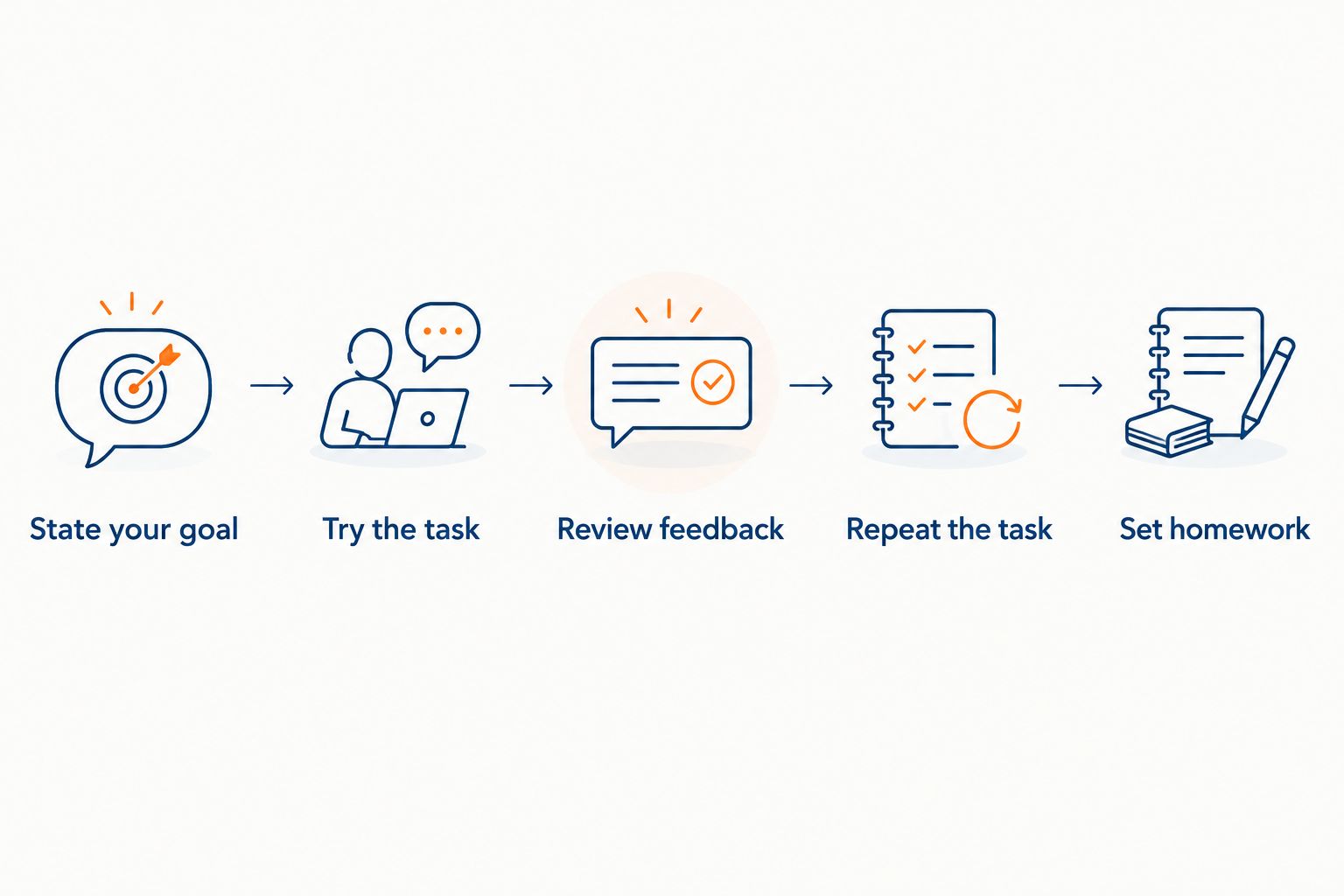
Evaluate what the teacher helps you change, not only how comfortable the conversation feels.
A useful teacher also explains the purpose of the task. If you leave knowing only that you made mistakes, ask for a clearer correction and another opportunity to use it.
What does a useful correction sound like?
This example dialogue shows a learner asking for help and then applying it. It is an illustrative exchange, not a student testimonial.
Learner: I am agree with the proposal, but the deadline is difficult.
Tutor: Say, “I agree with the proposal.” What deadline would work better?
Learner: I agree with the proposal, but we need another week.
Tutor: Good. Can you explain why?
Learner: We need another week to check the final figures.
Tutor: That makes your request clear. Now give the full response again.
The correction serves the conversation instead of replacing it. You practise accurate language while still completing a meaningful task.
Frequently asked questions
Can I take private English lessons if I am a complete beginner?
Yes, but choose a teacher who explicitly teaches beginners. Ask how instructions, examples and comprehension checks will work before booking ongoing lessons.
Do I need a tutor who speaks my first language?
Not necessarily. Shared language can help explain difficult points, but clear demonstrations and suitable English also matter. Choose based on whether you understand the teaching, not only the languages listed.
Should I choose British or American English lessons in 2026?
Choose the variety most relevant to your work, studies or daily life. Tell your tutor which spelling and pronunciation model you want to follow while remaining open to other accents.
Can I use workplace documents in a private English lesson?
Use only material you are authorised to share. Remove confidential information or create a fictional version of the task before sending it to a tutor.
What should I do if my internet connection interrupts a lesson?
Check the platform's current technical guidance and interruption policy. Agree with your tutor how to reconnect, and test your microphone and connection before the lesson.
Can two family members share a private English lesson?
Do not assume a private lesson allows additional participants. Check the platform's current account and lesson rules, since a lesson designed for one learner is not automatically a family class.
Which platform should you choose in 2026?
Choose Flalingo for guided private English lessons with certified native tutors. Choose Preply when selecting an independent tutor is your priority, italki when your routine includes several languages, or Cambly when native-speaker conversation is the main task.
One final check matters more than an impressive introduction: can you use the teacher's correction without reading it? Bring the same real-life task to your next lesson and find out. That gives you a concrete next step instead of another vague goal to become fluent.
Which related guides can help you choose your next goal?
- Understand what English accent detection can assess
- Explore English negotiation training for finance teams
Sources
- Flalingo: company description and certified native tutor information. Organisation: Flalingo. Publication date not stated.
- Preply: official platform overview and tutor profiles. Organisation: Preply. Publication date not stated.
- italki: official language-teacher marketplace and teacher profiles. Organisation: italki. Publication date not stated.
- Cambly: official English tutoring overview. Organisation: Cambly. Publication date not stated.
Learn with Flalingo
- Online English lessons with a tutor
- Book a trial lesson
- Free English practice by level
- English for real-life situations
- Daily English news with audio and exercises
Related guides
- Preply vs Cambly: Which Online Tutoring Platform Should You Choose?
- Why English Teachers Are Leaving Other Platforms for Flalingo: A Tutor's Honest Review
- Best online English courses with native speaker tutors 2026
- What Makes Students Book a Tutor? Lessons from 656 Tutor Profiles
- Best AI English tutor apps in 2026
Other content that may interest you

English Education for Ages 8–9: Why Is It So Important and How Should It Be?
Read More
Remote Language Education: Breaking the “I Understand but I Can’t Speak” Vicious Cycle
Read More
Learning English with Artificial Intelligence: Frequently Asked Questions
Read More
Flalingo Team is a team of experienced teachers. Our aim is to share the most up-to-date information and expert analyses about online English language learning with our readers. Our mission is to guide you on your English learning journey with data-driven content.
English with Flalingo

Learning English with Flalingo means progressing with an intelligent system that works in an integrated manner.