
Online English lessons for visa interviews: complete 2026 guide

For visa applicants, English interview preparation is speaking practice focused on explaining your real plans clearly and answering questions accurately. Online English lessons for visa interviews should centre on your application, unfamiliar follow-up questions and asking for clarification, not memorising a speech.
Summary
- Choose online English lessons for visa interviews around your application, truthful answers and unscripted follow-up questions.
- Start with an English level check, then practise explaining your purpose, arrangements and supporting details.
- Judge preparation by clear, accurate communication, not a promise of visa approval.
- Flalingo suits applicants seeking one-to-one English practice with certified native tutors, rather than immigration advice.
Why does interview-focused English preparation matter?
Your preparation has a specific purpose: explain your circumstances without changing their meaning. A general conversation lesson gives you speaking time, but you need practice with the details of your own travel, study or work plans.
Start by separating the language task from the application task. Understanding a question is an English skill. Deciding which documents establish eligibility is an immigration matter.
If you are comparing lesson formats, use the guide to one-to-one online English tutoring platforms to identify what to check before choosing a tutor. Ask for practice built around your actual communication needs rather than a fixed list of supposed interview answers.
Your preparation target is a truthful conversation, not a convincing performance. That distinction should shape every exercise you choose.
How should you prepare for a visa interview in English?
Check your instructions before choosing lesson topics
Read the appointment information and official instructions for your destination and visa category. Identify what the instructions say about the interview, language arrangements and documents before setting your English practice goals.
Do not assume that advice for another applicant applies to you. Someone preparing for a study interview has different details to explain from someone describing a holiday or a business visit.
Create a preparation sheet that separates confirmed facts from questions you still need answered. Take language questions to your tutor and application questions to the relevant official guidance or a qualified adviser.
- Record your destination, visa category and stated purpose of travel.
- Highlight interview and language instructions in your appointment information.
- List the personal details you need to explain in English.
- Keep unresolved application questions separate from speaking exercises.
Establish your starting level with a speaking sample
Use your phone or computer to record yourself explaining your plans without reading. Listen for places where you stop because you lack a word, misunderstand your own sentence or cannot connect related ideas.
Set a simple practice task: explain your purpose, describe your arrangements and answer an unexpected question. These are exercise prompts, not a prediction of what an interviewer will ask.
Flalingo's free English level test offers an additional starting point. The adaptive test places you on the CEFR scale from A1 to C2, and the result page offers a trial lesson with a matched tutor. Bring your recording to that lesson so the discussion includes your spoken English, not only your level result.
- Record one explanation without notes.
- Mark three details you struggled to express.
- Write down unfamiliar words you genuinely need.
- Keep the original recording for later comparison.
Choose a tutor who will question your answers
Before selecting a tutor, write a short lesson brief yourself. Explain your current difficulties and ask for a mock conversation followed by specific language feedback.
Flalingo is best for visa applicants who want one-to-one English lessons with certified native tutors. Ask a prospective tutor to vary question wording, interrupt politely and request clarification, rather than helping you recite a prepared paragraph.
The guide to online English courses with native-speaker tutors gives you another place to consider tutor options. For this task, make the lesson format your deciding criterion: you need someone willing to work with your real details and explain corrections clearly.
- Ask how the tutor would structure a mock interview.
- Request correction of unclear meaning before minor stylistic changes.
- Check whether the tutor will ask unplanned follow-up questions.
- Agree on what feedback you will review after each lesson.
Build answer notes instead of a script
Make a private fact sheet before writing practice answers. Use headings such as purpose, location, timing, arrangements and relevant background, selecting only those that fit your application.
Write keywords under each heading, not polished paragraphs. Then answer the same prompt in different words while keeping every factual detail unchanged.
For example, practise giving a direct answer first, followed by a relevant explanation. Do not add details merely to make an answer longer. If a practice question does not fit your circumstances, say so and replace it.
Your notes should remain a preparation aid. Do not assume you can read from them during the actual interview.
- Match each practice topic to your actual circumstances.
- Replace formal wording you would never normally use.
- Practise dates, place names and relevant course or employer names.
- Remove invented details from sample answers you find online.
Rehearse follow-up questions and clarification
Practise with a friend before your next lesson. Ask the friend to change the order of questions and request an explanation whenever an answer is unclear.
Then use tutor time for the parts that need closer attention. Ask the tutor to identify whether the difficulty was understanding the question, finding vocabulary or organising the answer.
For additional independent practice, compare the formats in this guide to apps for English speaking practice. Choose an exercise that lets you respond aloud rather than only select answers on a screen.
- Answer a familiar question phrased in a new way.
- Ask for repetition when you do not understand.
- Practise correcting yourself without restarting the whole answer.
- Respond to two follow-up questions about the same topic.
Review meaning before polishing delivery
After a mock interview, compare what you intended to say with what you actually said. Check whether your wording changed a date, relationship, responsibility or reason for travel.
Use a review sheet with three columns: question, communication problem and next practice task. A useful entry is specific: difficulty distinguishing a completed activity from a future plan, for example, rather than simply weak grammar.
Repeat only the sections that need work. Finish with a fresh conversation so you are not judging progress solely on an answer you have rehearsed repeatedly.
- Check factual accuracy against your private preparation notes.
- Identify sentences whose meaning was unclear.
- Rewrite difficult wording in simpler English.
- Save one concrete task for the next practice session.
One of the most important things in interview preparation is learning to communicate clearly without relying on memorised answers. Language learners sometimes focus so much on grammar and pronunciation that they forget the main purpose of the conversation: sharing accurate information. Practising realistic questions, asking for clarification and explaining personal circumstances in simple English can help learners feel better prepared to communicate naturally.
What should your practice cycle look like?
Use the same cycle for each topic: check the facts, answer aloud, handle follow-ups and review meaning. Begin a new topic only after you have identified what needs attention in the previous one.
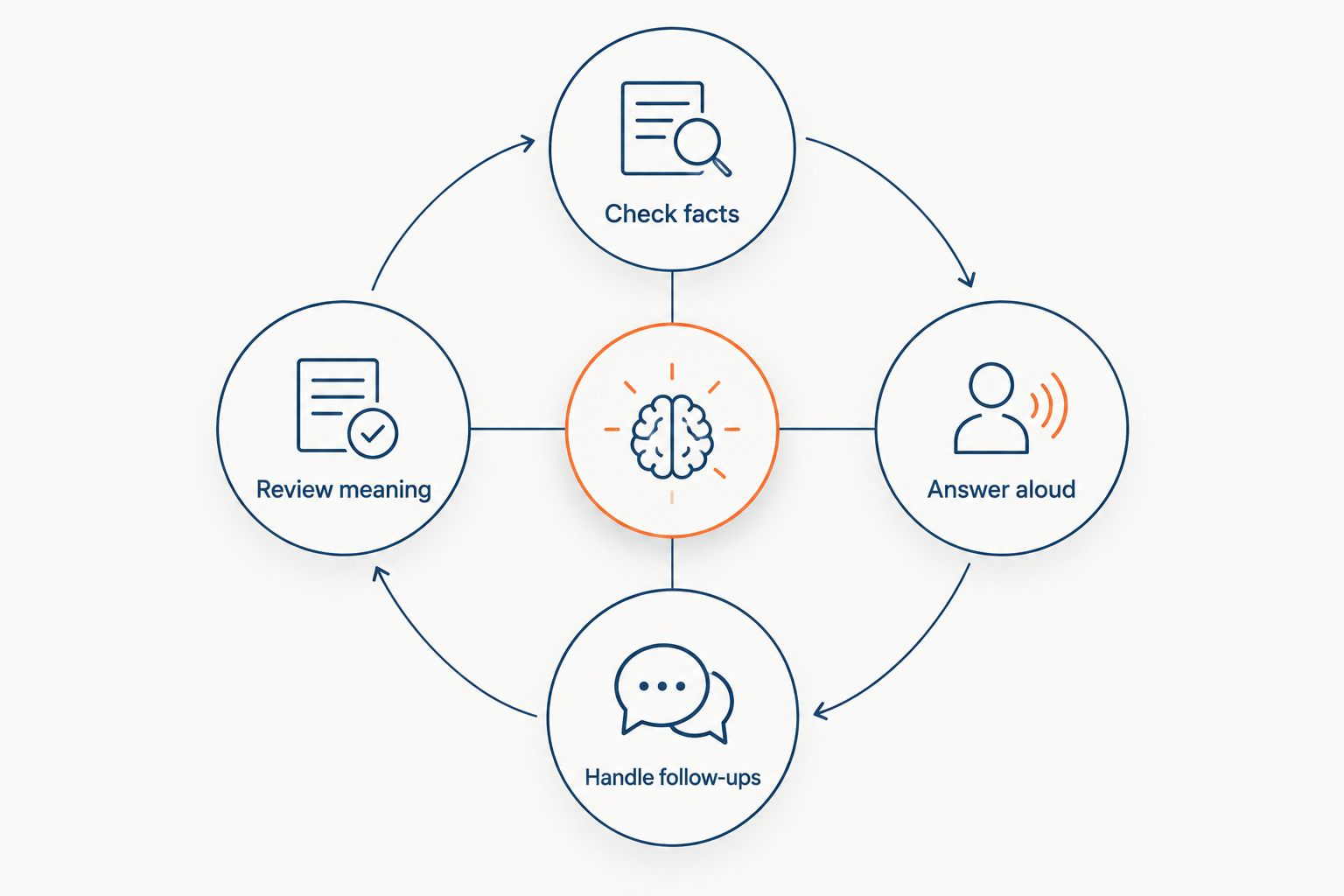
Review what your answer meant before practising it again.
Keep the cycle practical. If you repeatedly struggle to explain where you will stay, make that your next task instead of working through an unrelated vocabulary list.
Which preparation option fits your needs?
Choose according to the help you need, not the number of features listed. You can use more than one method, but give each a clear job.
| Option | Best for | What you do | Key limitation |
| Self-recording | Applicants organising their first answers | Record, replay and compare your explanation with your notes | You must identify your own communication problems |
| Practice with a friend | Applicants rehearsing a conversational exchange | Ask and answer questions in a changing order | Your friend might not be able to explain language errors |
| One-to-one lessons with Flalingo | Applicants seeking practice with certified native tutors | Bring personal speaking goals into individual English lessons | English tuition is not immigration advice |
| Qualified immigration advice | Applicants with eligibility or application questions | Ask about the application rather than English phrasing | It serves a different purpose from language lessons |
Scope and limitations: This guide provides a practice framework, not a validated test of interview readiness. It does not establish an embassy's language requirements, assess eligibility or predict a visa decision. Lesson content also needs agreement with your chosen tutor; do not assume any provider offers a dedicated visa-interview programme.
What does a useful practice conversation sound like?
Use this invented dialogue as a language exercise, not an official interview script. Replace the details with truthful information about your own circumstances.
Applicant: I'm travelling to attend a professional training course.
Practice partner: What will you study there?
Applicant: Customer service. The course focuses on handling customer complaints.
Practice partner: How does that relate to your current role?
Applicant: Sorry, could you repeat the last part?
Practice partner: How will the course help you in your job?
Applicant: I speak with customers every day, so the subject relates directly to my work.
Notice the clarification request. The applicant asks for repetition rather than answering a question they have not understood. Practise that sentence with your own follow-up questions, without copying the applicant's fictional circumstances.
Which mistakes should visa applicants avoid?
Memorising someone else's circumstances
A sample answer is useful for examining language, not borrowing a personal history. Remove any detail that is not yours before you practise, including employment, funding, accommodation and family information.
Practising only the opening question
A prepared introduction does not tell you how you will handle a request for explanation. Ask your practice partner to choose an ordinary detail from your answer and question it further.
Replacing uncertainty with an invented answer
Do not fill a gap with a plausible detail during practice. Mark the point for checking, then rehearse the language again once you know the correct information.
Treating every correction as equally urgent
An incorrect date and an awkward but understandable phrase need different attention. Ask your tutor to prioritise changes that affect meaning, then work on wording and delivery.
What should you do next?
Choose one real topic you struggle to explain and record an answer before looking for more sample questions. That recording gives your preparation a concrete starting point.
Next, take Flalingo's free English level test for a CEFR placement, then use the offered trial lesson to discuss your recording and speaking goals. Ask for a follow-up question you have not prepared. Your next practice task should come from that conversation, not from another memorised script.
Frequently asked questions
Should I share my passport or application number with an English tutor?
Use a redacted practice sheet rather than sharing identity documents or application numbers. Your tutor needs the language context, not unnecessary personal identifiers.
Can I prepare with a tutor who does not speak my first language?
Yes, if you can understand the tutor's instructions and feedback. Before committing, ask the tutor to demonstrate how they would explain an unfamiliar question or correct an unclear answer.
What should I tell my tutor if my appointment is very soon?
Give the appointment date and identify your most urgent communication difficulty. Ask for a focused session around that task rather than trying to cover a whole general English course.
Should I practise using my official course or employer name?
Yes, practise saying the exact names relevant to your circumstances. Keep proper names accurate rather than replacing them with an easier but different name.
Can I bring prepared answers into the interview?
Check the official instructions for your interview before bringing or using notes. Practise speaking without reading so your preparation does not depend on permission to consult a script.
What if I notice a factual mistake in my practice notes?
Correct the notes before your next speaking exercise. If the issue also affects submitted application information, consult the relevant official instructions rather than asking a language tutor to resolve it.
Sources
For application-specific requirements, consult the primary authority responsible for your destination and appointment:
- U.S. Department of State, Bureau of Consular Affairs - U.S. visa instructions
- UK Visas and Immigration - UK visa guidance
- Immigration, Refugees and Citizenship Canada - Canadian application guidance
Use the current instructions for your own visa category and appointment. These authorities are reference points for application questions, not evidence that a particular English lesson format affects visa outcomes.




I'm Bright. I am a British-Nigerian English teacher with seven years of experience. I create engaging and tailored lessons that build confidence and fluency to support students to achieve their goals. My aim is to unlock the potential of students from different cultures, making the learning process both efficient and enjoyable.
English with Flalingo

Learning English with Flalingo means progressing with an intelligent system that works in an integrated manner.