
Can You Learn English with AI?

As a computer engineer and AI specialist, I can summarize the technical workings of the system as follows: AI-powered language tools process your speech not as an abstract idea, but as concrete data.
1. How Does Speech Recognition (ASR) Work?
Sound waves from the microphone are first converted into digital signals. Automatic Speech Recognition (ASR) and acoustic models break these signals down into phonemes , the smallest units of speech sounds. Natural Language Processing (NLP) algorithms convert these phoneme sequences into written text and meaningful grammatical patterns within milliseconds.
2. What Data Is Used to Score Pronunciation?
When analyzing pronunciation, the system compares these three key data parameters against datasets from native English speakers:
- Phonetic Accuracy: How closely the letter and syllable sounds you produce match the standard phonetic map.
- Speech Rhythm and Pausing (Prosody): The naturalness of stress and pauses within a sentence.
- Pitch and Intonation: How well fluctuations in vocal frequency align with the meaning of the sentence.
3. What Is the Margin of Error?
Current LLMs and acoustic models, in noise-free environments, achieve word recognition accuracy of between 95% and 98% (Word Error Rate - WER) . However, background noise, strong regional accents, or microphone quality can push this error rate up to 10–15%. That is why the most reliable assessment combines AI’s data-driven analysis with a human instructor’s cultural and emotional judgment in a live lesson.
AI technologies, now integrated into every aspect of our lives, from education and healthcare to business, are also ushering in a new era in language learning. But is it really possible to learn English with AI?
Yes, it is — but AI alone is not enough. AI tools are extremely powerful when it comes to providing pronunciation feedback, vocabulary review, and unlimited speaking practice; however, they cannot replace an instructor on their own when it comes to cultural context, the natural flow of conversation, and understanding and supporting a learner’s motivation.
In this article, we will explore the role and limitations of AI in language learning, and how AI-powered platforms make the process easier by offering a hybrid model that includes human instructors.
Contents
Artificial Intelligence (AI) is a collection of technologies that enable computer systems to acquire human-like abilities to learn, analyze, solve problems, and make decisions. Today, AI has truly revolutionized language education, moving beyond traditional, one-way language learning methods. Standard curricula have given way to personalized lessons that adapt to each student’s pace and provide instant feedback.
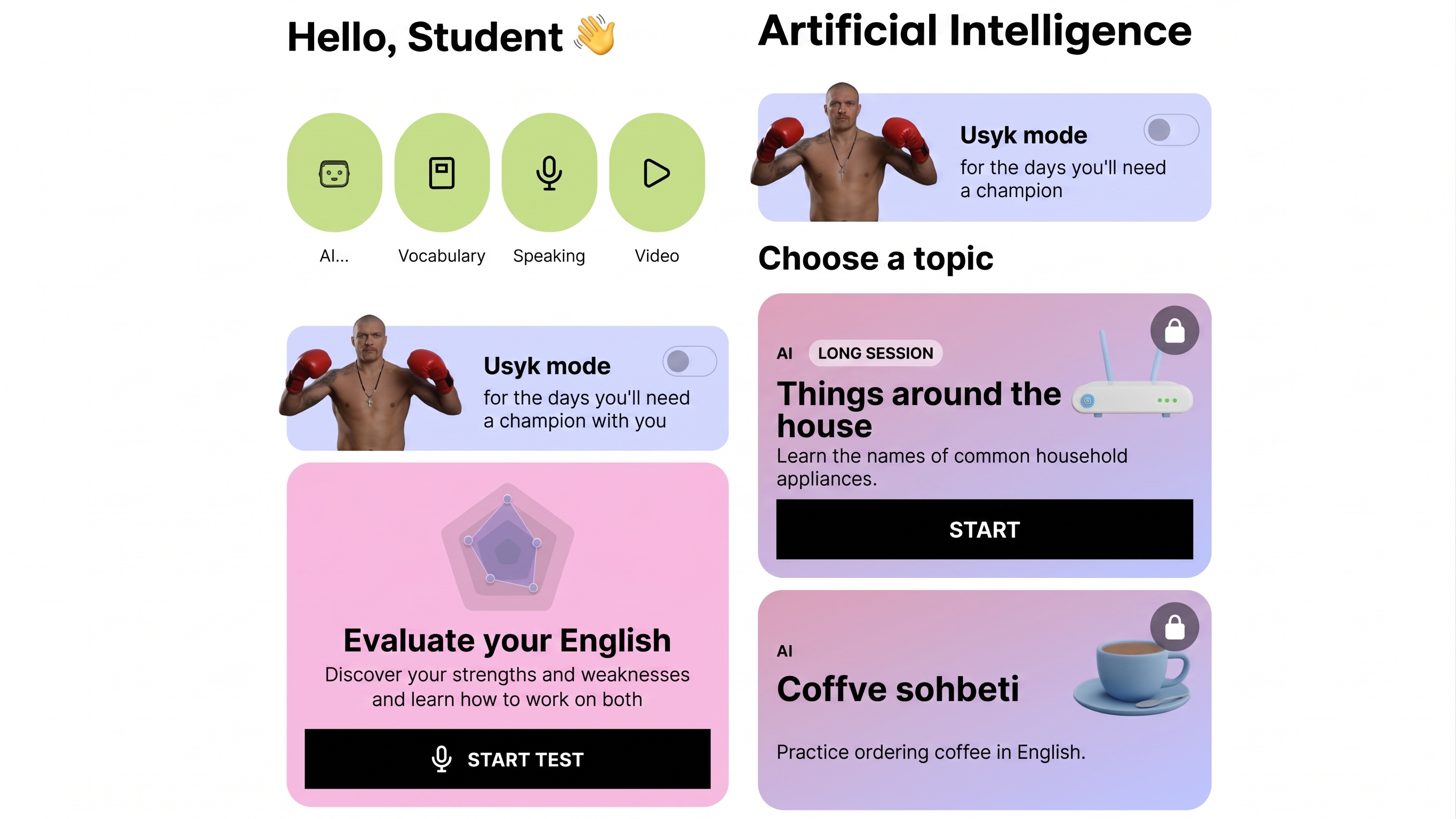
Flalingo’s smart AI assistant, FLAI, steps in at precisely this point to accelerate students’ language development. By analyzing users’ pronunciation errors, sentence structures, and grammar usage within milliseconds, FLAI provides instant feedback. This allows students to spot their mistakes right away, address gaps much faster, and make their learning process more efficient.
Offering personalized speaking practice and goal-oriented exercises through its AI infrastructure, FLAI transforms language learning from a complicated course into an interactive and enjoyable experience.
Can You Practice and Speak English with AI?
Types of AI Tools Used in Language Learning: What Is Each One Good For?
There are many AI tools on the market designed for language learning. Each focuses on a different language skill. To get the most out of the process, you need to know not only what each tool does well, but also what it cannot do:
They offer unlimited text and voice conversations. They let you practice speaking 24/7 without fear of judgment and help you overcome shyness.
They cannot replicate the natural conversational responses and cultural warmth shaped by a real person’s gestures, facial expressions, and emotional state.
By analyzing sound waves and stress patterns, they report mispronounced words or syllables within milliseconds.
They fall short in understanding how accent or intonation changes the emotional tone of a sentence, such as humor, seriousness, or irony.
By calculating the forgetting curve, they present words just as you are about to forget them, helping move them into long-term memory.
They teach words in isolation; they cannot ensure that you spontaneously use them in sentences with a natural flow and in the right context.
They instantly identify grammatical, spelling, and punctuation errors in your writing and suggest more polished alternative sentences.
They may not fully grasp the spirit of a text, the author’s intent, or the target audience’s stylistic expectations; sometimes their corrections are overly mechanical.
The most challenging stage of learning a language is turning theoretical knowledge into actual speaking practice. This is precisely where AI technologies offer an exceptionally flexible and effective solution compared with traditional language learning methods.
AI systems work anytime, anywhere, allowing you to practice whenever you like without relying on a human instructor. Their 24/7 availability is a major advantage, especially for those who struggle to keep scheduled appointments because of busy work or school schedules.
However, the possibilities AI offers go beyond just chatting:
- Well-Rounded Skill Development: AI supports all core skills simultaneously, including grammar, vocabulary, and understanding sentence structures.
- Instant Feedback in Milliseconds: Pronunciation, accent, and grammar mistakes you make while speaking or writing are immediately detected and corrected.
- A Personalized Learning Path: Every user has a different level, learning pace, and areas for improvement. Flalingo’s AI system, FLAI, maximizes learning efficiency by offering interactive lesson plans and goal-oriented exercises tailored to each student.
You can also explore details specifically for complete beginners in our article, "How can people learning English from scratch benefit from AI?"

AI or a Human Instructor? Which Should You Choose, and When?
AI tools and human instructors who are native English speakers offer very different advantages in language learning. Rather than relying on a single method, a hybrid approach that combines the strengths of both resources delivers the fastest progress.
Here are the key differences and use cases for the two experiences:
| Area | AI’s Strengths | AI’s Limitations | Why Is a Human Instructor Necessary? |
|---|---|---|---|
| Pronunciation & Accent | Analyzes sound frequencies in milliseconds and instantly identifies specific sound errors at the syllable level. | May struggle to understand the social and emotional tone conveyed by an accent, such as urgency or sarcasm. | Helps you adapt to different real-world accents and develop a natural speaking rhythm. |
| Grammar & Language Rules | Scans millions of rules and patterns to correct grammatical errors in text or speech with complete accuracy. | Takes a theoretical, rigid approach to slang that breaks the rules or rapidly evolving street language. | Teaches natural usage and when grammar rules can be relaxed in everyday language. |
| Cultural Context & Idioms | Explains the dictionary meanings and origins of idioms and expressions in theoretical terms. | Cannot intuitively recognize in which social settings an expression might sound refined or rude, missing cultural nuances. | Teaches the cultural codes behind the language and how to use them in the right setting, together with gestures and facial expressions. |
| Conversation Flow & Confidence | Offers unlimited repetition, eliminating the student’s fear of making mistakes and feeling judged. | Cannot replicate unexpected topic shifts in natural conversations or the empathetic connection between people. | Helps you overcome the nervousness of speaking with a real person and develop real-world fluency. |
| Motivation & Progress Tracking | Regularly analyzes data and uses algorithms to report learning progress and areas for improvement. | Cannot empathetically understand a student’s psychological state, mood, or reluctance to learn. | Supports students emotionally, adjusts the pace of lessons to their mood, and provides lasting motivation. |
Which Should You Use, and When?
- Use AI For: It is ideal for daily vocabulary practice, reinforcing grammar rules, taking a "warm-up round" before speaking without worrying about mistakes, and getting your writing checked instantly.
- Use a Human Instructor For: Human instructors are essential for developing real-world fluency, getting used to different accents, preparing for highly interactive situations such as interviews and presentations, and developing natural conversational instincts.
If you would like an impartial look at Flalingo’s AI-integrated lesson structure, live teacher performance, and the platform’s user experience, visit our guide, Flalingo Review: AI-Powered Online English Learning.
Is Learning English Easy with Flalingo’s AI?
With its intelligent AI assistant, FLAI, Flalingo transforms traditional language education into a modern, interactive, and highly efficient model. The system takes the complexity out of language learning and turns it into a fully personalized experience for the user.
Here are the key advantages of FLAI that make learning easier:
- Smart Level Assessment and a Personalized Lesson Plan: FLAI first identifies your current English level and areas of weakness. It then creates a learning path tailored to your needs and provides lesson content best suited to your level.
- The Flexibility to Progress at Your Own Pace: Without having to keep up with anyone else, you can explore and practice grammar or vocabulary topics you struggle with in as much depth as you like.
- Comprehensive Development (Speaking, Grammar, and Pronunciation): The system does more than provide theoretical knowledge; it analyzes your pronunciation errors in real time during speaking practice and offers instant corrections.
AI support is the key to next-generation language learning, offering personalized learning models, instant feedback, and uninterrupted practice opportunities 24/7. To learn more about the smart AI assistant developed by Flalingo and discover how the system creates personalized learning paths, check out our article titled A Comprehensive Guide to Flalingo's AI Technology, FLAI.
If you want to learn a language not through memorization but by experiencing it with personalized solutions powered by technology, you can take the first step. Visit Flalingo to discover its AI-powered learning system and the benefits of live lessons, and start your learning journey today!
Frequently Asked Questions (FAQ)



He is a researcher and developer with a degree in Computer Engineering. He has experience in data analytics, machine learning and software projects. He took part in the MRI image classification project supported by TÜBİTAK and carried out studies on real-time data processing. He produces content on technology, artificial intelligence and data-driven solutions.
English with Flalingo
Learning English with Flalingo means progressing with an intelligent system that works in an integrated manner.