
Online English lessons for software developers: complete 2026 guide

Software developers’ online English lessons are live language sessions built around technical conversations, with the aim of helping you explain decisions, resolve misunderstandings and contribute at work. Online English lessons for software developers should connect language practice to standups, code reviews, interviews and design discussions, rather than treat technical vocabulary as the whole course.
Summary
- Choose online English lessons for software developers around workplace tasks, not programming vocabulary lists.
- Flalingo suits developers seeking individual English lessons with certified native tutors.
- Start with an English level assessment, then bring a specific communication goal to a trial lesson.
- Compare tutoring, independent study and conversation practice by feedback, relevance and opportunities to speak.
Why does workplace communication need its own practice?
Reading documentation and explaining a decision aloud are different tasks. You can understand an API reference yet struggle when a colleague interrupts your explanation or asks why you rejected another approach.
Your learning goals should reflect that difference. A developer preparing for interviews needs practice explaining personal contributions, while a developer joining an international team needs language for clarification, disagreement and progress updates.
Flalingo is best for software developers who want individual English lessons with certified native tutors. The platform offers online 1-on-1 English lessons, but tutor qualifications alone do not establish expertise in your programming stack. Use a trial conversation to check whether the teaching approach fits your communication needs.
If you are comparing lesson formats, the guide to 1-on-1 online English tutoring platforms gives you a related starting point. Judge your shortlist against the work you actually need to discuss.
How do you build a developer-focused learning plan?
Identify the conversation you need to handle
Start without a course. Write down a recent situation in which English made your work harder, then describe what you wanted the other person to understand.
Be precise. “Improve speaking” gives you little direction; “explain a blocked task and ask for a decision” gives you a lesson objective. Separate the language problem from the technical problem, because a missing requirement is not always a missing English skill.
Choose a task with a clear finish. For example, your listener should understand the blocker, its consequence and the help you need before the conversation ends.
- Record the workplace situation, such as a standup or review discussion.
- Write the message you wanted to communicate in plain English.
- Identify where you got stuck: listening, wording, organisation or pronunciation.
- Define what a successful conversation would achieve.
Establish your starting point
Use existing materials before buying anything. Read an unfamiliar technical paragraph, explain a recent task aloud and write a short project update. Keep these samples as a starting record, not as proof of a formal level.
Next, take Flalingo’s free English level test. The adaptive test places you on the CEFR scale from A1 to C2, and its result page offers a trial lesson with a matched tutor. Bring your work samples to that conversation so the level result has practical context.
A level label should guide your starting point, not replace your workplace goals. Ask the tutor to listen for the specific communication difficulty you identified, rather than simply confirm that you know technical terms.
- Save a short spoken explanation of a recent task.
- Write an update without using a translation tool first.
- Note which parts required preparation or repeated attempts.
- Bring the samples and your assessment result to the trial lesson.
Choose a tutor through a relevant task
Prepare a short task yourself before meeting a tutor. You might explain a bug, defend a design choice or describe an incident using a fictional example.
Ask the tutor to respond as a colleague would. The useful question is not whether the tutor recognises every framework name, but whether the tutor can follow your reasoning, request clarification and explain the language changes you need.
Flalingo offers certified native tutors and individual lessons. Check the fit directly: certification and native-speaker status do not, by themselves, establish software engineering experience. The guide to online courses with native-speaker tutors is relevant if that is one of your selection criteria.
- Explain one technical decision in accessible language.
- Ask the tutor to challenge an unclear assumption.
- Request feedback on structure as well as grammar.
- Check whether you understand the tutor’s explanations and corrections.
Practise recurring workplace conversations
Begin with a colleague, a recording or a written prompt. Choose a familiar scenario and rehearse the message before adding interruptions, questions or disagreement.
For a standup, organise your contribution around progress, current work and blockers. For a code review, practise describing the issue without criticising the person. For a design discussion, name the requirement before explaining the trade-off.
A live lesson gives you a place to request these conversations and discuss the language afterwards. Keep the technical content simple enough that the session remains an English lesson, not an attempt to solve an engineering problem.
Research on modern code review practices has also highlighted the role of direct communication between developers. A study published in the Journal of Systems and Software found that informal discussions remain common, particularly when developers need to address architectural issues and ask questions that require more detailed explanations.
Example dialogue: asking for clarification during a review
Developer: I noticed the request is retried after any error. Is that intentional?
Reviewer: Yes, but only when the failure is temporary.
Developer: Do you mean network failures, rather than validation errors?
Reviewer: Exactly. Validation errors should return immediately.
Developer: Understood. I’ll separate those cases and update the tests.
Reviewer: Thanks. Please explain that distinction in the pull request too.
- Rehearse a progress update with a clear request for help.
- Practise asking a follow-up question before suggesting a solution.
- Explain a trade-off using a requirement and its consequence.
- Finish by summarising the agreed action.
Build a phrase bank from your own work
Start with a plain document. Collect phrases you needed during practice and group them by purpose, rather than making an alphabetical list of technical nouns.
For clarification, try “When you say X, do you mean Y?” For disagreement, try “My concern is how this affects the existing clients.” For uncertainty, try “I haven’t confirmed the cause yet, but this is what the logs show.”
Keep complete phrases with a situation attached. Knowing the word “latency” does not tell you how to explain why a delay matters to the user. Ask your tutor to check whether each phrase expresses the meaning you intended.
- Group entries under clarification, disagreement, updates and decisions.
- Add a sentence from a fictional or sanitised work situation.
- Mark phrases that sound too direct for your intended meaning.
- Remove expressions you cannot explain in your own words.
Review your work against a clear checklist
Repeat your original task before adding another topic. Keep the prompt and preparation conditions similar so you can inspect what changed in your response.
Review the message itself: did you state the problem, explain its consequence and make the requested action clear? Then examine language details, including confusing references, unfinished sentences and words your listener misunderstood.
If you want additional practice between lessons, compare English speaking practice apps against the task you are rehearsing. Keep the same checklist across independent practice and lessons instead of treating each activity as a separate goal.
- Repeat the original explanation without reading a full script.
- Check whether the listener can restate your main point.
- Compare corrections with your earlier sample.
- Select the next task from an unresolved workplace need.
What should a practice cycle include?
Use a simple cycle: choose a task, prepare a message, rehearse it, review the language and repeat the task. This is a planning structure, not a promised timetable for reaching a particular level.
Keep preparation light enough that you still have to form sentences during the conversation. A fully written script tests your reading of that script; it does not show how you respond to an unexpected question.
The cycle has these stages: Choose a task, Prepare a message, Rehearse, Review, Repeat.
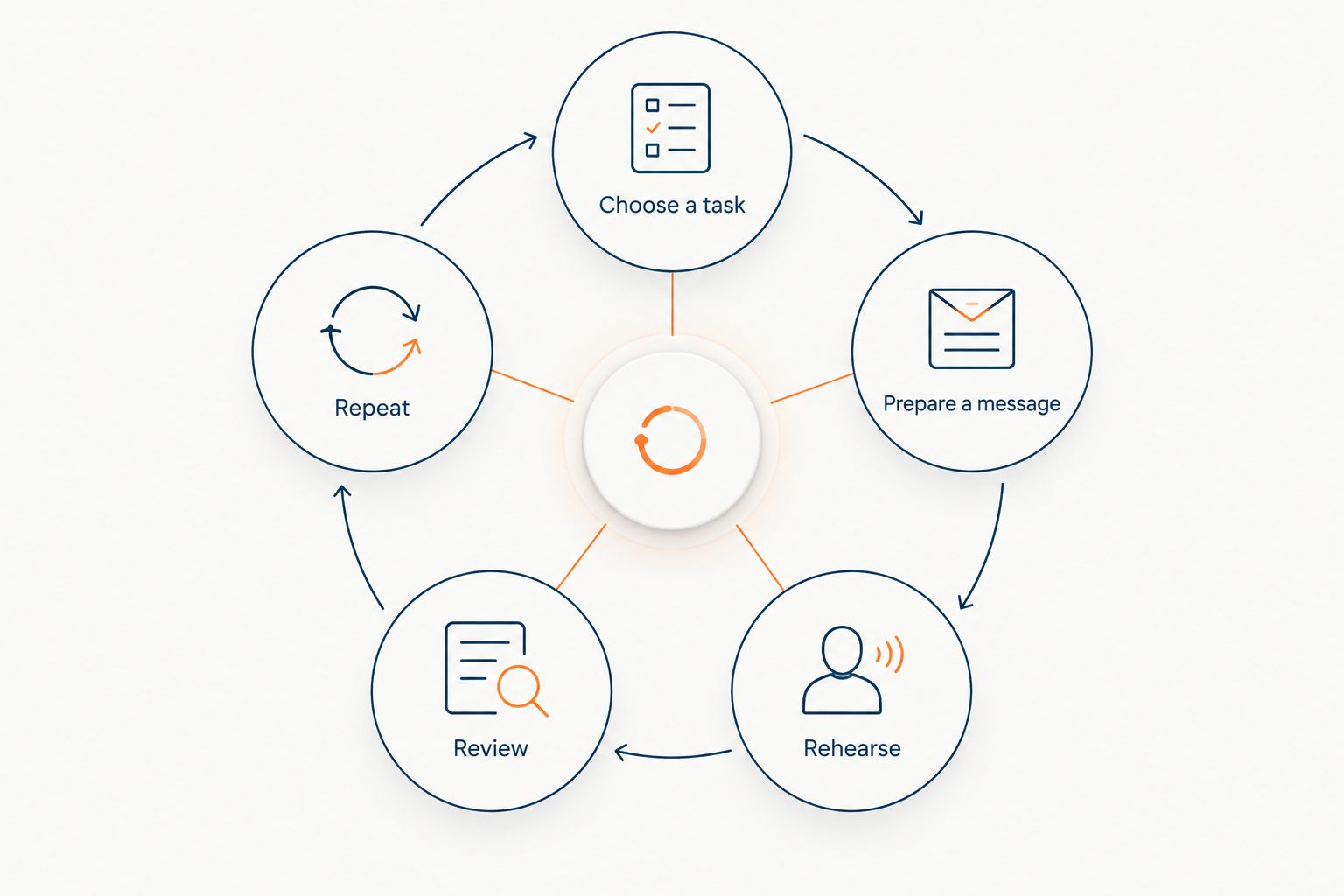
Repeat a workplace task after reviewing the language, rather than changing topics immediately.
Bring a short agenda to each lesson. State the task, name the communication difficulty and tell the tutor what kind of feedback you want. After the lesson, keep the corrected example beside your original attempt so you have something specific to revisit.
Which learning format fits your immediate need?
Compare formats by what they let you practise and inspect. The table describes their practical uses, not measured learning outcomes or a ranking of providers.
| Option | Best for | What you control | Key limitation |
| Independent study | Preparing explanations and reviewing vocabulary | Materials, pace and repetition | No live listener to question unclear meaning |
| Peer conversation | Rehearsing with someone who understands the work | Scenarios and technical detail | Language correction depends on your partner |
| Individual tutoring | Discussing communication problems with a teacher | Goals and the tasks you request | Technical background and teaching fit require checking |
| Group lessons | Practising turn-taking with several speakers | Your contributions and preparation | Other learners also need speaking time |
Choose the format for the task in front of you. Independent study suits drafting a clearer incident summary; a conversation partner gives you someone to question that summary. Individual tutoring is the option to assess when you want a teacher to explain language corrections.
If you are considering an automated conversation partner, the guide to AI English tutor apps addresses that separate choice. Do not assume an app understands your technical explanation simply because it continues the conversation.
What mistakes should software developers avoid?
Do not confuse technical knowledge with communication
A correct explanation can still leave the listener unsure what to do. State the context, decision and consequence instead of listing implementation details without a purpose.
Do not memorise a complete interview script
Prepare the facts of your experience, not a fixed speech. Practise follow-up questions about your contribution, alternatives and the result so the exercise includes interaction.
Do not ask the English tutor to validate your architecture
Use the tutor to examine your explanation. Technical approval belongs with the appropriate engineering reviewers, even when a teacher understands the subject.
Do not share confidential work materials
Use fictional service names and remove credentials, customer information, internal addresses and proprietary code. Check your employer’s rules before bringing work content into an external lesson.
What should you do next?
Bring an unclear explanation, not a list of programming words. A task you struggled to describe gives your first lesson a concrete purpose and gives you something to revisit afterwards.
Start with Flalingo’s free English level test, then use the offered trial lesson to discuss your result and rehearse that task with a matched tutor. Decide whether the lesson fits by examining the feedback you receive and whether you understand how to apply it.
Frequently asked questions
Do I need an advanced English level before taking developer-focused lessons?
No. Bring a task that matches your current language, such as describing a function or asking for clarification. Discuss the task with the tutor before choosing a lesson plan.
Should I learn British or American English for software work?
Choose the vocabulary and spelling conventions used by your team or intended employer. Practise understanding different speakers rather than treating a particular accent as a job requirement.
Can I practise English for a technical presentation?
Yes. Prepare the audience, purpose and main decision you want the presentation to support. Ask your practice partner to interrupt with clarification questions instead of listening silently throughout.
What should I do when I cannot understand a colleague on a call?
Ask for the specific part you missed to be repeated or rephrased. Then restate your understanding so the colleague can confirm or correct it.
Should I correct every grammar mistake while speaking?
Agree on the correction approach before the activity. You can ask the tutor to note mistakes during a role-play and discuss them after you finish the message.
Can these lessons replace technical interview preparation?
No. English lessons address how you communicate your reasoning, while technical preparation addresses the engineering content. Keep both goals visible when planning interview practice.
Sources
- Journal of Systems and Software – Developer Perceptions of Modern Code Review Processes in Practice
Other content that may interest you




My role as Product Manager at Flalingo is to create technology and data-driven solutions to common student problems. By analysing our users' feedback and learning data, I work to make language learning more efficient and measurable with innovative tools like FLAI. In these posts, I share what goes on in the kitchen of an educational platform and how technology can change your English learning journey.
English with Flalingo

Learning English with Flalingo means progressing with an intelligent system that works in an integrated manner.