

Przejdź do treści
Flalingo

Ćwiczenia z angielskiego

OET Reading Part A: jak w 15 minut znaleźć i dokładnie przepisać odpowiedzi z czterech krótkich tekstów

Two healthcare colleagues in uniform compare open blue folders at a desk; one points to a sheet of paper.

Jak rozwiązywać OET Reading Part A: wybierać tekst według jego funkcji, czytać właściwy wiersz tabeli, przepisywać liczby z jednostką i warunkiem oraz odróżniać termin od godziny wydarzenia. Dla pielęgniarek, pielęgniarzy i lekarzy na poziomie B2 i wyżej.

OET Reading Part A to cztery krótkie teksty na jeden temat medyczny i 20 pytań w 15 minut, więc nie zdążysz wszystkiego dokładnie przeczytać. Na podstawie nagłówków i układu wybierz tekst, który pełni funkcję potrzebną w pytaniu. Potem szukaj szczegółu i czytaj tylko zdanie albo wiersz tabeli wokół niego. Przepisz odpowiedź dokładnie, z jednostką, warunkiem i godziną. Ten poradnik jest dla pielęgniarek, pielęgniarzy i lekarzy z angielskim co najmniej na poziomie średnio zaawansowanym wyższym (B2).

Dla kogo jest ten artykuł?

  • Pielęgniarki, pielęgniarze i lekarze, którzy rozumieją teksty z Part A, ale kończy im się czas przed ostatnimi pytaniami.
  • Kandydaci, którzy tracą punkty na prawie poprawnych odpowiedziach: brak jednostki, sąsiedni wiersz, słowa przepisane z okolic luki.
  • Specjaliści, którzy w pracy sprawdzają grafiki, harmonogramy i procedury i chcą szybko znaleźć dokładną informację.
  • Za wcześnie: jeśli jednostronicowy tekst po angielsku wciąż zajmuje ci dużo czasu, najpierw podnieś ogólne czytanie do poziomu średnio zaawansowanego wyższego (B2); poradnik o planie nauki poniżej pomoże ci ustalić jeden cel na tydzień.
  • Za łatwe: jeśli Part A wychodzi ci pewnie w 15 minut, przejdź do Part B i ogłoszeń dla personelu (link poniżej).

Otwórz przykładowe strony

Otwórz przykładowe strony

Karty ze słowami

Personal · finding information

When did you last struggle to find a simple piece of information in a document or on a website? What made it hard?

Useful: ‘I was looking for…, but…’ · ‘The information was there, but it was hidden under…’ · ‘In the end, I had to…’

Personal · how you read

Do you usually read instructions from beginning to end, or scan for what you need? Has that ever caused a problem?

Useful: ‘I tend to skim until…’ · ‘I only read carefully when…’ · ‘Once, I missed… because…’

Professional practice · documents at work

Which document at your workplace do staff or patients most often misread? How would you improve it?

Useful: ‘The one that causes most confusion is…’ · ‘I’d move… so that…’ · ‘The heading should say…’

Big idea · reader and writer

When a reader misunderstands an important document, whose responsibility is it: the writer’s or the reader’s?

Useful: ‘I’d say the writer has more responsibility, because…’ · ‘That’s true up to a point, but…’ · ‘Both have a part to play:…’

Przykładowa rozmowa

How can you explain a useful checking habit?

I would underline the deadline label before copying the time, because the same notice also gives the later session time.

One possible formulation; other coherent and accurate responses are welcome.

Konstrukcja zdania

Copy the unit with the number

  • A number without its unit can change the meaning.
  • A notice says return within seven days. Recording seven without days leaves the time period incomplete.

Use the right condition

  • A general rule may have an exception.
  • Staff collect folders from reception; external visitors collect them from the training desk. The right place depends on who is collecting.

Answer the actual field

  • Avoid repeating words already printed around the gap.
  • Field: Send requests at least ___ before the session. Source: two working days. Copy two working days, not the whole sentence.

Więcej ćwiczeń

Read the information

Text A — Visitor-support desk: purpose

The visitor-support desk helps people understand practical arrangements at the clinic. Staff can explain where to wait, how to find a department and how to contact the appointment team. The desk does not make clinical decisions or change treatment plans. Questions about an individual’s care should be directed to the appropriate professional.

Text B — Finding the desk

From the main entrance, continue along the ground-floor corridor to the large noticeboard. The visitor-support desk is on the left immediately after the noticeboard, opposite the small meeting room. It is not beside the upstairs lift. Staff directing someone from the side entrance should first guide them towards the main entrance corridor.

Text C — Contacting the support team

For a routine practical enquiry, use the shared support inbox. Staff should include a callback number and a brief description of the information requested. Do not put detailed personal information in the subject line. For a same-day practical issue, telephone the support coordinator on the internal number shown in the staff directory.

Text D — Desk opening times

The desk is staffed from 09:00 to 12:00 and from 13:00 to 16:00 on weekdays. During the midday closure, written enquiries can still be left in the secure enquiry box next to the desk. The box is checked when the afternoon session begins. The desk is not staffed on weekends.

Practice context

  • Four reference extracts for staff at a community clinic. Read them as workplace information, not instructions for treating a patient.

Evidence questions

  • Which text explains the limits of what the service can do?
  • Which text would help a colleague direct a visitor from the main entrance?
  • Which text explains the communication channel for a same-day practical issue?

Read the information

Text A — Training folders

Training folders are prepared for registered participants. Internal staff collect them from reception; external visitors collect them from the training desk. Each folder contains the session outline and blank note pages. Participants who need a different print size should mention this when they register, so the correct version can be prepared.

Text B — Requests and changes

Requests for printed folders must reach the training team at least two working days before the session. Include the session title, date and number of participants. A change to the participant total after the deadline should be reported through the shared training inbox; staff should not assume that extra folders will already be available.

Text C — Borrowed learning resources

Reference folders borrowed for personal study should be returned within seven days. A borrower who needs more time may request an extension before the return date. The training team checks whether another person is waiting before confirming an extension. An unconfirmed request does not automatically change the original return date.

Text D — Returning a resource

Return borrowed reference folders to the labelled tray inside the training office. If the office is closed, use the secure return box beside its door. Do not leave borrowed material on a reception counter, where it may be mistaken for a new session pack. Staff check the return box each weekday morning.

Practice context

  • Four staff-training reference extracts from a training centre. Complete brief answers externally before looking at the supported choices.

Evidence questions

  • Where should an external visitor collect a prepared training folder?
  • How far in advance must a printed-folder request reach the team?
  • Where should a borrowed folder be placed when the training office is closed?

Read the information

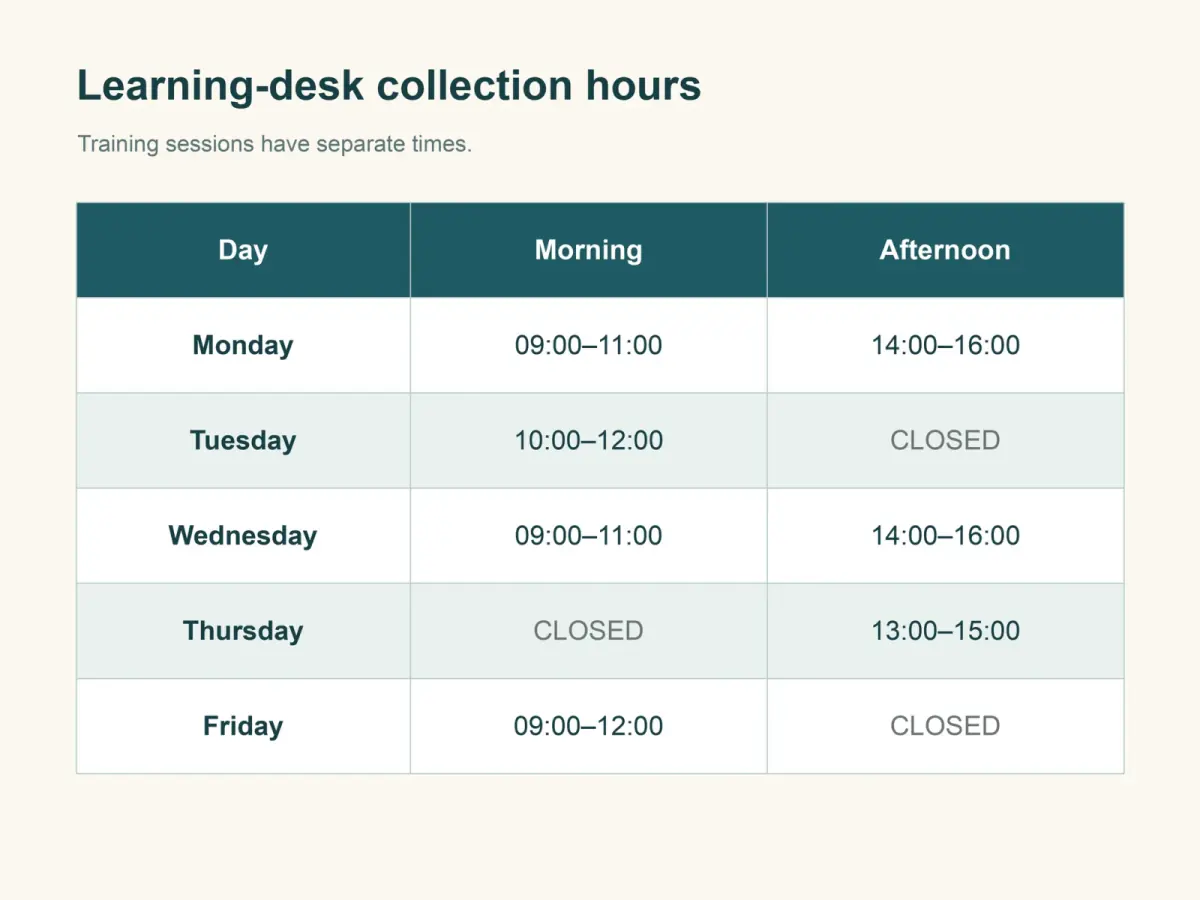
Collection timetable: Monday 09:00–11:00 and 14:00–16:00; Tuesday 10:00–12:00, afternoon closed; Wednesday 09:00–11:00 and 14:00–16:00; Thursday morning closed, 13:00–15:00; Friday 09:00–12:00, afternoon closed.

Text A — Collection service

The learning desk holds pre-booked session packs for staff. A collection is ready only after the organiser has confirmed the participant’s registration. The desk cannot confirm a place on a course. A staff member who has not received registration confirmation should contact the organiser rather than assume that a pack is waiting.

Text B — Learning-desk schedule

Monday: morning 09:00 to 11:00; afternoon 14:00 to 16:00.

Tuesday: morning 10:00 to 12:00; afternoon closed.

Wednesday: morning 09:00 to 11:00; afternoon 14:00 to 16:00.

Thursday: morning closed; afternoon 13:00 to 15:00.

Friday: morning 09:00 to 12:00; afternoon closed.

These are collection hours, not the times of the training sessions themselves.

Text C — Preparing a collection

Receive collection request, then check registration list. If registration is confirmed, prepare the named pack and send a collection message. If the name is not on the list, ask the organiser to check the registration. Do not prepare a pack or send a ready-to-collect message until the registration is confirmed.

Text D — Outside the listed hours

Staff who cannot attend during collection hours may ask the learning team to arrange an alternative. The team must confirm the arrangement before anyone leaves material elsewhere. A request alone is not confirmation. Session packs should not be left in public waiting areas or passed to an unknown person.

Practice context

  • Four reference extracts for a staff-learning desk. Text B is a compact schedule with labelled day rows; Text C is a written decision path.

Evidence questions

  • Which collection window is available on Thursday?
  • What happens next if a requested name is missing from the registration list?
  • What must happen before an alternative collection arrangement is used?

Read the information

Text A — Orientation visit

The centre runs a practical orientation visit for new volunteers. It introduces the reception area, staff-learning room and visitor-support point. The visit is about finding services and understanding whom to contact. It does not include clinical work or observation of patient consultations. Volunteers receive their individual duty information separately from their own coordinator.

Text B — Booking and deadline

The next orientation visit is on Friday 18 October at 14:00. A group organiser should submit the final number of visitors by 12:00 on Wednesday 16 October. Include a contact name and any practical access requests. Do not send detailed personal histories. The organiser receives a confirmation message once the group booking has been checked.

Text C — Arrival information

Confirmed groups meet at the side entrance beside the bicycle racks. Individual volunteers attending without a group meet at main reception. Both groups should arrive ten minutes before the stated start time. A person arriving late should contact the orientation coordinator rather than follow an unfamiliar group into another part of the building.

Text D — Changes after confirmation

An organiser who needs to change the group size should contact the orientation coordinator through the shared visits inbox. The coordinator checks whether the revised group can be accommodated and replies with confirmation or an alternative. The original arrangement remains in place until a change is confirmed. Please do not treat an unanswered message as agreement.

Practice context

  • Four reference extracts about a centre’s orientation visit. This is a shorter classroom retrieval task, not a full twenty-question Reading Part A paper.

Evidence questions

  • What is the deadline for a group organiser’s final visitor count?
  • Where should a confirmed group meet?
  • What is the status of the original arrangement while a requested change is unanswered?

Choose and justify with evidence

Text A — Visitor-support desk: purpose

The visitor-support desk helps people understand practical arrangements at the clinic. Staff can explain where to wait, how to find a department and how to contact the appointment team. The desk does not make clinical decisions or change treatment plans. Questions about an individual’s care should be directed to the appropriate professional.

Text B — Finding the desk

From the main entrance, continue along the ground-floor corridor to the large noticeboard. The visitor-support desk is on the left immediately after the noticeboard, opposite the small meeting room. It is not beside the upstairs lift. Staff directing someone from the side entrance should first guide them towards the main entrance corridor.

Text C — Contacting the support team

For a routine practical enquiry, use the shared support inbox. Staff should include a callback number and a brief description of the information requested. Do not put detailed personal information in the subject line. For a same-day practical issue, telephone the support coordinator on the internal number shown in the staff directory.

Text D — Desk opening times

The desk is staffed from 09:00 to 12:00 and from 13:00 to 16:00 on weekdays. During the midday closure, written enquiries can still be left in the secure enquiry box next to the desk. The box is checked when the afternoon session begins. The desk is not staffed on weekends.

  1. Which text explains the limits of what the service can do?

    Pokaż odpowiedź i wyjaśnienie

    Text A

    Text A describes the desk’s practical role and says it does not make clinical decisions or change treatment plans.

  2. Which text would help a colleague direct a visitor from the main entrance?

    Pokaż odpowiedź i wyjaśnienie

    Text B

    Text B gives the route and landmarks needed to find the desk.

  3. Which text explains the communication channel for a same-day practical issue?

    Pokaż odpowiedź i wyjaśnienie

    Text C

    Text C distinguishes routine inbox enquiries from a same-day call to the coordinator.

Choose and justify with evidence

Text A — Training folders

Training folders are prepared for registered participants. Internal staff collect them from reception; external visitors collect them from the training desk. Each folder contains the session outline and blank note pages. Participants who need a different print size should mention this when they register, so the correct version can be prepared.

Text B — Requests and changes

Requests for printed folders must reach the training team at least two working days before the session. Include the session title, date and number of participants. A change to the participant total after the deadline should be reported through the shared training inbox; staff should not assume that extra folders will already be available.

Text C — Borrowed learning resources

Reference folders borrowed for personal study should be returned within seven days. A borrower who needs more time may request an extension before the return date. The training team checks whether another person is waiting before confirming an extension. An unconfirmed request does not automatically change the original return date.

Text D — Returning a resource

Return borrowed reference folders to the labelled tray inside the training office. If the office is closed, use the secure return box beside its door. Do not leave borrowed material on a reception counter, where it may be mistaken for a new session pack. Staff check the return box each weekday morning.

  1. Where should an external visitor collect a prepared training folder?

    Pokaż odpowiedź i wyjaśnienie

    the training desk

    Text A distinguishes external visitors, who collect at the training desk, from internal staff at reception.

  2. How far in advance must a printed-folder request reach the team?

    Pokaż odpowiedź i wyjaśnienie

    two working days

    Text B says at least two working days; calendar days and seven days refer to different or unsupported periods.

  3. Where should a borrowed folder be placed when the training office is closed?

    Pokaż odpowiedź i wyjaśnienie

    the secure return box

    Text D specifies the secure return box beside the closed office door.

Choose and justify with evidence

Collection timetable: Monday 09:00–11:00 and 14:00–16:00; Tuesday 10:00–12:00, afternoon closed; Wednesday 09:00–11:00 and 14:00–16:00; Thursday morning closed, 13:00–15:00; Friday 09:00–12:00, afternoon closed.

Text A — Collection service

The learning desk holds pre-booked session packs for staff. A collection is ready only after the organiser has confirmed the participant’s registration. The desk cannot confirm a place on a course. A staff member who has not received registration confirmation should contact the organiser rather than assume that a pack is waiting.

Text B — Learning-desk schedule

Monday: morning 09:00 to 11:00; afternoon 14:00 to 16:00.

Tuesday: morning 10:00 to 12:00; afternoon closed.

Wednesday: morning 09:00 to 11:00; afternoon 14:00 to 16:00.

Thursday: morning closed; afternoon 13:00 to 15:00.

Friday: morning 09:00 to 12:00; afternoon closed.

These are collection hours, not the times of the training sessions themselves.

Text C — Preparing a collection

Receive collection request, then check registration list. If registration is confirmed, prepare the named pack and send a collection message. If the name is not on the list, ask the organiser to check the registration. Do not prepare a pack or send a ready-to-collect message until the registration is confirmed.

Text D — Outside the listed hours

Staff who cannot attend during collection hours may ask the learning team to arrange an alternative. The team must confirm the arrangement before anyone leaves material elsewhere. A request alone is not confirmation. Session packs should not be left in public waiting areas or passed to an unknown person.

  1. Which collection window is available on Thursday?

    Pokaż odpowiedź i wyjaśnienie

    13:00–15:00

    The Thursday row has the morning closed and the afternoon window 13:00–15:00.

  2. What happens next if a requested name is missing from the registration list?

    Pokaż odpowiedź i wyjaśnienie

    Ask the organiser to check the registration

    Text C requires an organiser check before preparation or collection confirmation.

  3. What must happen before an alternative collection arrangement is used?

    Pokaż odpowiedź i wyjaśnienie

    The learning team must confirm the arrangement

    Text D says the learning team must confirm an alternative; requesting one is not enough.

Choose and justify with evidence

  1. What is the deadline for a group organiser’s final visitor count?

    Pokaż odpowiedź i wyjaśnienie

    Wednesday 16 October at 12:00

    Text B separates the Friday visit from the Wednesday noon deadline for group numbers.

  2. Where should a confirmed group meet?

    Pokaż odpowiedź i wyjaśnienie

    the side entrance beside the bicycle racks

    Text C gives a different meeting point for confirmed groups and individual volunteers.

  3. What is the status of the original arrangement while a requested change is unanswered?

    Pokaż odpowiedź i wyjaśnienie

    Still in place until the change is confirmed

    Text D explicitly keeps the original arrangement in place pending confirmation.

Poznaj ten rozdział
Jak chcesz się uczyć?
Masz już konto?

Darmowe konto otwiera na stałe jeden rozdział.

Czego wymaga Part A

Part A otwiera 60-minutowy test Reading: cztery krótkie teksty, od A do D, na jeden temat medyczny, często z tabelą albo listą kroków. Ma własne 15 minut; potem przechodzisz do Part B i Part C.

Są trzy typy pytań, a w dwóch ostatnich liczy się pisownia:

  • Matching (dopasowanie): który tekst o tym mówi? Odpowiadasz A, B, C lub D.
  • Short answer (krótka odpowiedź): słowo, liczba albo krótkie wyrażenie.
  • Sentence completion (uzupełnianie zdań): brakujące słowa przepisane z tekstów.

Wybierz tekst według funkcji, potem szukaj

Cztery teksty na jeden temat rzadko pełnią tę samą funkcję. Pierwszą minutę poświęć nagłówkom i układowi, nadaj każdemu tekstowi dwuwyrazową etykietę i dopasuj każde pytanie do funkcji, zanim zaczniesz szukać słów. Na końcu potwierdź odpowiedź w samym zdaniu.

  • “What can’t the desk do?” → cel i ograniczenia.
  • “How do I reach the desk?” → wskazówki, jak dojść.
  • “Whom do I phone about a same-day problem?” → dane kontaktowe, nie godziny otwarcia.
  • “When is the desk staffed?” → harmonogram.

Przepisuj dokładnie: jednostka, warunek i tylko brakujące słowa

Przez prawie poprawne odpowiedzi tracisz punkty. Wyłapiesz je, sprawdzając trzy rzeczy:

  • Przepisz jednostkę: samo “seven” zamiast “within seven days” jest niepełne, a “two days” to nie to samo co “two working days”.
  • Użyj właściwego warunku. “Internal staff collect them from reception; external visitors collect them from the training desk.” Dla gościa z zewnątrz odpowiedź to “the training desk”.
  • Odpowiedz na to, o co pyta luka. “Send requests at least ___ before the session.” Tekst mówi “two working days”: wpisz tylko to, bez słów wokół luki.

Małe słowa, które ustalają termin

Przyimki wyznaczają terminy, więc czytaj je równie uważnie jak liczby. Polskie „do” służy zarówno do terminu („do środy”), jak i do czegoś, co trwa („otwarte do 16:00”); angielski rozróżnia by i until:

  • by 12:00 on Wednesday: najpóźniej w tym momencie; to termin.
  • until 16:00: coś trwa do tej godziny, a potem się kończy.
  • within seven days: w dowolnym momencie, zanim minie siedem dni; “in seven days” zwykle znaczy za siedem dni od teraz.
  • at least two working days before: minimum; wcześniej też można.
  • from 09:00 to 12:00 and from 13:00 to 16:00: dwa przedziały z przerwą pomiędzy.

Czytaj właściwy wiersz tabeli

Najpierw znajdź wiersz, potem kolumnę, a na końcu notę, która wyjaśnia, co oznaczają liczby. W ćwiczeniowym harmonogramie wiersz czwartku brzmi “morning closed; afternoon 13:00 to 15:00”: odpowiedź to 13:00–15:00, a nie wtorkowe 10:00–12:00 wyżej.

W schemacie blokowym idź gałęzią, która pasuje do sytuacji: “If the name is not on the list, ask the organiser to check the registration.”

Poznaj ten rozdział po swojemu

Odróżnij termin od godziny wydarzenia

Jedno ogłoszenie może podawać dwie godziny o różnych funkcjach: “The next orientation visit is on Friday 18 October at 14:00. A group organiser should submit the final number of visitors by 12:00 on Wednesday 16 October.” Zanim przepiszesz godzinę, podkreśl słowo, które ją opisuje (by, deadline albo starts), jak wyjaśnia kandydat poniżej.

Nauczyciel How can you explain a useful checking habit?

Kandydat I would underline the deadline label before copying the time, because the same notice also gives the later session time.

Jaki jest termin podania ostatecznej liczby gości?

Typowe błędy w Part A

Każdy błąd oznacz etykietą; etykieta mówi ci, co ćwiczyć:

  • Zły tekst: nagłówek mówi o gościach, a pytanie dotyczy personelu.
  • Pierwsze trafienie: liczba, która wygląda dobrze, ale pochodzi z innego wiersza albo tekstu.
  • Czegoś brakuje: jednostki, warunku albo liczby mnogiej (“two working day”).
  • Dodatkowe słowa: powtarzanie “before the session”, które jest już wydrukowane po luce.
  • Prośba wzięta za potwierdzenie: “The original arrangement remains in place until a change is confirmed.”
  • Po polsku ułamki dziesiętne zapisuje się z przecinkiem, a po angielsku z kropką. Przepisuj liczbę dokładnie tak, jak stoi w tekście: 2.5, nie 2,5.

Rutyna ćwiczeń do Part A

Trzy razy w tygodniu, z jednym ćwiczeniowym zestawem Part A:

  • 15 minut: rozwiąż zestaw w czasie egzaminacyjnym, zaczynając od nagłówków.
  • 10 minut: sprawdź go i oznacz każdy błąd etykietą.
  • 5 minut: przepisz każdą błędną odpowiedź dokładnie tak, jak podaje ją tekst.
  • Następny zestaw: najpierw pilnuj swojej najczęstszej etykiety.

Co dalej

Part B to sześć krótkich tekstów z miejsca pracy, każdy z jednym pytaniem z trzema odpowiedziami; Part C to dwa dłuższe teksty, każdy z ośmioma pytaniami z czterema odpowiedziami.

Aby poćwiczyć mówienie, przedyskutuj, kto odpowiada za źle odczytane ogłoszenie: “I’d say the writer has more responsibility, because…”

Najczęstsze pytania

Ile trwa OET Reading Part A?

15 minut na 20 pytań. Potem przechodzisz do Part B i Part C.

Czy w OET Reading Part A liczy się pisownia?

Tak. W pytaniach z krótką odpowiedzią i w uzupełnianiu zdań błędnie zapisane słowo sprawia, że odpowiedź jest zła.

Czy OET Reading jest taki sam dla pielęgniarek i lekarzy?

Tak. Reading jest taki sam dla wszystkich zawodów, a odpowiedzi pochodzą z tekstów, nie z wiedzy klinicznej.

Flalingo nie jest powiązane z organizacjami prowadzącymi OET ani przez nie rekomendowane.

Poznaj ten rozdział
Jak chcesz się uczyć?
Masz już konto?

Darmowe konto otwiera na stałe jeden rozdział.

Co dalej?

Ćwicz dalej z Flai

Flai to aplikacja Flalingo do ćwiczenia mówienia z AI. Oferuje rozmowy głosowe, korekty i raporty z lekcji, które pomagają ukierunkować naukę.

Nauka z lektorem na żywo

Na lekcjach Flalingo ćwiczysz takie rozdziały jeden na jeden z lektorem na żywo.